156 Franklin Street
Tribeca | built 1874
Open on the map5 entries

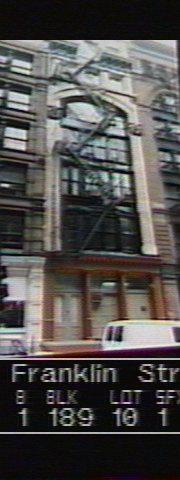
The city photographed every building for its tax records around 1940 and again in the 1980s. NYC Municipal Archives.
Written with AI from the source each entry cites, then fact-checked.
- 1874
Daniel Archer buys a three-story building and plans an iron-and-brick oil factory in its place
On April 30, 1874 Daniel O. Archer of Tarrytown paid $15,000 for the 25-foot-wide, three-story building that stood at 156 Franklin Street. He also owned the plot behind it on North Moore Street, and within weeks the architect Griffith Thomas submitted plans for a store and oil factory of iron and brick spanning both lots. The three-story building he bought was the earlier building on the site; the cast-iron base of the 1874 replacement still survives.
Source: Daytonian in Manhattan
- 1895
The North Moore Street half of a grocery warehouse collapses and burns, and the fire damages the Franklin Street half
J. H. Mohlman & Co., wholesale grocers, leased the building's Franklin and North Moore Street sections. In the week of April 20, 1895 heavy barrels and crates were hauled upstairs, and on April 30 the North Moore half collapsed under the weight and leaking gas from broken pipes ignited. Part of the rear wall and floors of No. 156 fell, and flames shot through its front windows.
Source: Daytonian in Manhattan
- 1897
Emery Roth, then in the firm Stein, Cohen & Roth, adds two stories and a Beaux-Arts face
After the fire, owner Benjamin Bleier hired Stein, Cohen & Roth in December 1897 to repair and renovate the building, although Emery Roth was the only partner practicing then. He added two stories, steel floors and a new beige-brick front above the old cast-iron base, with lions above fruit garlands and a projecting second-floor bay. The work was projected to cost $25,000.
Source: Daytonian in Manhattan
- 1902
Liquor and wine merchants H. B. Kirk & Co. move here after fifty years on Fulton Street
H. B. Kirk & Co., led by Harford B. Kirk, announced in April 1902 that it would leave Fulton Street after half a century and take the seven-story building at 156 Franklin Street from April 21. Its stock ran from hard liquor such as Old Crow Rye to costly imported wines and aperitifs. An extra story was added before the firm moved in.
Source: Daytonian in Manhattan
- 1907
Ralph L. Spotts, a liquor-firm executive and Olympic trapshooter, buys the building
Josephine Bleier sold No. 156 to Ralph L. Spotts on November 11, 1907; he was vice-president of H. B. Kirk & Co., the building's main tenant. Spotts had a stake in the Cantono Electric Tractor Co. as a partner, but he was best known as a marksman. He took the Larchmont Yacht Club's top prize of the season in 1910 and was on the 1912 American Olympic trapshooting team.
Source: Daytonian in Manhattan
Further reading
- An 1897 Remake - No. 156 Franklin Street Daytonian in Manhattan
Nearby
- 158 Franklin Street2 entries
- Pastene Building152 Franklin Street | 5 entries
- 160 Franklin Street1 entry
- 38 North Moore Street3 entries
- 148 Franklin Street1 entry
- 112 Hudson Street1 entry