Locomobile Company Building
16 West 61st Street | also 24 West 61st Street, 25 West 60th Street | Lincoln Square | built 1924
Open on the map15 entries

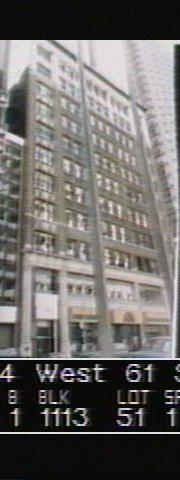
The city photographed every building for its tax records around 1940 and again in the 1980s. NYC Municipal Archives.
Written with AI from the source each entry cites, then fact-checked.
- 1912
Locomobile hires architects to design a headquarters for these West 61st Street lots
By 1912 the Locomobile Company of America needed more room than its premises at Broadway and 76th Street offered. On January 6 the Real Estate Record and Guide announced that the company had hired Kirby & Petit to design a headquarters with a showroom and service department. It would replace the old houses at 16 through 24 West 61st Street and the one behind at 25 West 60th Street. The ambitious plan was not carried out.
Source: Daytonian in Manhattan
- 1913
Walter Haefeli's plain brick design for Locomobile earns trade-press notice
The tower built for Locomobile was designed by architect Walter Haefeli and trimmed from twelve planned floors to eleven, finishing by the end of 1913. It was less striking than the earlier Kirby & Petit scheme, but the auto trade praised its function and its side-street site just off Broadway's Automobile Row, where rents were lower. Brown brick covers the front. Ornament is kept to the lower floors and the top two, leaving the middle of the facade plain.
Source: Daytonian in Manhattan
- 1913
Locomobile sells its West 61st Street lots to a developer who builds its new headquarters
The Locomobile Company of America planned a showroom and service building at 16-24 West 61st Street, hiring Kirby & Petit in 1912. In February 1913 it instead sold the lots to developer R. E. Pinchot, who would build and lease the building back to the company for 21 years. Architect Walter Haefeli designed a 12-story building, trimmed to eleven floors, which was finished by the end of the year.
Source: Daytonian in Manhattan
- 1914
The Marmon car company leases the whole eighth floor for a service department
Five of the building's eleven floors were rented out to other car-related firms, and they filled quickly. The New-York Tribune reported on June 21, 1914 that the Marmon Company had leased the entire eighth floor at 16 to 24 West 61st Street. Marmon was fitting it out as one of the city's best service departments, with a fully equipped machine shop staffed by mechanics who knew the Marmon car.
Source: Daytonian in Manhattan
- 1914
A walled-off corner of the 11th floor gets a forge past the fire inspectors
Car repairs sometimes called for welding or other work with an open flame, which city fire rules did not allow inside buildings. Haefeli's answer was to shut off one corner of the eleventh floor with fire walls and an air well so that it passed inspection. Automobile Topics reported in January 1914 that parts needing heat could be worked on there without carrying a flame into the main service floors.
Source: Daytonian in Manhattan
- 1914
Trade magazines praise an outdoor freight elevator that lifts two cars at a time
Auto-industry magazines were struck by the rear of the building, where a driveway led to a freight elevator built outside the structure, big enough to carry two cars. Locomobile used six floors for its showroom, offices and service department and rented the other five to car-related firms such as Marmon, which fitted out the eighth floor as a machine shop. A fire-walled corner of the eleventh floor held a forge room for welding.
Source: Daytonian in Manhattan
- 1916
John Philip Sousa Jr., a tenant, chases down a purse snatcher on Park Avenue
Among the building's unusual early tenants was the business office of John Philip Sousa Jr., son of the bandleader. On December 20, 1916, after a woman screamed near Park Avenue and 34th Street, Sousa ran after the thief and caught him, holding him until a policeman came. In court the following month, he offered the hungry man money, which the judge would not allow.
Source: Daytonian in Manhattan
- 1919
The League for Motorists' Protection sets up headquarters in the building
The League for Motorists' Protection was headquartered in the Locomobile building in 1919. On November 23 the New-York Tribune reported the group's view that an employer who kept a chauffeur with a record of recklessness was partly responsible if that driver injured or killed a pedestrian or another motorist. The tenant list that year also included the Lexington Motor Company and Asch & Co., which made auto accessories.
Source: Daytonian in Manhattan
- 1921
Locomobile, the building's anchor tenant, is bought by Durant Motors
Locomobile's luxury cars were still advertised in 1920 as built for buyers who put quality ahead of price, but the company was in trouble. A Hare's Motors advertisement that year said the dealer now operated Locomobile, Mercer and Simplex together, and on July 22, 1921 Durant Motors acquired Locomobile. Durant kept selling cars under the Locomobile name until 1929, when the marque ended. Other auto firms such as Cole Motor Car and American Taximeter rented floors in the building in the early 1920s.
Source: Daytonian in Manhattan
- 1931
Sculptor Alexander Archipenko teaches at his art school at 16 West 61st Street
By the 1930s car dealers shared the building with other trades. In 1931 a newspaper reported that the sculptor Alexander Archipenko taught sculpture, painting and drawing at his school at 16 West 61st Street. In 1933 the Needlework Guild of America held its annual meeting in a loft here, with sacks of new clothing for charity stacked around the walls.
Source: Daytonian in Manhattan
- 1933
A charity's clothing drive fills a loft with sacks of garments
The building's tenants were not all car companies. The Needlework Guild of America, which collects new clothing for the needy, held its annual meeting in a loft here, and The New York Times reported on November 3, 1933 that sacks of new garments lined the walls. The clothes were to be handed out among about 300 charities the guild had aided.
Source: Daytonian in Manhattan
- 1942
Nash-Kelvinator moves its car and refrigerator offices into the building
Under the headline 'More Icebox Space', The New York Times reported on August 8, 1942 that Nash-Kelvinator had leased space at 16 West 61st Street. The company was merging its automobile and refrigerator divisions here, with one large office, a display room and parts storage. The Telautograph Company was still a tenant at the time and stayed at least three more years, and Nash-Kelvinator was still operating here in 1953.
Source: Daytonian in Manhattan
- 1958
A tenant's bookkeeper is arrested for embezzling nearly $13,000
Lehr Distributors, a seller of auto parts and electrical appliances, had offices in the building by 1958. In June that year police arrested its 25-year-old bookkeeper, Nancy Von Dolin, for taking nearly $13,000 over time. The scheme came to light when the company pressed a customer for a $2,000 debt and the customer produced a cancelled check proving it had been paid.
Source: Daytonian in Manhattan
- 1986
Upper floors are converted to offices and studios after decades of auto-related tenants
Auto firms stayed for decades, among them Stutz, Checker Cab's used-car lot and Nash-Kelvinator, which took space in 1942. A renovation finished in 1974 added a garage for parking along 60th Street. A second, finished in 1986, turned the upper floors into offices and studios.
Source: Daytonian in Manhattan
- 2008
A renovation for the New York Institute of Technology puts classrooms and a lecture hall inside
A renovation finished in 2008 prepared the building for the New York Institute of Technology, which uses the sixth through tenth floors as classrooms and part of the eleventh as a lecture hall. The brick and limestone facade has changed little since the building opened, and the shaft of the old outdoor car elevator survives at the rear.
Source: Daytonian in Manhattan
Further reading
- New York Institute of TechnologyWikipedia
Nearby
- The Sofia (Kent Automatic Garage)45 Columbus Avenue | 7 entries
- Trump International Hotel and Tower1 Central Park West | 10 entries
- Lincoln Plaza Cinemas30 West 63rd Street | 1 entry
- 15 Central Park West15 entries
- Empire Hotel1889 Broadway | 8 entries
- Deutsche Bank Center (Time Warner Center)1 Columbus Circle | 13 entries