Former Firehouse, Engine Company 29
160 Chambers Street | Tribeca | built 1833
Open on the map10 entries

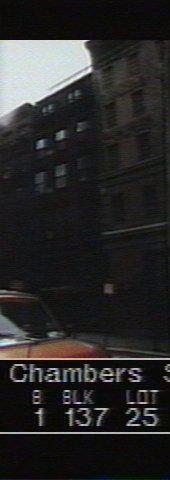
The city photographed every building for its tax records around 1940 and again in the 1980s. NYC Municipal Archives.
Written with AI from the source each entry cites, then fact-checked.
- 1795
A carpenter owns an earlier house on this lot before the present building
An earlier house stood on this site before the present building. Abraham Wilson, a merchant, sold the 24-by-75-foot plot to the carpenter Uzal Tuttle in 1793, and a house stood on it by 1795. Later owners included a teacher, Richard Tagart, and Sarah Ann Ellet, from whom the builder Samuel Thomson bought the property in 1831.
- 1833
Builder Samuel Thomson replaces the old house with a three-story home for himself
Samuel Thomson, a Baltimore-born carpenter who came to New York in 1804 and became one of its most prosperous builders, bought the lot in 1831. He built the present house in 1832-33 and lived in it while his firm worked from Lumber Street. His other work included the Administration Building at Sailors' Snug Harbor on Staten Island. He also built himself a Greek Revival mansion in Fort Washington.
- 1836
Lawyer David B. Ogden buys the house and lives here for about a dozen years
David B. Ogden, born in Morrisania in 1775, bought the house from Thomson in 1836. He was known for arguing important cases before the US Supreme Court against opponents such as Daniel Webster, William Wirt and John C. Calhoun. His family left around 1848, but the Ogden estate kept the house, which was let out as a boarding house in the 1850s.
“David B. Ogden (1775- 1849), a prominent lawyer, and his family lived in the house until about 1848. Ogden was born in Morrisania…”
- 1863
The Third Precinct station house shelters Black women and children during the Draft Riots
The city bought the house from the hotel keepers William and Jane Robinson for $20,000 and made it the station house of the Third Police Precinct, which moved in during 1863. Under Captain James Greer the precinct helped put down the Draft Riots of July 13 to 16 that year. Several African-American women and their children were sheltered inside the station house.
- 1868
The police department's architect adds floors and a mansard roof
Nathaniel D. Bush, the police department's official architect, raised the building to five stories in 1868 and gave it a Second Empire mansard roof with dormers. He also extended it to the rear lot line. The 25-foot-wide facade could not take the usual pavilions and arcades, so the mansard, projecting lintels and pediments carry the style. By 1871 the precinct already found it too small, and moved to Leonard Street in 1875.
“In 1868 under the direction of New York Police Department architect, Nathaniel D. Bush, the building was raised to a full five stories with a mansard roof…”
- 1875
New York Hospital opens a free emergency hospital here, the House of Relief
After City Hall Park's Park Hospital closed, New York Hospital founded the House of Relief, also called the Chambers Street Hospital, to treat emergencies in lower Manhattan. It occupied this building from July 1875 to November 1894, providing free care and ambulance service below Canal Street. Though it had only 26 beds, its last year here brought about 3,000 ambulance calls and more than 65,000 patient visits.
- 1897
Engine Company 29 moves into the building after the entrance is widened
The Fire Department altered the former hospital for Engine Company 29, widening the entrance with new brick piers that run from the foundation up to the second floor. Work began on November 5, 1896, and ended on March 31, 1897, though the company moved in on March 29. The sign above the door, '29 Engine 29', is still there.
- 1897
The firehouse becomes a field hospital after a deadly cold-storage warehouse fire across the street
On the night of May 6, 1897, smoke poured from the basement of a cold storage warehouse at 161-163 Chambers Street. Firefighters entering the cellar were overcome by gas, and fireman John G. Reinhardt of Engine 7 died. Engine 29's quarters, just opened, filled with groaning men laid on straw meant for the horses, and twenty-one firemen went to Hudson Street Hospital.
Source: Daytonian in Manhattan
- 1947
Engine 29 is disbanded and the Uniformed Fire Officers Association takes over
Engine Company 29 operated from the building until it was disbanded on January 1, 1947. The Uniformed Fire Officers Association then occupied it until 1962, when the city, which had owned the property for a century, sold it. From 1967 to 1973 it served as a lumber yard, and the building became residential above a commercial ground floor in 1983.
“…remained there until it was disbanded on January 1, 1947, while Hook and Ladder Company 10 continued to occupy 193 Fulton Street.”
- 2016
The city designates the former firehouse a landmark
The Landmarks Preservation Commission designated the former Firehouse, Engine Company 29 as a landmark on June 28, 2016, after a February 2014 hearing where Tribeca Trust and the Historic Districts Council spoke in favor. The report called it one of the city's earliest surviving police stations, noting that its narrow width recalls the residence it began as while its height reflects later civic uses.
“…one of the city's earliest surviving police stations, and is an early and an important reminder of the development of Chambers Street and southern Tribeca.”
Further reading
- Engine Company No. 29 -- 160 Chambers StreetDaytonian in Manhattan
- The lives of a former Chambers Street firehouseEphemeral New York
Nearby
- Richards Kingsland & Co. Building158 Chambers Street | 5 entries
- 154 Chambers Street5 entries
- 150-152 Chambers Street150 Chambers Street | 7 entries
- 153 Chambers Street5 entries
- The Tribeca (165 Chambers Street)165 Chambers Street | 5 entries
- 145 Chambers Street5 entries