Loew's Valencia Theatre
165-11 Jamaica Avenue | Jamaica | built 1928
Open on the map8 entries

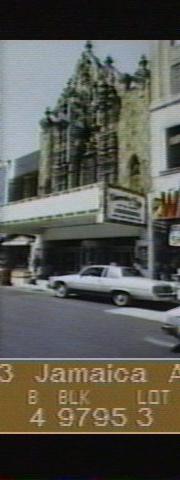
The city photographed every building for its tax records around 1940 and again in the 1980s. NYC Municipal Archives.
Written with AI from the source each entry cites, then fact-checked.
- 1926
Builder R. Riccardo buys the site, keeps the corner and sells the rest to Paramount for a theater
In 1926-27 the builder R. Riccardo bought land where Jamaica Avenue met Merrick Road and split it in two. He kept the corner for his own six-story Riccardo Building and sold the rest to the Famous Players-Lasky Corporation (Paramount), under restrictions apparently meant to guarantee Jamaica a handsome theater. Those conditions stayed with the land when Paramount passed it to Loew's, which filed plans for the Valencia in 1927.
“…keeping the corner plot on which he built the six-story Riccardo Building, and selling the other half to the Famous Players-Lasky Corporation…”
- 1928
Drew Eberson copies the night sky for the ceiling from National Geographic
The Thompson-Starrett Company started building the theater in June 1928 to designs by John Eberson. His son Drew, who helped on the job, laid out the stars painted on the auditorium ceiling by copying them from an issue of National Geographic. By August the house had its name, the Valencia, picked because the Spanish word sounded exotic; it was planned as Long Island's largest cinema.
“John Eberson's son Drew, who assisted in the theater's construction, sketched out the stars on the auditorium's ceiling by copying an issue of National Geographic magazine.”
Source: Wikipedia
- 1928
John Eberson gives the Valencia a Spanish Baroque front of brick and glazed terra cotta
Eberson, the architect who invented the "atmospheric theater," designed the 3,554-seat Valencia as one of his most important commissions. Its narrow Jamaica Avenue front borrows from Spanish and Mexican Churrigueresque churches, with ornate terra-cotta pilasters, curving gables, finials, spiral volutes, shells, swags of flowers and the heads of cherubs. The Tabernacle of Prayer, in the building since 1977, has kept that exterior almost entirely intact.
- 1929
The Valencia opens to an estimated 17,000 people on its first day
The Valencia opened on Saturday, January 12, 1929, the first of Loew's five Wonder Theaters to be finished, and ran shows from 11 a.m. to midnight before roughly 17,000 customers. Queens Borough President George U. Harvey gave the opening address. The bill paired the MGM talkie White Shadows in the South Seas with the revue "My Mantilla" from Broadway's Capitol Theater, featuring the 24 Chester Hale Girls.
- 1935
Loew's drops vaudeville at the Valencia after years of live stars
Through the early 1930s the Valencia mixed films with live acts: Ginger Rogers and Kate Smith appeared there, and winners of the Major Bowes Amateur Hour radio contest played every Monday night. In September 1935 Loew's ended vaudeville at the theater and switched to films only, cutting ticket prices, as it was doing at most of its houses. Managers later said the Valencia stayed profitable without the stage shows.
Source: Wikipedia
- 1977
Loew's hands the closed Valencia to the Tabernacle of Prayer for one dollar
Loew's shut the Valencia on June 15, 1977, blaming falling business; its final film was The Greatest. In July it gave the building to the Tabernacle of Prayer for All People, a Brooklyn congregation, for a token $1, after the church had failed to buy the Kings Theatre. Pastor Johnnie Washington called the gift a miracle from God.
Source: Wikipedia
- 1977
The church robes the theater's nude statues as angels and hangs a wall of crutches
Restoring the theater for worship, the Tabernacle of Prayer hired George Exarchou and spent about $250,000 before moving in during October 1977. The nude statues high on the auditorium walls became robed, winged angels, the projection booth turned into a prayer tower, and a choir loft and pulpit were built. A wall of crutches in the foyer marked people said to have been healed, and the drained goldfish pond became a backdrop for wedding photos.
“…the auditorium's nude statues were converted into winged angels with robes.”
Source: Wikipedia
- 1999
The Valencia becomes a city landmark at its own congregation's request
In 1998 the Tabernacle of Prayer asked the Landmarks Preservation Commission to reconsider the theater, which Loew's had opposed designating in 1976. The commission named the exterior a landmark on May 25, 1999, making it the second Queens theater so honored after the RKO Keith's in Flushing. The interior could not be protected because the commission does not designate interiors of houses of worship.
Source: Wikipedia
Further reading
- Valencia TheatreWikipedia
Nearby
- Valencia Theatre90-07 Merrick Boulevard | 2 entries
- Queens Central Library89-11 Merrick Boulevard | 3 entries
- First Presbyterian Church in Jamaica89-60 164th Street | 3 entries
- Jamaica Post Office88-40 164th Street | 3 entries
- J. Kurtz & Sons Store Building162-22 Jamaica Avenue | 4 entries
- Jamaica Chamber of Commerce Building89-31 161st Street | 8 entries