Wyckoff-Bennett Homestead
1669 East 22nd Street | Madison | built 1766
Open on the map6 entries

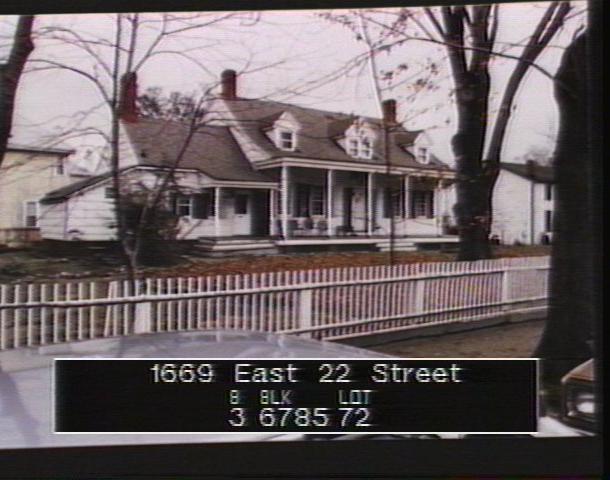
The city photographed every building for its tax records around 1940 and again in the 1980s. NYC Municipal Archives.
Written with AI from the source each entry cites, then fact-checked.
- 1766
The Wyckoff farmhouse stands by 1766 as a Dutch Colonial farmhouse
An inscription cut in a beam in the old barn leads the Landmarks Preservation Commission to assume the house was standing in 1766, and it believes Henry and Abraham Wyckoff built it. The one-and-a-half-story frame house is rectangular, with a northern extension holding a kitchen and a room once used as a milk house. In the late 1890s, when the land was divided into lots and streets cut through, the house, which had faced south, was turned to face west.
“From an inscription found cut in a beam in the old barn, we can assume that the house was standing in 1766.”
- 1776
Hessian officers quartered here scratch their names into window panes
After the British invasion of Brooklyn in 1776, Hessian soldiers were quartered in the Wyckoff farmhouse. Captain Toepfer of the Ditfurth regiment and Lieutenant M. Bach of the Hessen-Hanau Artillery scratched their names and units into windowpanes. A plaque outside says the men may well have joined the attack on the Battle Pass, in what is now Prospect Park, as fighting in the Battle of Brooklyn opened on August 27, 1776.
Source: Wikipedia
- 1835
Cornelius W. Bennett buys the Wyckoff farm and a pew in the Gravesend church
In 1835 Cornelius W. Bennett bought the farm, about 100 acres with meadows and woodlands, together with a pew (number 62) in the old Gravesend Dutch Reformed Church. The Bennett family worked the land until about 1900, and four generations of Bennetts lived in the house after buying it from the Wyckoffs. Only two family names were tied to the house during its first two centuries.
- 1968
The Landmarks Commission designates the Wyckoff-Bennett Homestead
The Landmarks Preservation Commission designated the homestead on January 17, 1968, calling it an outstanding Dutch Colonial farmhouse that prominent Brooklyn families had lived in continuously for over two centuries. At the 1966 hearing the owner spoke in favor and said he had spent $1,500 the previous year keeping the house in excellent condition. The report cites historian Maud Dilliard's view that it is the most beautiful Dutch Colonial house in Brooklyn.
- 1999
A deal for the city to buy the homestead falls apart
After Gertrude Ryder Bennett Williams died in 1982, her widower sold the house to Annette and Stuart Mont. In 1999 they agreed to a $2 million city purchase that would let the Monts stay on rent-free as caretakers. Years of hearings, a remapping as parkland and a budget earmark followed, but the paperwork then set the price at $1.3 million, and the Monts declined.
“The Monts also sought to have the house preserved and had reached a deal with the city in 1999 for $2 million…”
Source: Wikipedia
- 2024
The homestead is sold to Congregation Chabad Lubavitch of Flatbush
After the Monts died, their heirs listed the house for sale in 2020, at first asking $3.25 million. In the end they took a $2.4 million offer from 22nd Street Investors LLC. In December 2024 the house changed hands again, going to Congregation Chabad Lubavitch of Flatbush.
“In December of 2024, the property was sold to Congregation Chabad Lubavitch of Flatbush.”
Source: Wikipedia
Further reading
- Wyckoff-Bennett HomesteadWikipedia
Nearby
- Maimonides Midwood Community Hospital2525 Kings Highway | 5 entries
- Jewish Center of Kings Highway1218 Avenue P | 4 entries
- Elias Hubbard Ryder House1926 East 28th Street | 4 entries
- St. Edmund Preparatory High School2474 Ocean Avenue | 4 entries
- Edward R. Murrow High School1600 Avenue L | 5 entries
- East Midwood Jewish Center1625 Ocean Avenue | 7 entries