A. A. Low Building
171 John Street | also 89 South Street | Financial District | built 1980
Open on the map5 entries

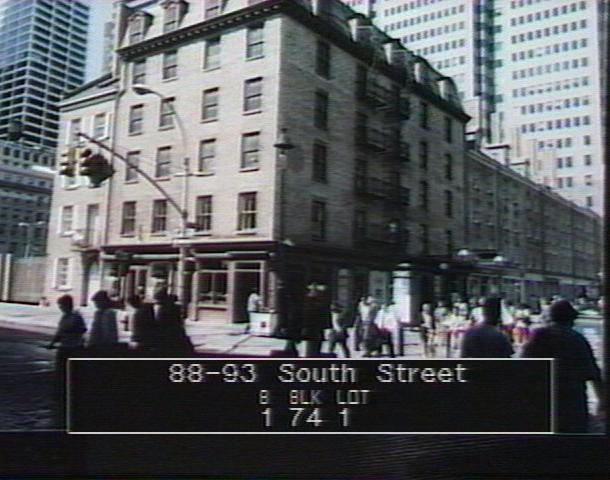
The city photographed every building for its tax records around 1940 and again in the 1980s. NYC Municipal Archives.
Written with AI from the source each entry cites, then fact-checked.
- 1850
Abiel Abbot Low moves his China-trade firm into a new counting-house on John Street
Low bought the site from George Codwise's widow in 1849 and had the building raised for A. A. Low & Brother the next year. He had gone to Canton at 22 to clerk for Russell & Co., where he became close to the merchant Houqua, and had become a partner in 1840. His firm had been on South Street since 1847, and the brothers moved here three years later, using the building as the firm's base into the 1900s.
- 1850
A. A. Low's counting-house has a cast-iron first floor from Daniel Badger's Architectural Iron Works
The building is five stories high and eight windows wide, faced in brownstone that has since been covered with stucco. Its cast-iron first floor came from Daniel D. Badger's Architectural Iron Works, a well-known firm. The iron dates from before 1865, though the report cannot say whether it was on the building from the start; its paneled square columns once had Corinthian capitals.
- 1853
Low's children visit on Saturdays to smell the teas, and the Delano family rents space
A. A. Low & Brothers used the buildings here as offices and warehouses, and on Saturday mornings Low's children were brought along to sniff the odors of tea, cinnamon and firecrackers. The museum's records show that the Delano family, merchants who worked at the address from 1850 to 1856, were paying Low rent as early as 1853.
Source: southstreetseaportmuseum.org
- 1863
Low becomes Chamber of Commerce president and protests British support for Confederate raiders
Low, whose firm worked from this building, was elected president of the New York Chamber of Commerce in 1863 and spoke for the city's merchants against British support of Confederate commerce destroyers. Two of his clippers, the Contest and the Jacob Bell, were destroyed by Confederate privateers during the Civil War. His son Seth, born in 1850, went on to serve as New York's mayor and as Columbia University's president.
“Two other of Low's clippers, the Contest and the Jacob Bell, were subsequently destroyed by Confederate privateers during the Civil War.”
Source: Wikipedia
- 1991
The South Street Seaport Museum restores the building after a marine-paint company leaves
The Baltimore Copper Paint Company used the building from 1965 to 1974 for offices and for storing marine paints. In 1991 Jan Hird Pokorny Associates restored it and adapted it for the South Street Seaport Museum, which now uses it for administrative offices, collections storage and archives.
Source: southstreetseaportmuseum.org
Nearby
- A. A. Low Building167 John Street | 5 entries
- 89 South Street1 entry
- 165 John Street4 entries
- Schermerhorn Row, No. 6 Fulton Street6 Fulton Street | 3 entries
- Schermerhorn Row, No. 4 Fulton Street4 Fulton Street | 3 entries
- Schermerhorn Row, No. 8 Fulton Street8 Fulton Street | 3 entries