The Dorilton
171 West 71st Street | also 2070 Broadway | Lincoln Square | built 1902
Open on the map10 entries

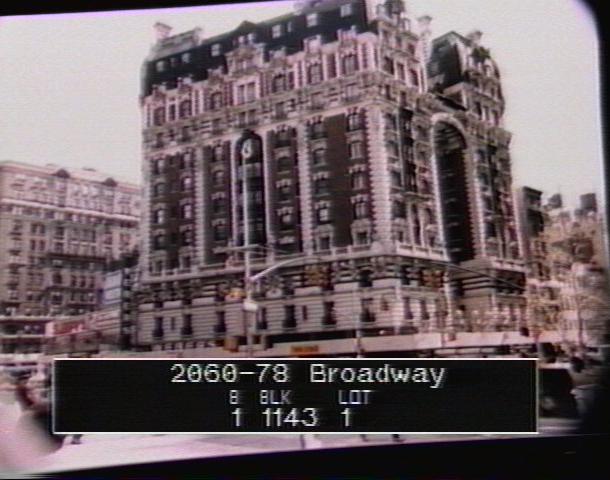
The city photographed every building for its tax records around 1940 and again in the 1980s. NYC Municipal Archives.
Written with AI from the source each entry cites, then fact-checked.
- 1900
Hamilton Weed files plans for Broadway's first tall apartment house built to ride the new subway
In March 1900, just after the route of New York's first subway was fixed along 42nd Street and up Broadway, developer Hamilton M. Weed filed plans for the Dorilton. The New York Times later called it the first high-rise apartment building on Broadway planned around the proposed line. Weed had bought the northeast corner of 71st Street in early 1899, before the route was official, and hired Janes & Leo, who had just designed his smaller Alimar uptown. The line was completed in 1904.
Source: Internet Archive
- 1902
Hamilton Weed's $750,000 Dorilton opens with servants' elevators and a way to recharge electric cars
Developer Hamilton M. Weed hired Elisha Harris Janes and Richard Leopold Leo to design the Dorilton, which opened in 1902 at a cost of $750,000. Tenants and servants had their own elevators, the apartments had French paneling, and the building offered filtered water and a way to recharge residents' electric cars. Despite the critics, the building quickly filled with socially recognized names.
Source: Daytonian in Manhattan
- 1902
Critic Montgomery Schuyler attacks the Dorilton for demanding attention, and mocks its gate globes
Montgomery Schuyler of the Architectural Record condemned the new Dorilton for shouting for notice so loudly that even the preoccupied or color-blind could not miss it. He said its motley elements set the viewer's teeth on edge, and he scoffed that the huge globes on the entrance columns looked left for titans to bowl with. Later critic Carter B. Horsley called the courtyard gate the most attractive in the city.
Source: Daytonian in Manhattan
- 1902
Weed sells the Dorilton to investors from Buffalo and Providence for $1.25 million
In March 1902, with the building just finished, Hamilton Weed sold the Dorilton to a syndicate of Buffalo and Providence investors. It was valued at $1.25 million, and only one of its 48 apartments was still vacant. Weed had completed it that year for $750,000.
“Weed sold the Dorilton in March 1902 to a group of investors from Buffalo, New York, and Providence, Rhode Island…”
Source: Wikipedia
- 1903
Mrs. Hector Havemeyer receives callers at the Dorilton, and millionaire Emil Wolff lives here until 1918
A year after the Dorilton opened, the Times noted that Mrs. Hector H. Havemeyer, who lived at 171 West 71st Street, would receive callers on January 8 and 9. Millionaire Emil Wolff lived in the building until he died in 1918. His will left more than $2 million to Jewish religious and educational charities.
Source: Daytonian in Manhattan
- 1905
An ammonia tank explodes in the basement and fumes fill all forty-seven apartments
Shortly after 11 p.m. on June 19, 1905, a tank of ammonia connected to the refrigeration plant in the Dorilton's basement blew up. Fumes spread through the building's forty-seven apartments and reached the rooms of the 250 people living there. The New York Times put the story on its front page the next morning.
Source: Internet Archive
- 1919
Sydney Sonn buys the fully occupied Dorilton and adds storefronts
George Noakes, who bought the Dorilton in November 1915, resold it in 1919 to Sydney H. Sonn, president of the Transit Realty Company. The building was then fully occupied and earned $111,000 a year in rent. Sonn added storefronts and renovated the interior. By 1923 the New-York Tribune counted six stores and 48 apartments in the building.
Source: Wikipedia
- 1938
The Dry Dock Savings Bank takes the Dorilton at a foreclosure auction over a $1.26 million mortgage debt
In 1938 the Dry Dock Savings Bank began foreclosure proceedings against the Dorilton because the owners had defaulted on $1,263,904 of the mortgage. The bank took the building at a foreclosure auction that year. By October 1939 the managing agent reported it fully rented, and in 1945 the bank sold it to Isaac Prussin at an assessed valuation of $900,000.
“The Dry Dock Savings Bank initiated foreclosure proceedings against the Dorilton in 1938, as the previous owners had failed to pay $1,263,904 on the mortgage.”
Source: Wikipedia
- 1974
The Landmarks Preservation Commission designates the Dorilton, noting its popularity with artists and musicians
The Landmarks Preservation Commission designated the Dorilton a city landmark on October 8, 1974, calling it among Manhattan's best Beaux-Arts buildings. The report says the big rooms and soundproofing have long made the building a favorite home for artists and musicians. It also says the Dorilton complements the Ansonia, diagonally across Broadway.
“Because of its large rooms and soundproof construction, the Dorilton has always been popular as a residence for artists and musicians.”
- 1984
The Dorilton becomes a co-op, and residents restore the roof and paint a missing cornice in trompe l'oeil
By the 1950s dormers and cornices on the Dorilton were crumbling or gone, and in 1979 critic Paul Goldberger lamented its decay. It became a co-op in 1984, and residents began restoration a year later. Work continued for more than a decade, with the mansard roof re-slated, missing dormers and cresting reproduced and a $1.5 million roof restoration. Painters John Williams and John Wright Stephens imitated the absent 11th-floor cornice with a trompe l'oeil painting.
Source: Daytonian in Manhattan
Further reading
- The DoriltonWikipedia
Nearby
- Church of the Blessed Sacrament147 West 70th Street | 5 entries
- James Baldwin Residence137 West 71st Street | 8 entries
- Pythian Temple135 West 70th Street | 12 entries
- 200 Amsterdam Avenue13 entries
- Rutgers Presbyterian Church236 West 73rd Street | 2 entries
- Central Savings Bank Building (Apple Bank)2112 Broadway | 11 entries