Angel Orensanz Center
172 Norfolk Street | Lower East Side | built 1850
Open on the map13 entries

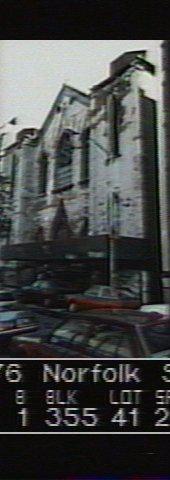
The city photographed every building for its tax records around 1940 and again in the 1980s. NYC Municipal Archives.
Written with AI from the source each entry cites, then fact-checked.
- 1849
Congregation Anshe Chesed builds a Gothic Revival synagogue on Norfolk Street
Congregation Anshe Chesed built this synagogue in 1849 to a Gothic Revival design by architect Alexander Saeltzer, inspired by Cologne Cathedral. It is the oldest surviving synagogue building in New York City. After Anshe Chesed left, a series of Eastern European Orthodox congregations worshipped here, the last of them Sheveth Achim Anshe Slonim from 1921 to 1974.
Source: Wikipedia
- 1850
Anshe Chesed consecrates its Norfolk Street synagogue before the mayor and city officials
Congregation Anshe Chesed formally opened its new Norfolk Street building on May 16, 1850, with an elaborate consecration ceremony. Guests included New York's mayor, several members of the Common Council and a number of Christian clergymen. The sanctuary held 700 men downstairs and 500 women in the gallery, which made it the largest synagogue in the city at that time.
“…formally opened and consecrated on May 16, 1850, with much ceremony. Invited guests included the mayor of New York…”
- 1869
Anshe Chesed adds an organ and family pews to its Norfolk Street services
In 1869 the congregation took its biggest step toward Reform worship in the Norfolk Street building, starting to use an organ and letting families sit together in shared pews. Change had come slowly before that. A choir of men and women arrived with the new building, yet the sexes still sat apart, and in 1865 conservative members used a court action to block Rabbi Mielziner's attempt at further reforms.
“It was not until 1869 that the congregation finally took major steps toward reform by adopting the use of an organ and instituting family pews…”
- 1890
The First Hungarian Congregation welcomes its first rabbi, Philip Klein, with a banquet
On June 19, 1890, the First Hungarian Congregation, then worshipping in the Norfolk Street synagogue, received its first rabbi, Dr. Philip Klein. The New York Times reported that the building was completely filled, with six other rabbis and three judges in attendance, and a banquet followed. Among the letters of regret read aloud were notes from Mayor Grant, ex-President Cleveland, Vice President Morton and President Harrison.
Source: Daytonian in Manhattan
- 1905
Rev. H. Pereira Mendes tells the First Hungarian Congregation it feels the most grief over Russia's persecution of Jews
On December 4, 1905, Rev. H. Pereira Mendes spoke to the First Hungarian Congregation, which worshipped at Norfolk Street and counted many Russian Jews among its members. He said the congregation felt the most grief because its members personally received letters from Russia, where Jews were being killed that year. He tried to give hope, saying the outcome would be equal rights for all Jews in Russia.
Source: Daytonian in Manhattan
- 1910
Two hundred newsboys march to the synagogue for the wedding of their 'King of Newsboys'
In 1910 Jacob A. Rich, a newsboy known on the street as Jack Sullivan who had earned the title 'King of Newsboys', married Sarah Siegel at the Norfolk Street synagogue. The New-York Tribune reported on November 24 that two hundred newsboys would set out together from the Newsboys' Home and walk to the synagogue in his honor. A reception at the Cafe Boulevard was to follow, and the couple planned to spend their honeymoon in Lakewood.
Source: Daytonian in Manhattan
- 1921
The Anshe Slonim congregation buys the aging Norfolk Street synagogue
Congregation Sheveth Achim Anshe Slonim bought the 1849 Gothic Revival synagogue on July 2, 1921, from the First Hungarian Congregation Ohab Zedek, which had worshipped there since 1886. The building had already changed congregations twice since Anshe Chesed, its original builder, moved out in the 1870s, and Anshe Slonim would use it for more than fifty years.
Source: Daytonian in Manhattan
- 1974
The Slonim congregation disperses, leaving the synagogue abandoned
By 1974 the Anshe Slonim congregation had dwindled and dispersed, and its Norfolk Street synagogue sat abandoned and was repeatedly vandalized. The city took ownership of the derelict building in 1981 before it passed through two private owners and was finally bought by the sculptor Angel Orensanz in 1986.
Source: Wikipedia
- 1986
Sculptor Angel Orensanz buys the abandoned synagogue for an arts center
By 1974 the last congregation had dispersed and the building fell into disrepair. The Spanish artist Angel Orensanz bought it in 1986 and restored it as a gallery and performance space, and the city designated it a landmark in 1987. Sarah Jessica Parker and Matthew Broderick were married here in 1997, and a liberal congregation still holds occasional services.
Source: Wikipedia
- 1987
The city designates the Anshe Slonim Synagogue a landmark as New York's oldest surviving synagogue building
The Landmarks Preservation Commission designated the building at 172-176 Norfolk Street a landmark on February 10, 1987, under the name Anshe Slonim Synagogue, originally Anshe Chesed. Its report calls the structure the oldest surviving building in New York City constructed as a synagogue. The commission had held its public hearing in June 1983, where four witnesses spoke in favor and none against.
- 1993
The synagogue's interior becomes the backdrop for the Enter the Wu-Tang (36 Chambers) cover
Wikipedia says the photographer Daniel Hastings shot the cover of Enter the Wu-Tang (36 Chambers), the 1993 album by the Wu-Tang Clan, against the interior of the synagogue. Angel Orensanz had bought the building in 1986 and turned it into an art gallery and performance space.
“Photographer Daniel Hastings used the interior of the synagogue as the backdrop for the cover art for the Wu-Tang Clan's 1993 album Enter the Wu-Tang (36 Chambers).”
Source: Wikipedia
- 1994
Andres Serrano directs a controversial Godflesh music video at the Orensanz Center
In 1994 Andres Serrano directed a music video at the Orensanz Center for 'Crush My Soul,' a song by Godflesh. Wikipedia describes the video as controversial. By then Angel Orensanz had owned the former synagogue for eight years and was running it as an art gallery and performance space.
“In 1994, the controversial Andres Serrano-directed music video for Godflesh's song "Crush My Soul" was filmed in the center.”
Source: Wikipedia
- 1997
Sarah Jessica Parker and Matthew Broderick marry at the center
Actors Sarah Jessica Parker and Matthew Broderick were married in 1997 inside the former synagogue, by then known as the Angel Orensanz Foundation Center for the Arts. The Gothic Revival sanctuary, restored by the artist Angel Orensanz after decades of abandonment, has since hosted music videos and concerts, including a 2011 MTV Unplugged taping by Florence and the Machine.
Source: Wikipedia
Further reading
- Angel Orensanz CenterWikipedia
- The 1849 Congregation Anshe Chesed -- No. 172 Norfolk StreetDaytonian in Manhattan
Nearby
- Norfolk Arms170 Norfolk Street | 1 entry
- 169 Suffolk Street5 entries
- Isaac F. Fisher House249 East Houston Street | 6 entries
- Webster House251 East Houston Street | 5 entries
- 154 Stanton Street2 entries
- Lower East Side Preparatory High School145 Stanton Street | 1 entry