Aguilar Library
174 East 110th Street | also 172 East 110th Street | East Harlem | built 1899
Open on the map4 entries

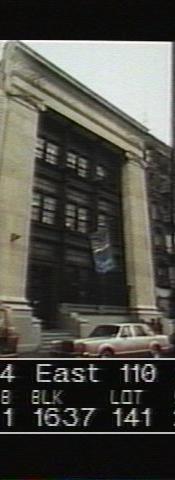
The city photographed every building for its tax records around 1940 and again in the 1980s. NYC Municipal Archives.
Written with AI from the source each entry cites, then fact-checked.
- 1899
The Aguilar Free Library Society builds a library for Jewish immigrants
The Aguilar Free Library Society, founded in 1886 and named for the Sephardic Jewish author Grace Aguilar, lent books to working-class Jewish immigrants. It came to 110th Street in 1896 and built this library in 1898 and 1899. The architects, Herts & Tallant, were known for theaters, and the Landmarks Preservation Commission later described the facade as framed like a stage by a proscenium arch.
Source: Village Preservation
- 1899
Theater architects give the library a stage-like facade
Herts & Tallant, best known for theaters such as the New Amsterdam, win a competition to design the new Aguilar library, built in 1898-99. The judges call the plan 'extremely simple' and 'severely bold,' and the architects use cast iron for a decorative facade. The Landmarks Preservation Commission later describes the design as theatrical, as though a proscenium arch frames a stage.
Source: Village Preservation
- 1905
Carnegie money enlarges the Aguilar branch as it joins the public library
The Aguilar library became part of the New York Public Library in 1903, and in 1904 and 1905 Herts & Tallant expanded and raised its facade with funds from Andrew Carnegie. Its readers changed with the neighborhood: first Jewish immigrants, then Italians, then Puerto Ricans and Dominicans, for whom it built up Spanish-language collections after World War II. It became a city landmark in 1991.
Source: Village Preservation
- 1991
The city designates the Aguilar branch a landmark
The Landmarks Preservation Commission designates the Aguilar branch library an individual New York City landmark in 1991. The branch still operates on East 110th Street. Its neighbors are now predominantly Puerto Rican, Mexican, Dominican, and African American, and since World War II it has built up a large collection in Spanish.
Source: Village Preservation
Nearby
- First Spanish United Methodist Church163 East 111th Street | 5 entries
- Church of Our Lady Queen of Angels228 East 113th Street | 2 entries
- St. Ann Church312 East 110th Street | 3 entries
- Cristo Rey New York High School112 East 106th Street | 3 entries
- La Marqueta1580 Park Avenue | 6 entries
- Jackie Robinson Educational Complex (Graffiti Hall of Fame)1573 Madison Avenue | 2 entries