177 Waverly Place
West Village | built 1890
Open on the map5 entries

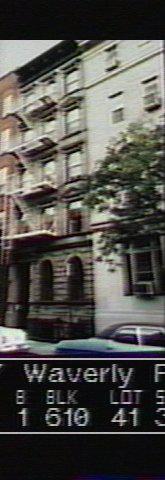
The city photographed every building for its tax records around 1940 and again in the 1980s. NYC Municipal Archives.
Written with AI from the source each entry cites, then fact-checked.
- 1890
An old two-story house, a rooming house by the late 1870s, is sold and cleared for a new flat building
An earlier building stood on this lot: a two-story brick-faced frame house of Federal style that had become a rooming house by the late 1870s. Its tenants included Martha McFarland and her son William, who attended New York City College, and a clerk named Richard Bolton. On March 1, 1890, developer William Rankin bought it from the widow Anna Hoch for $9,000, and the roomers had to find other lodgings before the old house was replaced.
Source: Daytonian in Manhattan
- 1890
James W. Cole files plans for a five-story stone flat that blends several styles
On April 18, 1890, developer William Rankin had architect James W. Cole submit plans for a $13,000, five-story "stone flat," and the first tenants moved in before the year ended. Cole combined undressed brownstone and arched windows suggesting Romanesque Revival with a Greek Revival entrance and neo-Grec brackets, topped by a cast-metal cornice. Rankin sold it in March 1891 for $25,000.
Source: Daytonian in Manhattan
- 1920
A deliveryman who lives here is arrested with a truck carrying 146 cases of whiskey
George Wilkinson, a trucker's delivery assistant who lived in the building, and driver William J. Flynn were arrested on the night of January 15, 1920, while delivering to a saloon at West and Liberty Streets from a horse-drawn truck. The truck held 146 cases and a barrel of whiskey, and the arrests came just as the Volstead Act brought in Prohibition. A hostile crowd of thirsty men surrounded the two federal agents, who drove them back at gunpoint, and the whiskey was seized.
Source: Daytonian in Manhattan
- 1936
Architect George Provot, once of Welch, Smith & Provot, dies after years living in the building
George Provot moved into the building around 1926. A New York native, he studied architecture in France for nine years, earning his first degree there in 1886, and then took a bachelor's degree in architecture at Columbia in 1889. He belonged to the firm Welch, Smith & Provot before working alone. He died on July 9, 1936, at the French Hospital on West 13th Street, still a resident of No. 177.
Source: Daytonian in Manhattan
- 1962
Bruce Brown, whose father married Helen Gurley Brown, shares an apartment here in 1962
College student Bruce Brown shared an apartment in the building with a classmate by 1962. His father, David Brown, was married to Helen Gurley Brown, whose book Sex and the Single Girl came out that year. According to a 2016 biography of Helen Gurley Brown, David wrote in 1963 to Bruce's girlfriend and future wife, Kathy Ames, suggesting she might persuade him to cut his hair.
Source: Daytonian in Manhattan
Further reading
- James W. Cole's Eclectic 1890 177 Waverly PlaceDaytonian in Manhattan
- Then & Now photos: 177 Waverly PlaceVillage Preservation: Greenwich Village Then & Now
Nearby
- Switzer Institute and Home27 Christopher Street | 5 entries
- 25 Christopher Street1 entry
- 23 Christopher Street2 entries
- 19 Christopher Street1 entry
- 17 Christopher Street1 entry
- 35 Christopher Street2 entries