Edward Mooney House
18 Bowery | also 7 Pell Street, 3 Pell Street | Chinatown | built 1789
Open on the map6 entries

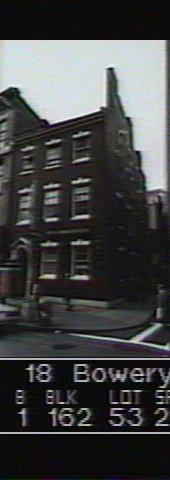
The city photographed every building for its tax records around 1940 and again in the 1980s. NYC Municipal Archives.
Written with AI from the source each entry cites, then fact-checked.
- 1785
Butcher Edward Mooney buys a Loyalist's confiscated land and builds a house
After the Revolution, New York's Commissioners of Forfeiture auctioned off property seized from the Loyalist James De Lancey, and in 1785 the butcher Edward Mooney bought this lot at the corner of the Bowery and Pell Street. The brick house he built was finished by 1789, the year of Washington's inauguration. Mooney lived here until his death in 1800, and a rear addition doubled the house's size in 1807.
Source: Daytonian in Manhattan
- 1807
A rear addition doubles the house's size
Seven years after Edward Mooney's death, the house doubled in size with an addition built onto the rear in 1807. The enlarged building kept its brick Federal-style front facing the Bowery while the extension reached toward Pell Street. The original oval-shaped handrail on the staircase in that added section survives today.
Source: Daytonian in Manhattan
- 1965
The Landmarks Commission hears the case for the Mooney House and no one objects
On October 19, 1965, the Landmarks Preservation Commission meets for a public hearing on designating the Edward Mooney House at 18 Bowery, listed as Item No. 56. Two witnesses speak in favor and nobody speaks against. The commission's later report calls the house the only known town house in Manhattan to survive from the American Revolution period.
- 1966
The city designates the Mooney House a landmark
By the 1820s the house had been turned into a tavern, and it never again served as a private home; later it was a hotel, poolroom, brothel, store, restaurant and Chinese club. When the Landmarks Preservation Commission designated it in 1966, it called the house the only surviving townhouse from the American Revolutionary period. The building was restored in 1971 and has since housed a bank.
Source: Daytonian in Manhattan
- 1971
Restorers return the Mooney House to its Federal-era look
By the 1820s the Mooney family's former home had already become a tavern, the first of more than a century of commercial uses that followed. Later tenants ran it as a hotel, brothel, poolroom, restaurant, and Chinese social club before the Landmarks Preservation Commission recognized it as the city's only surviving townhouse from the Revolutionary War period. Restorers returned its exterior to its Federal-era appearance in 1971, five years after landmark designation.
Source: Daytonian in Manhattan
- 1976
The Mooney House joins the National Register of Historic Places
In 1976 the Edward Mooney House at 18 Bowery is added to the National Register of Historic Places, ten years after the city made it a landmark. By then the house, built for a wealthy butcher near the slaughterhouses and tanneries of his trade, had been a hotel, a brothel and a saloon since its life as a private home ended in the 1820s.
Source: Wikipedia
Further reading
- Edward Mooney HouseWikipedia
Nearby
- 16 Bowery1 entry
- Bowery Mission's first home14 Bowery | 3 entries
- 12 Bowery1 entry
- 9 Pell Street1 entry
- On Leong and Hip Sing tong headquarters, 10 Pell Street10 Pell Street | 3 entries
- 11 Pell Street1 entry