Philip Muller House
190 Spring Street | SoHo | built 1824
Open on the map6 entries

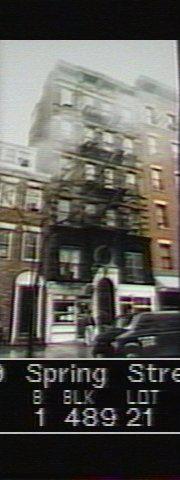
The city photographed every building for its tax records around 1940 and again in the 1980s. NYC Municipal Archives.
Written with AI from the source each entry cites, then fact-checked.
- 1824
Nathaniel Paine builds a Federal-style brick row house, later converted for commerce
This row house dates to about 1824 and was built by the developer Nathaniel Paine. Its brick walls are laid in common bond, and its massing is typical of the Federal style. By 1901 the ground floor had a commercial use, and a tax photograph from around 1940 shows a cobbler there. The Landmarks Preservation Commission classes it as an altered Federal house.
- 1851
Bootmaker Philip Muller buys the house at auction and opens his shop on the ground floor
The bootmaker Paul Brehm was still living in the 16-foot-wide house when it was auctioned on February 8, 1851, and sold for $4,300. Another bootmaker, Philip Muller, bought it, moved his family upstairs and opened his shop on the ground floor. The household took in five boarders that year, shoemakers and cabinetmakers among them. The Mullers stayed in the building for decades.
Source: Daytonian in Manhattan
- 1878
The tailor shop used as a polling place sits over a basement beer saloon, drawing a police inquiry
Each year from 1876 the tailor Henry Otto rented his ground-floor shop to the city as an election polling place; he was paid $35 for the day in 1876. The arrangement became a problem because Jacob Hensle ran a beer saloon in the basement below. In December 1878 the Eighth Precinct's captain was questioned by the Board of Police about it, and he admitted the saloon was under the polling room.
Source: Daytonian in Manhattan
- 1891
Pasquelina Robertielio shoots Nicolo Pierro outside the house after he skips their wedding
Nicolo Pierro, a young Italian immigrant who lived here with his cousin Michael, was to marry Pasquelina Robertielio of Mott Street after she became pregnant. He failed to appear at the March 1, 1891 wedding and planned to sail for Italy the next day. Pasquelina waited outside the house all night and shot him when he stepped out. He stumbled back to his room and died a few minutes later, as Michael told the court.
Source: Daytonian in Manhattan
- 1957
Paul Clayton's apartment becomes a hub for Sunday-evening folk sings
By about 1957 the upper floors were apartments and a gathering spot of the Village folk revival. The singer and song collector Paul Clayton moved in around then, and the future folklorist Roger Abrahams soon followed. Sunday-evening jam sessions were held, with different apartments leaning toward bluegrass or ballads. In his history of the folk revival, Robert Cantwell relays Abrahams's memory that Pete Seeger, Dave Van Ronk, Theodore Bikel, Bob Gibson and Odetta were regular visitors.
Source: Daytonian in Manhattan
- 1968
James Hormel, later the first openly gay U.S. ambassador, buys the house and lives here until a fire
After Richard Nixon won the presidency in 1968, James C. Hormel went back to New York, moved into the lower triplex at 190 Spring Street and bought the building. He stayed until 1972, when an electrical fire badly damaged it while he was out of town. He sold it that year and relocated to Hawaii. He later served as U.S. Ambassador to Luxembourg from 1999 to 2001, the first openly gay man to hold an ambassadorship for the country.
Source: Daytonian in Manhattan
Further reading
- The Philip Muller House - 190 Spring StreetDaytonian in Manhattan
Nearby
- Eighth Ward Hotel188 Spring Street | 6 entries
- 192 Spring Street5 entries
- 196 Spring Street2 entries
- 79 Thompson Street2 entries
- 200 Spring Street2 entries
- 75 Thompson Street2 entries