Corbin Building
192 Broadway | also 11 John Street, 9 John Street, 5 John Street | Financial District | built 1910
Open on the map13 entries

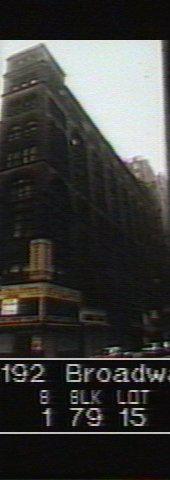
The city photographed every building for its tax records around 1940 and again in the 1980s. NYC Municipal Archives.
Written with AI from the source each entry cites, then fact-checked.
- 1881
Austin Corbin takes over the lease on a lot holding four small brick buildings
Before the Corbin Building, the corner lot belongs to the Collegiate Reformed Protestant Dutch Church, which leased it in 1869 to the North American Fire Insurance Company. That tenant defaulted in 1872, and the lease passed through several hands. In 1881, with four small brick buildings on the lot, Austin Corbin acquired the lease, then signed a new 21-year lease in 1886 at $18,000 a year.
“…while the lot was developed with four small brick buildings, the lease was acquired by…”
- 1888
Austin Corbin builds a speculative office building for his bank
Long Island Rail Road president Austin Corbin, who leased the site from the Collegiate Reformed Protestant Dutch Church in 1886, erects the building between 1888 and 1889 to house his banking firm and rent out the extra space. Architect Francis H. Kimball, credited with the final design despite Stephen Decatur Hatch's initial listing, draws on his earlier terracotta work to give it richly decorated surfaces. The building goes up in just 11 months.
Source: Wikipedia
- 1889
Architectural Era describes the Corbin Building's Guastavino arches as a first
The building's cage construction uses cast-iron columns and wrought-iron beams with brick, concrete, tile and terra cotta. Floors, ceiling and roof use Guastavino arches, a fireproofing system patented in 1885, and the October 1889 Architectural Era described the Corbin Building as the first use of it. Its terra cotta came from the New York Architectural Terra Cotta Company, one of that firm's earliest commissions.
- 1898
Montgomery Schuyler singles out the Corbin Building's terra cotta as a model of design
Writing about Francis Kimball's work in Architectural Record in 1898, the critic Montgomery Schuyler calls the Corbin Building of very high interest. He finds the terra cotta of the upper stories hard to match elsewhere in New York outside Kimball's own work, and calls the top story a model of design in baked clay. He dislikes the horizontal divisions, but thinks the two end towers quite successful.
“He noted that the "work is of a very high interest.”
- 1907
The Corbin Banking Company, founded by Austin Corbin, assigns its affairs to a creditors' attorney
The Corbin Banking Company of 192 Broadway, the private partnership Austin Corbin founded, files an assignment for the benefit of its creditors. Its partners are Corbin's namesake son and his son-in-law George S. Edgell, and the assignment goes to the firm's attorney, George C. Austin. The Times headline says the assignee promises all depositors will be paid in full.
Source: The New York Times
- 1908
The Corbin Building Company sells the building to the Chatham National Bank
In 1908 the Corbin Building Company sells the building to the Chatham National Bank of New York, which already leases the ground floor for the long term, while the land is still held by the Dutch Reformed Church. The company appears to have become a Chatham subsidiary, and in 1925 the Schulte Cigar Stores Company buys the building and the land lease from it.
“The Corbin Building Company subsequently sold the building in 1908 to the Chatham National Bank of New York…”
Source: Wikipedia
- 1937
Wholesale jeweler Herman A. Groen leases the nine-story building at Broadway and John Street
Broker Charles F. Noyes Company announces that Herman A. Groen, a wholesale jeweler, has leased the nine-story building at 192 Broadway, on the northeast corner of John Street. The New York Times ran the item on May 7, 1937, under a headline saying the jeweler took the corner and gave the term as 21 years.
Source: The New York Times
- 2003
The MTA agrees to preserve the Corbin Building as it plans the Fulton Street transit center
The Metropolitan Transportation Authority agrees to preserve the 115-year-old building and, if possible, work it into its planned Fulton Street transit hub. The World Monuments Fund had listed it among the 100 most endangered sites. Landmarks chairman Robert B. Tierney skipped formal designation because it would take time and the MTA, a state agency, could demolish a landmark anyway.
Source: The New York Times
- 2003
The Corbin Building is added to the National Register of Historic Places
After the Fulton Center project is announced, the World Monuments Fund lists the Corbin Building among the 100 most endangered historic sites worldwide. The Metropolitan Transportation Authority weighs demolishing it, leaving it alone, or folding it into the new transit hub, and a study finds it historically significant. The building joins the National Register of Historic Places in 2003, and its end bays and main entrance are cleaned and renovated that year.
Source: Wikipedia
- 2012
The restored Corbin Building reopens as part of Fulton Center
After a $59 million rehabilitation led by contractor Judlau Contracting with Page Ayres Cowley Architects and Arup Group, the Corbin Building reopens in December 2012 with retail space on the ground floor. Its basement and ground floor are absorbed into the new Fulton Center transit complex, and foundation work for the project turns up a stone-lined well holding 1889 newspapers, a jewelry invoice, and handwritten stock-trade records.
Source: Wikipedia
- 2013
The Times reports that Corbin Building crews dug the underpinning pits by hand and unearthed an old well
The New York Times reports in June 2013 that, because the lot is as little as 20 feet wide, the pits for the Corbin Building's new foundation work were dug with picks, shovels and buckets. In and around a stone-lined well that the digging reached, workers found a clay pipe with a carved eagle, a pince-nez case, 1880s ledgers of railroad stock trades, a 1915 invoice and 1889 newspapers.
Source: cityroom.blogs.nytimes.com
- 2015
The city designates the Corbin Building a landmark
The New York City Landmarks Preservation Commission designates the Corbin Building a city landmark on June 23, 2015. Critics such as Montgomery Schuyler had long debated Francis H. Kimball's division of its facade into two horizontal sections. The coworking company WeWork leases space in the building the following year.
Source: Wikipedia
- 2016
WeWork leases space in the Corbin Building
In 2016 the coworking company WeWork takes space in the Corbin Building, which was restored as part of the Fulton Center project. The building's above-ground floors offer 31,000 square feet of leased office space, and its ground floor holds shops and escalators down to the Fulton Street subway station.
Source: Wikipedia
Further reading
- Corbin BuildingWikipedia
Nearby
- Fulton Center200 Broadway | 9 entries
- Cushman Building174 Broadway | 6 entries
- 63 Nassau Street3 entries
- Fulton Building130 Fulton Street | 5 entries
- 14 Maiden Lane4 entries
- 141 Fulton Street1 entry