Little Branch
20 7th Avenue South | also 58 Leroy Street | West Village | built 1958
Open on the map8 entries

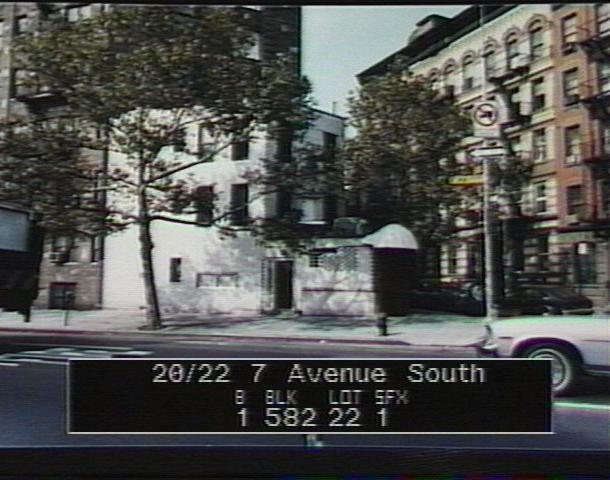
The city photographed every building for its tax records around 1940 and again in the 1980s. NYC Municipal Archives.
Written with AI from the source each entry cites, then fact-checked.
- 1889
William Rauch buys a five-story apartment house at 58 Leroy Street for $26,500
In 1889 William J. Rauch paid $26,500 for a five-story brick apartment house with a ground-floor store at No. 58 Leroy Street, then midway along the long block between Bedford and Hudson Streets. This earlier building was lost when Seventh Avenue was extended south to Varick Street between 1913 and 1917, which also swept away the 1840 Bedford Street Methodist Church nearby.
Source: Daytonian in Manhattan
- 1917
The avenue extension leaves a triangular lot, and a small gas station with underground tanks goes up
Daytonian in Manhattan says that when the Seventh Avenue extension was finished in 1917, it left wedge-shaped plots where it crossed the old Village streets, and many became gas stations as cars replaced horses. A tiny station rose on what remained of Rauch's lot, with a large masonry vault below for the fuel tanks. The Landmarks Preservation Commission dates the gas station and repair shop on this lot from the early 1920s.
Source: Daytonian in Manhattan
- 1958
Joseph Lau designs a three-story white-brick building for Amalia DiMartino
The Landmarks Preservation Commission dates the present building to 1958, when it was built from plans by Joseph Lau for owner Amalia DiMartino. It has three stories plus a one-story wing, with white brick laid in common bond below and stretcher bond above. The ground floor was commercial and the upper floors residential; in the early 1960s a bar and restaurant occupied the basement and first floor.
“…was erected in 1958 on the irregular lot ... by the early 1960s the basement and first floor of the building were used as a bar and restaurant.”
- 1974
Trombonist Roswell Rudd opens the St. James Infirmary jazz room in the basement
In 1974 Roswell Rudd started a jazz room under the name St. James Infirmary at 22 Seventh Avenue South. New York Times columnist John S. Wilson wrote on December 4 that it was a small, low-ceilinged, informal basement that gave Rudd a permanent nightly home for his growling, shouting style. The club was gone within a year despite good reviews.
Source: Daytonian in Manhattan
- 1975
The Milk Bar is called the most-whispered-about new watering hole in town
Writing in the New York Times on November 26, 1975, Michael Gross mentioned the Milk Bar as one of the city's talked-about new drinking spots. Steven Blush later recalled in his book New York Rock that in the 1980s the Milk Bar hosted late-night depravity. It lasted until 1993.
Source: Daytonian in Manhattan
- 1993
Le Vingt-Deux brings a speakeasy routine: a bouncer, a porthole and no sign
New York magazine described Le Vingt-Deux on June 28, 1993: a bouncer peered through a porthole to choose who could descend the dimly lit stairs to a candlelit room with a brass bar. The door carried no sign, only brass street numbers. Daytonian in Manhattan credits this club with creating the below-ground mystery that later bars kept.
Source: Daytonian in Manhattan
- 1996
Mason Reese invites Joey Buttafuoco to Nowbar and lands before the State Liquor Authority
Former child actor Mason Reese opened Nowbar in the space after Tribal Lounge, and a New York magazine writer called it a subterranean heaven for budding playboys and super-vixens in 1995. On April 10, 1996, the Times reported that Reese had to answer to the State Liquor Authority because Joey Buttafuoco, an ex-convict, was photographed mixing drinks there. It was a publicity stunt, and no drinks were served.
Source: Daytonian in Manhattan
- 2005
Sasha Petraske opens Little Branch with no sign and a doorman who sizes up arrivals
Bartender Sasha Petraske opened Little Branch in the basement room in 2005 and kept up its Prohibition-era speakeasy style. In 2008 the Times described it as a faux speakeasy marked only by a subtle plaque on the door. A doorman still evaluates patrons, a heavy curtain hides the stairs, and bartenders wear garter sleeves.
Source: Daytonian in Manhattan
Further reading
- A Contemporary Speakeasy in the Village - 22 Seventh Avenue SouthDaytonian in Manhattan
Nearby
- 62 Leroy Street1 entry
- Hudson Park Branch Library66 Leroy Street | 6 entries
- 26 7th Avenue South1 entry
- 28 7th Avenue South1 entry
- 42 Leroy Street1 entry
- 42 Morton Street4 entries