20 Bond Street
NoHo | built 1895
Open on the map4 entries

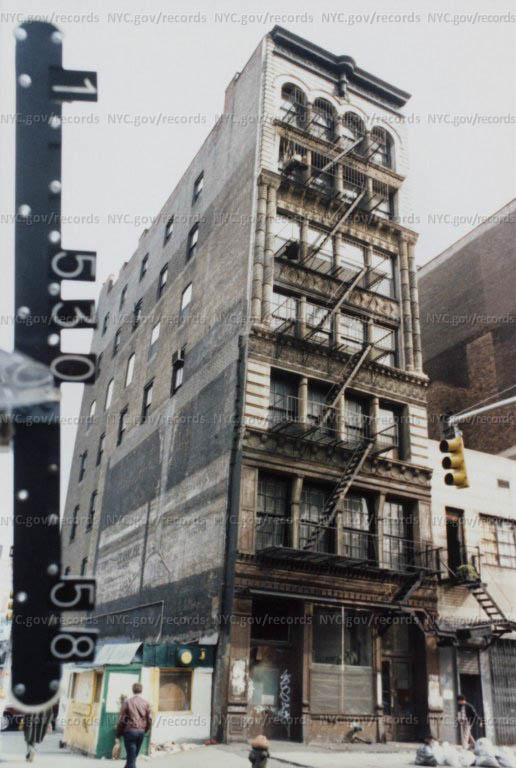
The city photographed every building for its tax records around 1940 and again in the 1980s. NYC Municipal Archives.
Written with AI from the source each entry cites, then fact-checked.
- 1839
Maria Banyer hosts the founding meeting of the Colored Home in her Bond Street house
An earlier marble-fronted mansion, built in 1824 for Knowles Taylor, stood on this lot. In the fall of 1839 its owner, Maria Banyer, a widow and daughter of Chief Justice John Jay, invited ten women to the house, and they founded the Colored Home that afternoon. The institution later stood on East 65th Street, just off Fifth Avenue. Banyer lived in the house until her death in 1856.
Source: Daytonian in Manhattan
- 1895
Cleverdon & Putzel replace a marble mansion with a Moorish-flavored loft at 20 Bond Street
The real estate investors Weil & Mayer commissioned Cleverdon & Putzel to design a store-and-loft building here in 1894-95, after buying the old mansion. The architects stacked styles in sections, with a cast-iron base, a Moorish Revival midsection of swirling arabesques and twisted columns, and a Romanesque Revival top. Weil & Mayer sold it in 1896.
Source: Daytonian in Manhattan
- 1899
The Protective League of Salt Water Fishermen is based at 20 Bond Street
In 1899 the building housed the Protective League of Salt Water Fishermen, an unlikely tenant, which adopted a platform to protect game fish in the Hudson River between Bedloe's Island and Tarrytown. Striped bass and other fish were then being netted to feed fertilizer plants. The league added pollution and the taking of undersized fish to its causes the next year.
Source: Daytonian in Manhattan
- 1975
Artists and loft dwellers move into the emptied factory floors at 20 Bond Street
Garment, hat, textile, thread and yarn firms, along with bookbinders and electrical suppliers, filled the building for most of the twentieth century. As manufacturing declined, loft dwellers were drawn to its vacant floors by the mid-1970s. The artist Chuck Close has had his studio here since the late 1980s, and the Landmarks Commission lists him among the most prominent tenants.
Further reading
- Cleverdon & Putzel's 1896 No. 20 Bond StreetDaytonian in Manhattan
Nearby
- 25 Great Jones Street2 entries
- Gene Frankel Theatre building24 Bond Street | 4 entries
- De Forest House26 Bond Street | 4 entries
- 363 Lafayette Street2 entries
- 28 Bond Street2 entries
- 27 Great Jones Street3 entries