Arbuckle Brothers warehouse (20 Jay Street)
20 Jay Street | also 19 Pearl Street, 22 John Street, 163 Plymouth Street | DUMBO | built 1909
Open on the map6 entries

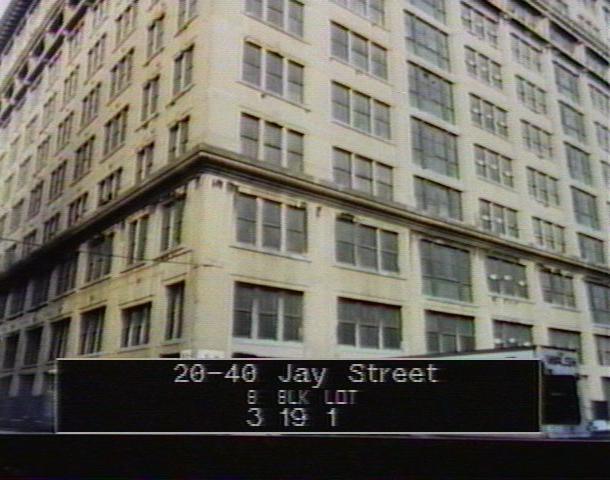
The city photographed every building for its tax records around 1940 and again in the 1980s. NYC Municipal Archives.
Written with AI from the source each entry cites, then fact-checked.
- 1887
Oil makers, boiler works and a vinegar works occupy the block before Arbuckle clears it
By 1887 the block between Jay, John, Plymouth and Pearl Streets held a linseed oil manufacturer (Campbell & Thayer), Smith Brothers Boiler Works, a kindling wood factory, the Empire Vinegar Works and a cooperage. John Arbuckle began buying property there in 1897 and owned the whole block by 1906. He cleared it but put up only a one-story building on part of the block, used for iron and syrup storage and bag drying.
“In 1887, industrial firms on the block were Campbell & Thayer, a linseed oil manufacturer; Smith Brothers Boiler Works; De Brun Kindling Wood Factory…”
- 1909
Arbuckle Brothers build a reinforced-concrete warehouse and freight station on the block
John Arbuckle applied for a permit for a ten-story warehouse in 1908, but that filing appears to have been superseded by a new one in 1909. In 1909-11 he erected a large reinforced-concrete warehouse and freight station here, with offices on the top floor. The landmarks commission says his friend Robert Gair, who had already built several concrete warehouses and factories on nearby blocks, was undoubtedly his inspiration.
“…in 1909-11, Arbuckle erected this monumental reinforced-concrete warehouse and freight station with offices on the top floor…”
- 1909
William Higginson designs an 11-story Industrial Neo-Classical warehouse filling the whole block
Architect William Higginson gave the Arbuckle building smooth concrete walls, a three-story base under a heavy cornice, and an 11-story height, with loading docks on the ground floor. It occupies the entire block, with four street fronts: Jay and Pearl Streets each show nine bays, while John and Plymouth Streets have twelve.
- 1946
Kinsey Distilling of Philadelphia gets a permit to use the warehouse for bonded whiskey
A 1945 alteration filed by William Higginson's son Clarence suggests part of the building was already a bonded liquor warehouse. The next year a permit went to the Kinsey Distilling Company of Philadelphia to use it as a bonded whiskey warehouse. Other companies had used the building after Arbuckle's death.
- 1948
Abraham & Straus, Brooklyn's leading department store, leases the building as its main warehouse
By 1948 Metropolitan Life Insurance Company owned the building and leased it to A&S. The department store kept its major warehouse facility here for several decades. A later Cushman & Wakefield brochure advertised the upper floors as the "Abraham & Straus Industrial Building," with sprinklers and two interior rail sidings.
- 2009
Four nonprofits sign leases at 20 Jay Street in the recently upgraded building
In the weeks before Brownstoner's March 2009 report, Equal Justice USA, Jewish Funds for Justice, Oasis Children's Services and the New York Foundation for the Arts all signed leases at 20 Jay Street. Brownstoner wondered whether the draw was the river views or easy access to the F train.
Source: brownstoner.com
Further reading
- Verso BooksWikipedia
Nearby
- Front & York85 Jay Street | 3 entries
- Thomson Meter Company Building100 Bridge Street | 6 entries
- Empire Stores55 Water Street | 7 entries
- 60 Water Street37 Front Street | 2 entries
- Jane's Carousel47 Water Street | 3 entries
- St. Ann's Warehouse (Tobacco Warehouse)45 Water Street | 4 entries