Fort Jay
201 Governors Island | also 201 Andes Road, 140 Carder Road | Governors Island | built 1900
Open on the map8 entries

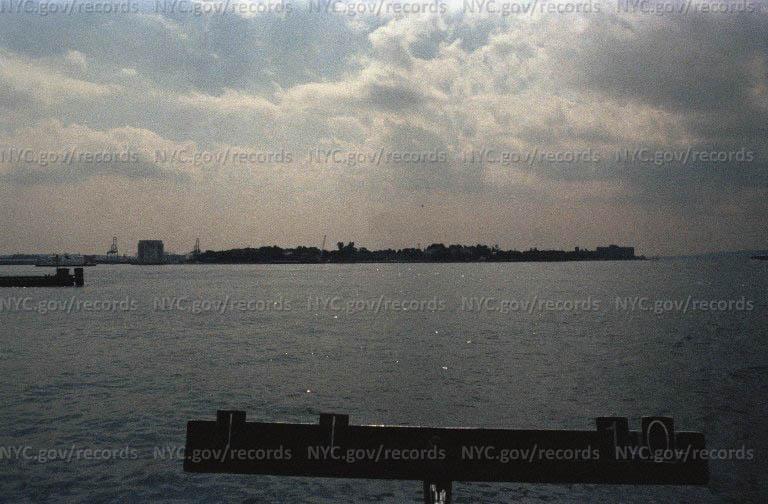
The city photographed every building for its tax records around 1940 and again in the 1980s. NYC Municipal Archives.
Written with AI from the source each entry cites, then fact-checked.
- 1776
Israel Putnam's gunners trade fire with two British warships from earthworks on the Fort Jay site
General Israel Putnam began an earthen fort on this high ground of what was then Nutten Island in April 1776 and mounted eight cannons on it. On July 12 the island's batteries fought HMS Phoenix and HMS Rose, and the damage made British commanders wary of entering the East River. Wikipedia credits that caution with helping Washington's retreat from Brooklyn that August. The Americans gave up the works in September, and the British occupied them until 1783. This was an earlier fortification on the site.
“…on July 12, 1776 the Nutten Island batteries engaged HMS Phoenix and HMS Rose.”
Source: Wikipedia
- 1796
Civilian volunteers, many from Columbia College, finish the first earthen Fort Jay
The first Fort Jay, an earthen work completed in 1796, was built on an inadequate government budget. Volunteers from the city's trade, social and educational societies did much of the labor, among them many students and professors of Columbia College. In 1952 Columbia's alumni gave the fort a plaque honoring their effort. This earlier fort on the site was torn down and rebuilt as a masonry fort in 1806-09.
- 1806
Jonathan Williams begins rebuilding Fort Jay in masonry, and the fort is renamed Fort Columbus
In 1806 the earthen fort began to be rebuilt in masonry under Lt. Col. Jonathan Williams, an American-trained engineer who knew French fort design from his travels and was now in charge of New York Harbor's defense. Forts of this Second American System were the first the country built under American rather than French supervision. The rebuilt fort took the name Fort Columbus; the LPC report links this to John Jay's fall from public favor over his treaty talks with Britain, though Wikipedia notes no document confirms the reason.
“…had by then fallen out of favor with the public due to his treaty negotiations with the British.”
- 1808
Williams reshapes the fort's north side so its guns cannot fire on the city
In an 1808 report, Williams said he had altered the north side of the new fort specifically so that its guns would not have a line of fire onto the city, and instead could cover the East River and the entrance to the North River. A ravelin with two retired casemated flanks was added on the north, while the other three sides each gained fourteen feet. With four bastions, the finished fort could mount 104 guns.
“…expressly to take off a Line of Fire which could not avoid the city and to form two Lines commanding the East…”
- 1861
Troops from Fort Columbus are secretly sent to relieve Fort Sumter, and the second try sparks war
Twice the Army sent soldiers and supplies out of Fort Columbus, quietly, to relieve the garrison under siege at Fort Sumter in Charleston. The first, ordered by President Buchanan, sailed on the steamship Star of the West and was fired on by Citadel cadets on January 9, 1861. The second left with new recruits on April 9, and South Carolina forces then shelled Sumter on April 12, beginning the Civil War.
“…with new Army recruits departing from Fort Columbus on April 9, 1861, also failed when it prompted South Carolina forces to fire on Fort Sumter…”
Source: Wikipedia
- 1878
Fort Columbus becomes headquarters of the Army's Division of the Atlantic
In 1878, as part of an Army-wide cost-cutting drive, nearly all of the Army's New York City offices left rented space in town and moved to Governors Island. Fort Columbus became the seat of the Atlantic division, later the Department of the East, which covered almost every Army activity east of the Mississippi. A command here ranked just behind the top Washington posts, and its generals included Winfield Scott Hancock, Oliver O. Howard, Nelson Miles and Arthur MacArthur.
“…making Fort Columbus the headquarters for the Division of the Atlantic and later the Department of the East.”
Source: Wikipedia
- 1904
Elihu Root restores the name Fort Jay as he leaves office as Secretary of War
Among his final acts as Secretary of War, in February 1904, Elihu Root gave the fort back its original name, Fort Jay. Root had hired McKim, Mead and White to plan an island growing from 60 to 172 acres on subway excavation and harbor dredging. The plan would have demolished every existing building except the three original fortifications and a new chapel, which showed Root's interest in keeping the old forts.
Source: Wikipedia
- 1942
Most of Fort Jay's Civil War cannons are barged to Pittsburgh and scrapped
Late in the Civil War the fort's armament was upgraded to nearly fifty 10-inch and 15-inch Rodman guns. In October 1942, during a World War II scrap drive, almost all of them were sent by barge to steel mills in Pittsburgh. Only four 10-inch guns and one 15-inch gun stayed behind, as ornaments at the east entrance gate and the north ravelin.
“…the remainder were shipped on barges to steel mills in Pittsburgh, Pennsylvania and scrapped for the war effort in October 1942.”
Source: Wikipedia
Nearby
- Fort Jay barracks202 Governors Island | 1 entry
- Building 204, Fort Jay204 Andes Road | 2 entries
- 203 Governors Island1 entry
- Fort Jay Barracks (Building 206)206 Governors Island | 5 entries
- Fort Columbus Barracks (Building 214)214 Governors Island | 2 entries
- 205 Governors Island1 entry