Magen David Synagogue
2017 67th Street | also 2021 67th Street | Bensonhurst | built 1921
Open on the map7 entries

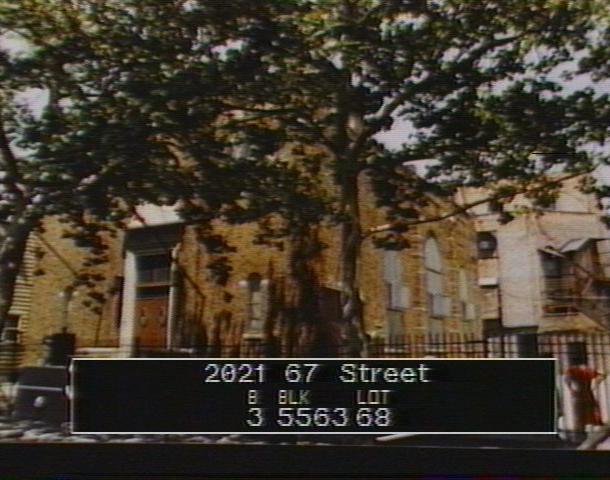
The city photographed every building for its tax records around 1940 and again in the 1980s. NYC Municipal Archives.
Written with AI from the source each entry cites, then fact-checked.
- 1919
Syrian Jews in Bensonhurst charter the Magen David Congregation
Some of the first Syrian Jews to settle in Bensonhurst founded the Magen David Congregation, which New York State chartered in 1919. Its first services were held in an Ashkenazic synagogue's basement on 66th Street, and the group soon bought a rowhouse nearby on the same street. A large wave of new immigrants from Syria around 1919 made a bigger building necessary.
- 1920
Asian and Salha Chalom buy a lot on 67th Street and give it to the congregation
The Chaloms, Asian and Salha, who belonged to the Syrian-Jewish community, bought a lot on 67th Street in October 1919 and donated it to the Magen David Congregation the next year, so that it could build a new synagogue. The congregation had already bought a rowhouse on 66th Street, and a large wave of new Syrian immigrants around 1919 had created a need for more space.
- 1921
The synagogue is dedicated on 67th Street
The cornerstone of the new synagogue was laid on September 12, 1920, and the building opened and was dedicated on December 21, 1921. The congregation asked for a sanctuary large enough for at least 500 worshipers, one that could serve for many years to come, and hired architect Maurice Courland to design it.
- 1921
Maurice Courland, a Palestine-born architect of synagogues, designs the building
The congregation hired Maurice Courland (1892-1957), who was born in Palestine, studied at the Ecole des Beaux-Arts in Paris, then at City College in New York. He had practiced in Buenos Aires before setting up in New York in 1919 and specialized in synagogues and schools. His other work included the Gates of Hope Temple on West 179th Street and the Free Synagogue of Flushing.
- 1921
Brick patterns, Egyptian motifs and a Star of David roof mark the neo-Romanesque design
Courland built the synagogue on a modern steel skeleton but clad it in patterned brick, with round-arched windows and projecting piers that suggest buttresses. Egyptian motifs over the main door and on stone panels near the roofline point to the Middle Eastern roots of the congregation and architect. Stone Tablets of the Law top the front roof and a bronze Star of David crowns the pyramidal roof.
“Egyptian motifs above the main door and on the stone panels near the roofline are suggestive of the Middle Eastern provenance of both the congregation and the architect.”
- 1940
As families move to Midwood and Gravesend, the synagogue remains the place for funerals
In the 1940s most Syrian Jews left Bensonhurst for larger houses in Midwood and Gravesend, where new synagogues were built. Magen David kept serving a small local group, and Rabbi Jacob Kassin, the community's chief rabbi, was long affiliated with it. Community members who no longer attend regularly still commonly hold their funerals in the building.
“…it is common for members of the Syrian-Jewish community who do not attend here regularly to have their funerals at this building.”
- 2001
The city designates the synagogue a landmark
The Landmarks Preservation Commission designated the synagogue a landmark on April 24, 2001, after a public hearing on February 13. Four speakers backed designation, including the congregation's president and a representative of the Historic Districts Council, and no one spoke against it. The commission also received a letter of support from the congregation.
“There were four speaker s in favor of designation, including the president and another representative of the congregation and a representative of the Historic Districts Council.”
Further reading
- Magen David Synagogue (Brooklyn)Wikipedia
Nearby
- Cafe Lily42 Avenue O | 2 entries
- Franklin Delano Roosevelt High School5800 20th Avenue | 2 entries
- Edith and Carl Marks Jewish Community House of Bensonhurst7802 Bay Parkway | 3 entries
- Magen David Yeshivah High School7801 Bay Parkway | 1 entry
- New Utrecht Reformed Church1831 84th Street | 5 entries
- Basilica of Regina Pacis1230 65th Street | 5 entries