James and Euphemia Russell House
208 West 11th Street | West Village | built 1856
Open on the map6 entries

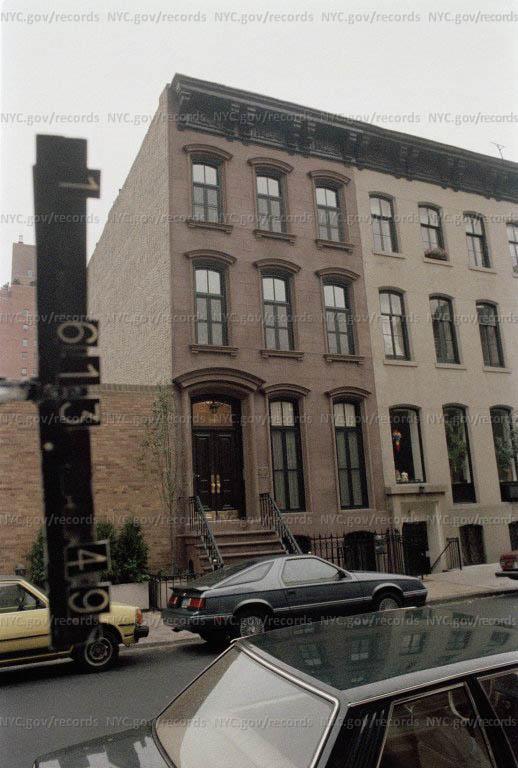
The city photographed every building for its tax records around 1940 and again in the 1980s. NYC Municipal Archives.
Written with AI from the source each entry cites, then fact-checked.
- 1856
Elisha Bloomer builds a row of four brownstone houses that includes 208 West 11th Street
In 1856 Elisha Bloomer, a merchant then living on Perry Street, builds four brownstone houses on what was Hammond Street, today 208 to 214 West 11th Street. A single bracketed cornice still ties the row together. By the time of the 1969 landmark report, numbers 208, 210 and 212 had entrances at basement level and numbers 210 and 212 had lost all the trim from their openings, while the corner house at 214 best showed the row's original look.
“This row of four dignified town houses was built in 1856 for Elisha Bloomer, a property owner of The Village.”
- 1868
Eighteen barrels of distilled spirits turn up at brewer James Russell's house
James Russell, who runs a brewery on Greenwich Avenue, lives at 208 West 11th Street with his wife Euphemia from 1864. On June 3, 1868 the New York Evening Express reports that a condemnation action was started once eighteen barrels of distilled spirits turned up at the address. Daytonian reads this as a sign that Russell had quietly branched into the liquor trade that year.
Source: Daytonian in Manhattan
- 1883
A violinist who gives lessons here is panned at Steinway Hall
Brothers Carl and Edward Hermann, a pianist and a violinist, give lessons from rooms at 208 West 11th Street in 1882. On January 22, 1883 Edward plays Beethoven's Violin Concerto at Steinway Hall with Carl accompanying. The reviewer for Music and Drama calls the performance deplorable, saying he cannot play in tune and shows no intelligence, and spares Carl only a passing mention.
Source: Daytonian in Manhattan
- 1892
Robert Mayhew, the Village's self-styled son of an admiral, dies after years as a local character
Robert Mayhew, a boarder under Harriet Goble, was by the Times's account the 8th Ward's most celebrated resident, known for a gray duster, a straw hat and pockets of candy for children. He lived by offering shopkeepers who blocked the sidewalk to settle matters with the authorities for a fee. Called the neighborhood's greatest liar, he claimed to be the son of an English admiral and a descendant of Robert the Bruce. He dies at St. Luke's Hospital on January 5, and papers in his room appear to back up his tale.
Source: Daytonian in Manhattan
- 1896
A boarder is found dead and her estate goes to her lawyer's clerk, not her sister
Margaret J. Seiley, 50, widow of an English army officer, takes a room at Harriet Goble's boarding house in July 1896 and lives on his $75 monthly pension. On November 11 she is found dead in her room, and newspapers report it as a suicide. Two days later The New York Times reports under the headline "Suicide Slights Relative" that she left her whole estate to a 45-year-old clerk in her lawyer's office rather than her sister, and her bank books showed assets of almost a quarter of a million dollars in current terms.
Source: Daytonian in Manhattan
- 1918
A boarder is among the first men jailed under the wartime Loafer Law
In July 1918 John Collins, a 35-year-old tenant at 208 West 11th Street, is arraigned under a new New York State law requiring every able-bodied man aged 18 to 50 who is not in military service to hold a useful job until the war ends. The Sun reports on July 11 that he is one of the first three men sentenced to jail under it. He receives three months in the workhouse.
Source: Daytonian in Manhattan
Further reading
- The 1856 James and Euphemia Russell House - 208 West 11th StreetDaytonian in Manhattan
- Then & Now photos: 208 West 11th StreetVillage Preservation: Greenwich Village Then & Now
Nearby
- 186 7th Avenue South1 entry
- 184 7th Avenue South1 entry
- 182 7th Avenue South1 entry
- Joseph Low House211 West 11th Street | 4 entries
- 215 West 11th Street6 entries
- Village Vanguard174 7th Avenue South | 12 entries