St. John the Baptist Church
209 West 30th Street | Midtown South | built 1920
Open on the map11 entries

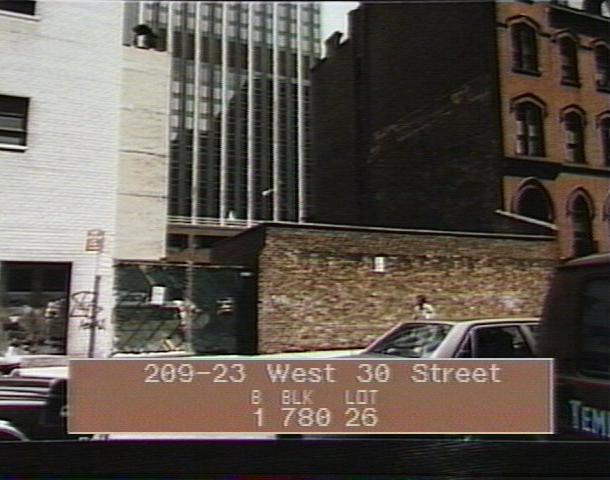
The city photographed every building for its tax records around 1940 and again in the 1980s. NYC Municipal Archives.
Written with AI from the source each entry cites, then fact-checked.
- 1840
St. John the Baptist parish is founded as Manhattan's second German Catholic church
German Catholic immigrants organized St. John the Baptist parish and dedicated a timber church at 125 West 30th Street on September 20, 1840, the second German Catholic parish founded in Manhattan. Conflict between trustees and clergy repeatedly disrupted the young congregation, and the original church burned to the ground on January 10, 1847.
Source: Daytonian in Manhattan
- 1871
Father Bonaventure Frey lays the cornerstone of the new French Gothic church
Father Bonaventure Frey set the cornerstone of the new church on June 11, 1871, with ceremonies The New York Times called the most imposing. Napoleon LeBrun, who had designed the cathedral in Philadelphia, was the architect. The Times forecast that the building would rank among the city's loveliest churches, in a pure French Gothic style. Frey's Capuchins had ended the quarrels that had troubled the parish.
Source: Daytonian in Manhattan
- 1872
Archbishop McCloskey dedicates the present French Gothic church
Capuchin friars, who had taken control of the fractious parish around 1870, built the present sandstone church at a cost of $175,000 to designs by architect Napoleon LeBrun. Archbishop John Cardinal McCloskey dedicated the 165-foot-long French Gothic Revival church on June 23, 1872, after its cornerstone was laid the previous year.
Source: Wikipedia
- 1891
The parish marks its golden jubilee
St. John the Baptist parish celebrated its golden jubilee on January 18, 1891, fifty years after German Catholic immigrants first organized the congregation. Prominent city and church officials attended the West 30th Street celebration, held in the French Gothic sanctuary consecrated two decades before.
Source: Daytonian in Manhattan
- 1895
A church fair opens with a rifle range in the basement and no mayor
The women of the parish opened a fair in the church hall on October 14, 1895, with a rifle range in the basement and prizes for the best scores. Mayor Strong was meant to open it but did not appear, so his private secretary Job Hedges stood in. Hedges explained that the mayor usually attended only gatherings of men, and a group of young women then urged him to take chances on various schemes. He took a few chances on a tea set in the mayor's name.
Source: Daytonian in Manhattan
- 1906
A fleeing gangster plows through the congregation as Sunday services end
On December 30, 1906, Razor Alley Gang member "Gorilla" Tom Cooney shot another gang member in the leg at a saloon, then commandeered a streetcar at gunpoint. He jumped off along West 30th Street just as services ended and ran into the crowd leaving the church. Parishioners Frank Flanagan and John Costello tried to hold him; Cooney clubbed one and punched the other. The delay let patrolman John O'Dea catch him.
Source: Daytonian in Manhattan
- 1913
A seamstress kneels paralyzed in prayer for 14 hours before anyone notices
Hannah Moran, a 50-year-old seamstress, knelt for her usual 7 a.m. prayers on November 10, 1913, and found she could not rise. Stricken with paralysis, she kept praying for hour after hour while other worshipers came and went. After 14 hours, women leaving an evening service found her faint from hunger. She was fed from the rectory and taken home by ambulance.
Source: Daytonian in Manhattan
- 1918
Brother Anselm hides in a confessional with a police whistle to catch a poor-box thief
In 1918 Brother Anselm, suspecting that someone was robbing the poor box, waited inside a confessional with a police whistle. He saw a bartender, Otto Feriendo, come in and try to rummage through the box. The friar blew the whistle and Feriendo was caught. According to the New-York Tribune, he was sentenced to sixty days in the workhouse.
Source: Daytonian in Manhattan
- 1922
Odell installs a three-manual organ in the church
In 1922 the J.H. & C.S. Odell company of Yonkers installed a new three-manual, 24-stop organ in the church. Odell repainted the existing organ case and set it roughly two feet nearer the tower room, and the front display pipes were repaired and gilded. The organ and choir gallery were destroyed in the fire of 1997.
Source: nycago.org
- 1997
A fire destroys the church's organ and stained glass
A fire tore through St. John the Baptist Church on January 10, 1997, destroying the organ and choir gallery and a number of statues and stained-glass windows. The parish, tended by Capuchin friars who had run it since around 1870, had the organ replaced and continued services in the West 30th Street sanctuary.
Source: Wikipedia
- 2026
The Capuchin friars leave the parish after nearly 175 years
The Capuchin Order had served the parish since 1852. The friars withdrew on June 30, 2026, with Michael Ramos as the last Capuchin pastor. Capuchins had taken over after Archbishop McCloskey suppressed the parish in 1870 amid years of disputes, and the parish merged with Holy Cross Church on West 42nd Street in 2015.
Source: Wikipedia
Further reading
- St. John the Baptist Church (Manhattan)Wikipedia
- St. John the Baptist Church -- No. 207 West 30th StreetDaytonian in Manhattan
Nearby
- Madison Square Garden390 7th Avenue | 4 entries
- Madison Square Garden4 Penn Plaza | 19 entries
- Church of St. Francis of Assisi135 West 31st Street | 7 entries
- The Cass Gilbert130 West 30th Street | 4 entries
- The Epic132 West 32nd Street | 3 entries
- One Penn Plaza250 West 34th Street | 9 entries