Umbrella House
21 Avenue C | East Village | built 1900
Open on the map8 entries

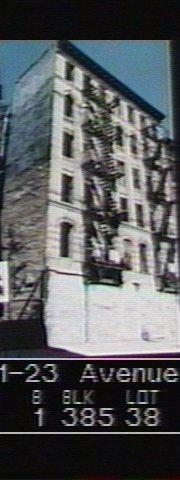
The city photographed every building for its tax records around 1940 and again in the 1980s. NYC Municipal Archives.
Written with AI from the source each entry cites, then fact-checked.
- 1899
Michael Bernstein designs the tenement, and the Nieburg brothers buy it a year later for $31,800
The building at 21-23 Avenue C was put up in 1899 by the architect Michael Bernstein under the Old Law tenement provisions. In 1900 it was bought by the brothers Benjamin and Louis Nieburg, one of them a button and paper peddler, for $31,800. Ownership then passed through several hands until 1976, when the owner, Benjamin Cohen, died.
Source: Wikipedia
- 1905
Hannah Felix, 23, dies in the airshaft on the eve of her wedding to another tenant
In 1905 a 23-year-old tenant named Hannah Felix threw herself down the building's airshaft the day before she was to marry another resident of the tenement. She lived with her mother-in-law. The census counted around 250 other people in the building at the time.
Source: bedfordandbowery.com
- 1921
Baker Louis Waldstreicher is caught in a union boycott of the bakery next door
After buying the building from his landlady, Peppy Riess, the 50-year-old baker Louis Waldstreicher ran a Jewish bakery on the ground floor. Two months later his neighbor Max Schlessinger tried to dismiss a worker without the approval of the Jewish Bakers Union, and the union began a year of picketing and opened a rival "spite store" next door selling bread and rolls at a loss. Samuel Untermeyer, lead counsel of the state's Lockwood Committee on trade unions, ordered the rival shop closed and its bakers arrested.
Source: bedfordandbowery.com
- 1976
The city takes over the building after its owner dies, and a nonprofit seals it with cinder blocks
Benjamin Cohen, the owner, died in 1976. The building was then sold to Lacer Realty and repossessed by the city, which handed it to Adopt-a-Building, an interfaith group. The group closed the building up and blocked the windows with cinder blocks. A staffer later explained that the aim was to hold off urban renewal and keep the housing intact so it could be turned over to the community.
“The building was given to Adopt-a-Building, an interfaith group, which sealed up the building and put cinder blocks in the window.”
Source: Wikipedia
- 1984
The documentary Urban Indians shows Native American squatters living in the building
A 1984 documentary by DCTV, Urban Indians, follows Joe Killsright, a Sioux man from South Dakota, and his community through daily life in New York, including the lack of heat, electricity and health care. The film shows the building as a squat occupied by Native Americans, and one of the squatters calls it a Native American survival house.
“…shows that the building was originally squatted by Native Americans.”
Source: Wikipedia
- 1988
Five people break in with a sledgehammer after the Tompkins Square riot, and a leaky roof names the house
Right after the Tompkins Square Park Riot, in November 1988, five people smashed in through the rear of the building with a sledgehammer. One was Steven Ashmore, 28, who studied art and worked as a go-go dancer; they picked the place because it was solidly built but neglected. The interior was derelict, with a leaking roof, so the squatters joked that they needed umbrellas indoors, which gave the building its name. After two weeks only three of the five remained.
Source: Wikipedia
- 1989
Squatter Siobhan Meow barricades herself in as a wrecking crew demolishes the building next door
In the spring of 1989 the building next door began to collapse and a demolition crew arrived with a wrecking ball, with police saying the squatters had to leave. Siobhan Meow, a transgender activist and artist, barricaded herself inside and hung a sign saying she was willing to die for her home. The lawyer Stanley Cohen then negotiated a deal letting the squatters stay, and the neighboring building was dismantled with crowbars rather than the claw.
Source: bedfordandbowery.com
- 2002
Umbrella House is one of eleven squats sold to their residents for $1 each, with help from UHAB
In 2002 the Urban Homesteading Assistance Board arranged the sale of eleven squatted buildings to their residents for one dollar apiece, and Umbrella House was one of them. UHAB helped convert it into a Housing Development Fund Corporation, and in 2010 it officially became a housing cooperative. It now holds 18 units and about 32 residents. By 2016 two local businesses rented its storefronts at market rates, and that income helps keep housing costs down for residents.
“…one of eleven squatted buildings sold to their residents for one dollar per buildings, in a deal organized by the Urban Homesteading Assistance Board…”
Source: Wikipedia
Further reading
- Umbrella HouseWikipedia
- 21 Avenue CVillage Preservation: East Village Building Blocks
Nearby
- 272 East 3rd Street1 entry
- 274 East 3rd Street1 entry
- 240 East 2nd Street1 entry
- 270 East 2nd Street2 entries
- Bracetti Plaza288 East 4th Street | 3 entries
- Nuyorican Poets Cafe236 East 3rd Street | 9 entries