Stuyvesant Fish House
21 Stuyvesant Street | East Village | built 1804
Open on the map10 entries

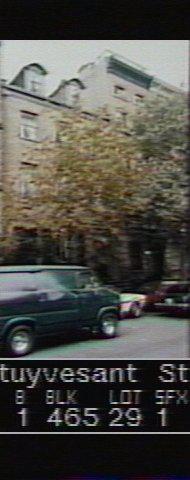
The city photographed every building for its tax records around 1940 and again in the 1980s. NYC Municipal Archives.
Written with AI from the source each entry cites, then fact-checked.
- 1804
A Federal-style house is built as a wedding gift for Elizabeth Stuyvesant and Nicholas Fish
This brick Federal house on Stuyvesant Street was built around 1804 as a wedding present for Elizabeth Stuyvesant and her husband, Nicholas Fish. It stayed in the Fish family until about 1900, became a rooming house, and was restored in the 1960s. Cooper Union now owns it as its president's residence.
Source: Wikipedia
- 1808
Hamilton Fish, later Secretary of State, is born in the house
Hamilton Fish was born here in 1808 and grew up in the house. He went on to serve as governor of New York and U.S. senator, and as Secretary of State under Ulysses S. Grant he negotiated the 1871 Treaty of Washington with Britain. The house became a city landmark in 1965 and a National Historic Landmark in 1975.
Source: Wikipedia
- 1811
The Stuyvesant family wins an exception to the new street grid
When the Commissioners' Plan lays out Manhattan's streets in a rectangular grid, it threatens to cut through the diagonal Stuyvesant Street and the family's property. The Stuyvesants secure a special dispensation preserving the angled street, leaving the house sitting at an angle to the surrounding blocks to this day.
Source: Daytonian in Manhattan
- 1824
The Marquis de Lafayette is received at the house
During his farewell tour of the twenty-four states, the Marquis de Lafayette is entertained at the Stuyvesant-Fish house, by then home to Elizabeth and Nicholas Fish and their teenage son Hamilton, the future U.S. secretary of state.
Source: Daytonian in Manhattan
- 1854
Elizabeth Stuyvesant Fish stays in the house until her death
Nicholas Fish dies in 1833, and his son Hamilton and Hamilton's wife stay on in the house until 1838. Elizabeth Stuyvesant Fish remains until her death in 1854. The family keeps owning the property until around the turn of the 20th century, but wealthy families are leaving the neighborhood by the Civil War and its renters become increasingly blue-collar.
Source: Daytonian in Manhattan
- 1861
A burglar breaks into the basement and steals a copper boiler
On January 27, 1861, while Daniel T. McFarland lives at the house, a burglar forces the basement door and steals a $50 copper boiler. Police officer Eagan nabs the man not far off, hauling the boiler away in a hand cart. The house had been home to Hamilton Fish until 1838.
Source: Daytonian in Manhattan
- 1964
F. Philip Geraci buys the house and begins restoring it
Advertising executive F. Philip Geraci purchases the deteriorated house, which had become a rooming house, for about $140,000. A restoration beginning in 1967 uses old photographs and surviving fragments to return the building to its 1804 appearance.
Source: Daytonian in Manhattan
- 1965
The city designates the Stuyvesant-Fish House a landmark as the Order of Lafayette plans to buy it
After a hearing on September 21, 1965, at which four witnesses including the owner's representative spoke for designation and none against, the Landmarks Preservation Commission designates the house. At the hearing Hamilton Fish, a former congressman who heads the Order of Lafayette as its President General, announces plans for his organization to buy the building and use part of it as a museum.
“…announced plans for his organization to purchase the building and to use a portion of it for a museum…”
- 1975
The house is declared a National Historic Landmark as the only surviving home of Secretary of State Hamilton Fish
In 1975 the house is declared a National Historic Landmark, because it is the sole surviving home of Hamilton Fish, Ulysses S. Grant's Secretary of State. Fish negotiated the 1871 Treaty of Washington with Britain, which opened an era of peace and cooperation between the two nations.
Source: Wikipedia
- 2001
George Campbell Jr. becomes the first Cooper Union president to live in the house
George Campbell Jr., who became Cooper Union's president the previous summer, moves in with his wife Mary Schmidt Campbell, dean of NYU's Tisch School of the Arts, and their youngest son. F. Philip Geraci, who had owned the house for 30 years after buying it as a rooming house and restoring it, had given it to the college for use as housing for its president.
Source: The New York Times
Further reading
- Hamilton Fish HouseWikipedia
- The 1803 Stuyvesant-Fish House - 21 Stuyvesant StreetDaytonian in Manhattan
- 21 Stuyvesant StreetVillage Preservation: East Village Building Blocks
Nearby
- 23 Stuyvesant Street3 entries
- Claudius B. Conant House25 Stuyvesant Street | 4 entries
- 27 Stuyvesant Street1 entry
- Raefle House112 East 10th Street | 4 entries
- 110 East 10th Street4 entries
- 29 Stuyvesant Street2 entries