New Amsterdam Theatre
214 West 42nd Street | also 219 West 41st Street | Times Square | built 1903
Open on the map14 entries

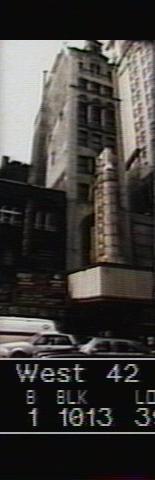
The city photographed every building for its tax records around 1940 and again in the 1980s. NYC Municipal Archives.
Written with AI from the source each entry cites, then fact-checked.
- 1902
Klaw and Erlanger buy a through-block lot to house their booking empire and two theaters
In 1902 the producing partners Marc Klaw and Abraham Erlanger bought land west of Seventh Avenue stretching from 41st Street to 42nd Street. They hired Herts & Tallant to design one structure holding two performing spaces plus a ten-story office tower for their booking and producing business. The partners had helped found the Theatrical Syndicate in 1896, which controlled bookings at more than 500 theaters across the country.
“It was in the role of producer that Klaw & Erlanger purchased, in 1902, a parcel of property west of Seventh Avenue and extending through the block between 41st and 42nd Streets…”
- 1903
The New Amsterdam opens with A Midsummer Night's Dream
Designed by Herts & Tallant with a Beaux-Arts exterior and Art Nouveau interiors, the New Amsterdam opened on October 26, 1903, with Shakespeare's A Midsummer Night's Dream. It began with serious drama before turning to musicals and revues.
Source: Wikipedia
- 1903
Construction of the New Amsterdam's facade is halted until aldermen change the rules
While the New Amsterdam was rising in 1903, the Manhattan Borough President stopped construction because the ornamental front would jut past the building line. Klaw and Erlanger claimed the neighboring owner, former Parks Commissioner Samuel McMillan, was behind the order because they had declined to buy his property. The Board of Aldermen then passed an ordinance allowing ornamental projections up to four feet, so the exterior could be finished as designed.
“The ornamental portions of the building were designed to project beyond the building line, and the Manhattan Borough President ordered work stopped.”
- 1903
Herts and Tallant give the New Amsterdam balconies with no columns blocking the view
The New Amsterdam's balconies were built on a cantilevered frame, so no pillars stood in the sightlines of patrons in the seats below. The commission's report says the idea is generally credited to Henry Herts. He and Hugh Tallant had met while studying at the Ecole des Beaux-Arts in Paris, and both were considered skilled in acoustics, Tallant having written extensively about it. Fireproof construction and large stages marked their theaters.
“…they pioneered the use of cantilever construction to create theater balconies without supporting pillars that would obstruct the vision…”
- 1907
The Merry Widow has its American premiere at the New Amsterdam
Franz Lehar's operetta The Merry Widow was first staged in America at the New Amsterdam in 1907. The theater had opened as a home for serious drama but soon became known as a musical-comedy house, with early attractions such as Forty-five Minutes from Broadway, starring Fay Templeton and Victor Moore, and Richard Mansfield in Richard III and Peer Gynt.
“…the American premiere of Franz Lehar's The Merry Widow in 1907…”
- 1913
The Ziegfeld Follies make the New Amsterdam their home
From 1913 to 1927 the theater was home to Florenz Ziegfeld Jr.'s Follies, with stars including Fanny Brice, Eddie Cantor and Will Rogers. Ziegfeld kept offices in the building and ran a rooftop theater called the Aerial Gardens. In 1937 the New Amsterdam became a movie house.
Source: Wikipedia
- 1914
Irving Berlin's first musical, Watch Your Step, opens with the Castles at the New Amsterdam
Among the productions the Landmarks Preservation Commission singles out from the theater's early years is Watch Your Step, which opened in 1914. It was the first musical by Irving Berlin, and its stars were the ballroom-dance team of Vernon and Irene Castle. The show reached a stage that Florenz Ziegfeld had already begun to use for his yearly Follies the year before.
“Irving Berlin's first musical, Watch Your Step, in 1914, starring the dance team of Vernon and Irene Castle.”
- 1915
Ziegfeld turns the theater's roof into a late-night dance venue, the Midnight Frolic
Ziegfeld had the rooftop Aerial Gardens, which opened in 1904, rebuilt with a 22,000-square-foot dance floor and a U-shaped balcony. In 1915 he began presenting Danse de Follies there, a racier late-night companion to the Follies that was later renamed the Midnight Frolic and doubled as a testing ground for promising young performers. Because it served alcohol, it closed in the early Prohibition years.
Source: Wikipedia
- 1920
Marilyn Miller makes her musical-comedy debut in Sally at the New Amsterdam
Sally opened at the New Amsterdam in 1920 as Marilyn Miller's musical-comedy debut and ran for 570 performances. Miller was one of the performers who appeared in Ziegfeld's Follies at the theater. The house filled the stretches between yearly editions of that revue with other productions, among them a run of Shakespeare plays staged in 1916 by Sir Herbert Tree and his company.
“The New Amsterdam staged Sally, where Marilyn Miller had her musical comedy debut, in 1920; it ran for 570 performances.”
Source: Wikipedia
- 1930
NBC converts the New Amsterdam's roof theater into a radio studio
In February 1930 NBC took over the rooftop theater and turned it into the NBC Times Square Studio, which opened the following month. The changes cost $70,000. The floor was soundproofed, and smaller studios were fitted into the 42nd Street office wing. The conversion arrived as the Depression was cutting attendance at Broadway houses, and the main auditorium below kept staging shows.
“NBC took over the roof theater in February 1930 and converted it into a broadcast studio, the NBC Times Square Studio…”
Source: Wikipedia
- 1937
The theater reopens as a movie house with the same play that launched it
A production of Othello in January 1937 closed out the New Amsterdam's run as a live Broadway house. The theater reopened on July 3, 1937 as a movie theater, its first screening a film version of A Midsummer Night's Dream, the same play that had opened the New Amsterdam back in 1903.
Source: Wikipedia
- 1979
New York City designates the New Amsterdam a landmark amid its decline
By the late 1970s the once-grand theater was showing martial-arts films to sparse audiences and falling into disrepair. The city's Landmarks Preservation Commission designated the New Amsterdam a landmark on October 23, 1979, and the building was added to the National Register of Historic Places the following January.
Source: Wikipedia
- 1993
Michael Eisner tours the decayed New Amsterdam and agrees to bring Disney to Times Square
Disney's own studies had warned that a Times Square venue would clash with the clean, gated image of its parks, and architect Robert A. M. Stern had been turned down before. In March 1993 Eisner changed his mind. Stern arranged a tour of the New Amsterdam, where Cora Cahan, president of New 42nd Street, walked Eisner through the ruined interior. He quickly agreed to renovate the theater, which reopened in 1997.
“Eisner quickly agreed to renovate the theater after New 42nd Street president Cora Cahan guided him through the dilapidated interior.”
Source: Wikipedia
- 1997
Disney reopens the restored theater with The Lion King
As 42nd Street declined, the New Amsterdam ended up screening kung fu films and closed in the early 1980s, though the city had made it a landmark in 1979. Disney leased and restored it between 1995 and 1997, and The Lion King opened there in November 1997, part of the street's revival.
Source: Wikipedia
Further reading
- New Amsterdam TheatreWikipedia
Nearby
- Candler Building221 West 41st Street | 8 entries
- 5 Times Square210 West 42nd Street | 8 entries
- Nederlander Theatre208 West 41st Street | 15 entries
- Times Square–42nd Street subway station234 West 42nd Street | 7 entries
- New Victory Theater209 West 42nd Street | 12 entries
- Times Square Theater217 West 42nd Street | 12 entries