Lyric Theatre
214 West 43rd Street | also 213 West 42nd Street | Times Square | built 1903
Open on the map13 entries

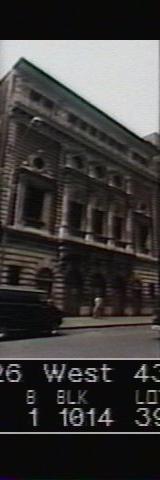
The city photographed every building for its tax records around 1940 and again in the 1980s. NYC Municipal Archives.
Written with AI from the source each entry cites, then fact-checked.
- 1903
The Brooklyn Bridge is closed so a single-piece steel proscenium arch can be hauled to the new Lyric
The original Lyric Theatre on this lot, designed by V. Hugo Koehler, had a huge proscenium arch cast as one piece of solid steel by the Milligan Brothers of Brooklyn. On March 27, 1903, the Brooklyn Bridge was closed so the arch could be carried slowly across the East River. Koehler also gave the house side corridors about twenty feet wide so audiences could empty quickly. This is an earlier building on the lot.
Source: Daytonian in Manhattan
- 1903
Richard Mansfield opens the first Lyric in Old Heidelberg, with a sealed private bathroom in his dressing room
The Lyric opened on October 12, 1903, with matinee idol Richard Mansfield in Old Heidelberg. The Shubert brothers had stepped in to lease the house after its planned opera school failed, and they signed Mansfield to a ten-year contract. He won changes to his dressing room, which had a private bathroom that, by contract, had to be kept sealed whenever he toured and another show played. This is an earlier building on the lot.
Source: Daytonian in Manhattan
- 1904
Douglas Fairbanks Sr. and Otis Skinner headline the new Lyric in January 1904
Within three months of Richard Mansfield opening the original Lyric, whose 43rd Street facade survives in today's theater, the house was booking other stars. Douglas Fairbanks Sr. and Wilton Lackaye opened in The Pit, and about a week later Otis Skinner took the role of Petruchio in The Taming of the Shrew. The Times reported on January 19, 1904 that applause kept interrupting Skinner before he could finish his lines.
Source: Daytonian in Manhattan
- 1918
Vitagraph's war film Over the Top plays the Lyric, with live talks by journalists and military men
In 1918 the Lyric began mixing live shows with motion pictures. By April 14 the Vitagraph feature Over the Top, starring Sergeant Arthur Guy Empey, was in its third week there, and its president, Albert E. Smith, said it would continue indefinitely. Audiences also heard live addresses by journalists and military men. This is an earlier building on the lot.
Source: Daytonian in Manhattan
- 1933
Run, Little Chillun! is the first Lyric's last try at live theater before it becomes a movie house
After the Great Depression ended its run of successes, the last of which was Cole Porter's Fifty Million Frenchmen, the Lyric made one final attempt at legitimate theater with Run, Little Chillun!, which opened on March 1, 1933. It then became a movie house. The Brandt brothers hoped to bring plays back in 1979, but the neighborhood's condition and Broadway's troubles stopped them. This is an earlier building on the lot.
Source: Daytonian in Manhattan
- 1997
The Ford Center is dedicated, built behind the old Lyric's preserved four-story facade
Livent, led by Garth Drabinsky, leased the old Lyric and Apollo theaters after New 42nd Street took them over in 1990, then had them demolished, saving only the Lyric's four-story facade and plaster decorations, which were restored off site. Beyer Blinder Belle and Peter Kofman designed a new 1,821-seat house, the Ford Center for the Performing Arts, dedicated on December 12, 1997. Its first musical, Ragtime, began previews two weeks later.
Source: Wikipedia
- 1997
Ford Motor Company agrees to put its name on the new Broadway theater
By December 1996 only the old Lyric's four-story facade was still standing, and the next month Ford announced it would sponsor the new house, to be called the Ford Center for the Performing Arts. The New York Daily News said no company had put its name on a Broadway theater, at least in most theatergoers' memory, since houses usually carried the names of actors or operators. Work moved quickly so the building could be finished by the end of 1997.
“…this was the first corporate sponsorship of a Broadway theater "in most theatergoers' memory", as Broadway theaters were typically named for actors or theater operators…”
Source: Wikipedia
- 1999
Producers announce Ragtime will close, citing the cost of its 160-person production
On October 28, 1999, producers said Ragtime would end its run at the Ford Center on January 16, 2000, after 26 previews and 861 performances. Livent, the show's original producer, had been taken over by SFX Entertainment, and the production employed more than 160 people on stage and backstage. The New York Times put its running cost at $530,000 a week. It had won four 1998 Tonys but lost Best Musical to The Lion King.
Source: playbill.com
- 2011
Spider-Man: Turn Off the Dark opens after the longest preview period in Broadway history
Spider-Man: Turn Off the Dark began previews at the renamed Foxwoods Theatre in December 2010 and opened for critics on June 14, 2011, following seven months of previews, the longest such stretch in Broadway history. The theater had stood unused for nearly two years while the show's financing and technical problems dragged on. In 2013 ATG paid $60 million to lease the house, and the musical closed in early 2014 after 1,066 performances.
“Spider-Man officially opened on June 14, 2011, after seven months of previews.”
Source: Wikipedia
- 2011
Spider-Man producers cancel three weeks of shows and move the opening to June 14
On March 11, 2011, lead producers Michael Cohl and Jeremiah J. Harris pushed the opening of Spider-Man: Turn Off the Dark at the Foxwoods Theatre to June 14. Performances from April 19 through May 11 were cancelled so the cast could rehearse script revisions overseen by newcomers including Roberto Aguirre-Sacasa and director Philip William McKinley. Julie Taymor was no longer to handle day-to-day duties.
Source: playbill.com
- 2013
Britain's Ambassador Theatre Group buys the Foxwoods, its first theater outside the UK
In May 2013 Ambassador Theatre Group, the largest theater owner-operator in Britain, acquired the roughly 2,000-seat Foxwoods through a subsidiary named Lyric Theatre LLC. The Guardian reported a price of $60 million to $70 million, and the previous owner was Live Nation Entertainment. Spider-Man: Turn Off the Dark kept playing, and the company held the right to rename the house.
Source: theguardian.com
- 2018
The Lyric is redecorated with Harry Potter motifs for Harry Potter and the Cursed Child
ATG renamed the former Foxwoods Theatre the Lyric in 2014, though the house still incorporates restored pieces of the old Lyric and Apollo theaters. For Harry Potter and the Cursed Child, which reached Broadway on March 16, 2018, it gained a Harry Potter carpet in the lobby and a Patronus room. Its seating was also reduced in a renovation.
Source: playbill.com
- 2018
Harry Potter and the Cursed Child sets a Broadway record for a play in its third week of previews
Variety reported on April 9, 2018 that Harry Potter and the Cursed Child grossed $2,138,859 from eight previews, the highest single-week total ever reported by a nonmusical on Broadway. It beat the $1.6 million taken in by Bryan Cranston's last week in All the Way in 2014. Even in the 1,600-seat Lyric, some 300 tickets per performance went for $40 or less.
Source: variety.com
Further reading
- Lyric Theatre (New York City, 1998)Wikipedia
- The 1903 Lyric Theater -- 213 West 42nd StreetDaytonian in Manhattan
Nearby
- New Victory Theater209 West 42nd Street | 12 entries
- Times Square Theater217 West 42nd Street | 12 entries
- 3 Times Square (Reuters Building)1481 Broadway | 12 entries
- Paramount Building1501 Broadway | 14 entries
- 5 Times Square210 West 42nd Street | 8 entries
- Former New York Times Building229 West 43rd Street | 15 entries