Bea Arthur Residence
222 East 13th Street | East Village | built 1910
Open on the map4 entries

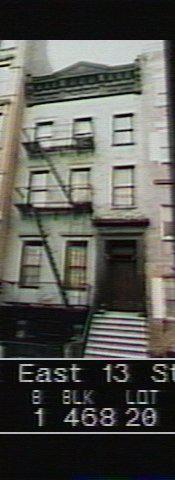
The city photographed every building for its tax records around 1940 and again in the 1980s. NYC Municipal Archives.
Written with AI from the source each entry cites, then fact-checked.
- 1855
The Tremain family moves into a new Greek Revival house on East 13th Street
Around 1855, banker Edwin Ruthven Tremain moves his family into the new 22-foot-wide house, then numbered 130 East 13th Street. When the Civil War begins, his sons Henry and Walter both go off to fight for the Union. Walter comes home ill with typhoid and dies in the house on Christmas Day 1862, aged 19. The address is renumbered 222 in 1867, and the family leaves around 1868.
Source: Daytonian in Manhattan
- 1864
Henry Tremain earns the Medal of Honor at the Battle of Resaca
Henry Edwin Tremain, a son of the family that lived in this house, earns the Medal of Honor at the Battle of Resaca in Georgia. As a major, he rides between two Union brigades that were mistakenly firing at each other and halts the shooting. After his discharge in 1866 he returns to the East 13th Street house to resume his law studies at Columbia.
Source: Daytonian in Manhattan
- 1922
A resident is arrested in a $250,000 platinum theft from a gunpowder plant
Emma Weller, who lives in a room here, is among four people captured for stealing $250,000 worth of platinum from the Old Hickory gunpowder plant near Nashville, Tennessee. The theft occurred in 1920 and came to light in New York when platinum began turning up in the city, prompting a joint investigation by the Justice Department and city police. The New York Times reports the arrests on March 29, 1922. The neighborhood has been declining since the end of World War I.
Source: Daytonian in Manhattan
- 2017
The house reopens as the Bea Arthur Residence for homeless LGBT youth
The house had been a notorious crack house in the 1980s and was firebombed in 1989, after which the city took it over and left it vacant for about two decades. A renovation by Magnusson Architecture & Planning, completed in late 2017, turns it into supportive housing for homeless LGBT young people in partnership with the Ali Forney Center. Part of the money comes from $300,000 that actress Bea Arthur left the center when she died in 2009. The dedication is marked with a cheesecake-cutting instead of a ribbon-cutting.
Source: Daytonian in Manhattan
Further reading
- The Edward R. Tremain House - 222 East 13th StreetDaytonian in Manhattan
- 222 East 13th StreetVillage Preservation: East Village Building Blocks
Nearby
- Edward C. Chapin House220 East 13th Street | 3 entries
- Robert H. Sherwood House206 East 13th Street | 3 entries
- 204 East 13th Street4 entries
- 87 3rd Avenue4 entries
- Kiehl's Since 1851109 3rd Avenue | 2 entries
- 226 East 14th Street2 entries