Transportation Building
225 Broadway | also 4 Barclay Street, 2 Barclay Street | Tribeca | built 1927
Open on the map6 entries

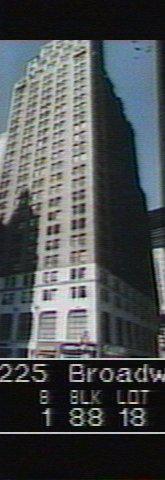
The city photographed every building for its tax records around 1940 and again in the 1980s. NYC Municipal Archives.
Written with AI from the source each entry cites, then fact-checked.
- 1836
The Astor House opens on the Broadway block between Barclay and Vesey streets
On June 1, 1836, John Jacob Astor's Astor House opened its doors on Broadway, taking the whole frontage from Barclay Street to Vesey Street, so its northern end stood at the corner where 225 Broadway is now. Isaiah Rogers designed the five-story Quincy granite hotel, which took four years and about $400,000 to build. It made its own gas for lighting and offered running water and 17 bathing rooms. A London newspaper praised its grandeur, though friends had warned Astor that the site was too far uptown.
Source: Daytonian in Manhattan
- 1852
Daniel Webster hears at the Astor House that he has lost the Whig nomination
Daniel Webster would stay at no other hotel, and manager Charles Stetson always vacated the best suite for him, though Webster never managed to pay for it. In 1852, at the Astor House, whose northern half stood on the site of today's 225 Broadway, he learned that Millard Fillmore had beaten him for the Whig candidacy. Still in his dressing gown and slippers, he told the delegates that his public life was ended.
Source: Daytonian in Manhattan
- 1861
President-elect Lincoln leaves the Astor House quietly by the Vesey Street stairs
Shortly after eight on the morning of February 20, 1861, Abraham Lincoln left the Astor House, whose northern half stood on the site of today's 225 Broadway, by carriage for breakfast with merchant Moses H. Grinnell. The New York Herald reported that a Mr. Troy, formerly the hotel's engineer and by then a Metropolitan policeman, got him out of the building. Lincoln and his friends walked quietly down the stairs of the Vesey Street entrance and were driven away, accompanied by Thurlow Weed and several others.
“Mr. Lincoln and friends were very quietly walkiug down the stairs of the Vesey street entrance, and ha 1 been driven off…”
Source: Library of Congress
- 1906
Old New York families dress in 1836 costume for a 'ghost dance' in the Astor House ballroom
In 1906 the Astor House, whose northern half stood where 225 Broadway is now, held a ball in its ballroom to celebrate its early days, and only families who had been in New York in the 1830s were invited. The Times described the invitation list as the old-line aristocracy and the tone as exclusive. Members of the Roosevelt, Hamilton, Fish, Clinton, de Peyster, Schuyler and Schermerhorn families were told to wear nothing later than costumes of 1836, the year the hotel opened.
Source: Daytonian in Manhattan
- 1913
The Astor House closes despite a 5,000-signature petition, and its furnishings go to auction
Notices posted on May 3, 1913 said the Astor House, whose northern half stood where 225 Broadway is now, would shut on May 29. Its two halves belonged to cousins who were at odds, William Waldorf Astor holding the north and Vincent Astor the south, and Vincent had already sold his share because subway excavation threatened the structure. On May 29 he received a petition with more than 5,000 signatures asking him to save it, but the bar and restaurant closed at midnight and every patron was turned out. An auction of the contents began June 10 and included a 108-year-old Chinese ivory bridal bed.
Source: Daytonian in Manhattan
- 1927
York & Sawyer's 44-story Transportation Building replaces the northern Astor House
After the southern part of the Astor House was razed in 1913, the northern part was torn down in 1926 to clear the corner of Broadway and Barclay Street. The 44-story Transportation Building, designed by York & Sawyer in the Renaissance Revival style with the setbacks that followed the 1916 zoning rules, rose there in 1927, facing the Woolworth Building across Barclay Street. Among its first tenants was Pace Institute, the forerunner of Pace University, which moved in during 1927 and stayed until the 1950s.
“The northern part was torn down in 1926 to make way for the Transportation Building.”
Source: Wikipedia
Further reading
- Transportation Building (Manhattan)Wikipedia
Nearby
- New York County Lawyers' Association Building14 Vesey Street | 4 entries
- Barclay Tower10 Barclay Street | 3 entries
- Woolworth Building233 Broadway | 22 entries
- New York Evening Post Building20 Vesey Street | 4 entries
- St. Peter's Church22 Barclay Street | 12 entries
- St. Paul's Chapel209 Broadway | 14 entries