225 Mott Street
Nolita | built 1900
Open on the map5 entries

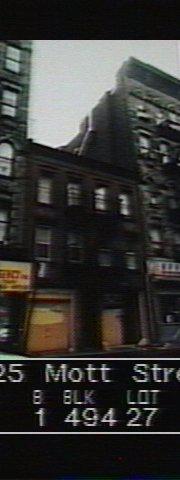
The city photographed every building for its tax records around 1940 and again in the 1980s. NYC Municipal Archives.
Written with AI from the source each entry cites, then fact-checked.
- 1886
William McKenna buys the old stable and sets up a blacksmith shop at street level
In 1860 a plan to open a slaughterhouse in this three-story stable was refused, as neighbors would not accept it. In December 1886 the estate of Henry Manron sold the property, which was still described as a tenement with stables. William McKenna paid $12,000, turned the ground floor into shops, took an apartment upstairs and moved his blacksmith business in. By 1904 he held the contract to shoe the horses of about six fire stations.
Source: Daytonian in Manhattan
- 1887
Harness maker Jacob Friedenthal, who works from the ground floor, is nominated for the State Assembly
Jacob Friedenthal, a harness maker, opened a shop at street level in 1887 and lived in the building with his wife. That October, anti-Tammany groups met to choose a candidate for the State Assembly after the Fusion nominee withdrew, and The New York Times reported Friedenthal's nomination. His shop was used as a polling place in 1909.
Source: Daytonian in Manhattan
- 1904
A widow sues her ground-floor neighbors over piano complaints, and a blacksmith hums to the judge
In 1904 Mrs. Teahan, a widow who had bought a piano on installments for her daughters, took the harness maker, the blacksmith and the butcher on the ground floor to court after they complained about the noise. McKenna the blacksmith hummed tunes for the judge to show which suited filing a horse's hoof, and the butcher said one song helped his chopping rhythm. The magistrate dismissed the case in March and told everyone to get along.
Source: Daytonian in Manhattan
- 1922
Sale of the building after 42 years prompts a reflection on neighborhood change
William McKenna sold the property in 1922, after owning it for 42 years, to Norman S. Reisenfeld and Joseph F. A. O'Donnell, who were real estate operators. The Real Estate Record and Builders' Guide took the occasion of the sale to describe how the Irish and Germans had been followed by Italians and then Jews. The building was assessed at $18,000 at the time of sale.
Source: Daytonian in Manhattan
- 1929
An undertaker has the upper floors converted to a family home and the ground floor to a garage
The building was soon sold to an undertaker, who in 1929 hired Brooklyn architect Ferdinand Gavigano to convert the upper floors into a single-family home. The ground floor became a garage approved for nine cars, two of them hearses, and only as an accessory to the undertaking business. By 2015 half of that garage space had become a retail store.
Source: Daytonian in Manhattan
Further reading
- Blacksmiths, Butchers and Piano Music -- No. 225 Mott StreetDaytonian in Manhattan
Nearby
- Old St. Patrick's Convent and Girls' School32 Prince Street | 5 entries
- Hook & Ladder Company No. 9 firehouse209 Elizabeth Street | 6 entries
- 211 Elizabeth211 Elizabeth Street | 3 entries
- Lombardi's Pizza205 Mott Street | 2 entries
- Rosanna Dunn House21 Prince Street | 3 entries
- Lombardi's Pizza32 Spring Street | 2 entries