238 President Street House
238 President Street | Carroll Gardens | built 1853
Open on the map8 entries

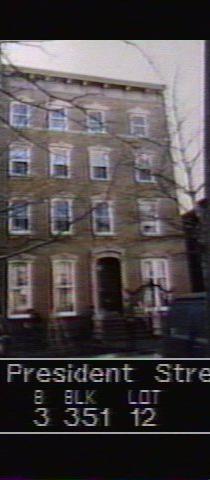
The city photographed every building for its tax records around 1940 and again in the 1980s. NYC Municipal Archives.
Written with AI from the source each entry cites, then fact-checked.
- 1855
Economist Edward Kellogg's pair of oversized mansions on President Street are finished
Edward Kellogg moved to Brooklyn after the Panic of 1837, made enough money in real estate to retire from business and then focused on writing about economics. He built this house and a matching sister house at 240 President Street, both definitely finished by 1855. Each was 38 feet wide, nearly twice the width of a typical Brooklyn row house. Directories show the Kelloggs living at number 240 by 1854; that house was demolished in 1897.
- 1864
Two owners advertise the house as a first-class mansion with frescoed parlors
Merchant Frederick Probst bought the house in January 1856 but had moved to Yonkers by 1860. In 1864 he and Edward Root Kellogg, the builder's son, ran joint New York Herald advertisements offering it and its sister house for sale, describing plate-glass windows and frescoed parlors and halls. In April of that year Probst sold this house to another merchant, William Barber, and it stayed a private home for three more decades.
“In April of 1864, Probst sold 238 President Street to another merchant, William Barber, and it would remain a private residence for the next three decades.”
- 1890
Five South Brooklyn girls hold a bazaar here for the Fresh Air Fund
Etta C. Shattuck, wife of a Lower Manhattan leather-goods partner, bought the house in the early 1880s and was involved in social causes. Under her ownership it hosted several fundraisers. In 1890 five girls from South Brooklyn organized a bazaar in the house to benefit the Fresh Air Fund.
- 1897
The house opens as the Brooklyn Deaconess Home of the Methodist Episcopal Church
Elmira Christian bought the house in February 1897 and transferred the deed to the Brooklyn Church Society two months later. Woodruff Leeming's renovation produced 23 rooms, not counting the parlor and dining room, and a new fourth-floor social space where deaconesses could entertain guests. Methodist dignitaries attended the dedication on November 9, 1897, where Bishop E. G. Andrews praised the home as a bright spot for Methodism and for Brooklyn. Mrs. Christian was too ill to attend, and a letter from her was read.
- 1897
Architect Woodruff Leeming turns the attic into a full fourth story
For the 1897 conversion, the young architect Woodruff Leeming enlarged the top floor from an attic into a full story. Born in Quincy, Illinois in 1870, he studied at MIT and the Ecole des Beaux-Arts and worked for Heins & LaFarge before opening his own Brooklyn practice in 1893, the year he designed the rectory at South Congregational Church. The Landmarks Commission believes his work likely included the fourth-story lintels and the classical metal cornice.
“…the house's top story was enlarged from an attic to a full story by the skilled young architect Woodruff Leeming…”
- 1909
Deaconesses living in the house make about 25,000 visits in a year
Roughly a dozen deaconesses usually lived at 238 President Street during its years as the Deaconess Home. By 1909 they were making around 25,000 visits a year, giving hundreds of families free food, clothing, bedding, furniture and medicine, visiting the sick and finding jobs for the unemployed. That year they carried nearly six tons of coal to people in need, delivering it pail by pail.
“By 1909, the deaconesses were making about 25,000 visits annually.”
- 1939
Rev. Alberto Baez, founder of First Spanish Methodist Church, moves his family in
By April 1939 the Rev. Alberto B. Baez, pastor of First Spanish Methodist Church, and his wife Thalia had moved here from Bay Ridge, and the house stayed their home until his retirement in 1961. The church's Christian Center, also based at the house, held a Christmas party in December 1939 for disadvantaged neighborhood children. Their son Albert became a physicist, and Albert's daughters are the musicians Joan Baez and Mimi Farina.
“It would remain their home until Alberto's retirement from the church in 1961, ten years after Thalia's death.”
- 1974
A state assemblyman and a television reporter convert the house into apartments
In 1973 or 1974 the house was sold to Carroll Gardens residents who, after two months, sold it to Michael L. Pesce, elected New York State Assemblyman from Carroll Gardens in 1972, and Rose Ann Scamardella, a reporter at ABC's Eyewitness News. They converted it to an apartment house. Scamardella became co-anchor in 1978, the first woman in that job at one of the city's three network stations. The building is still apartments today.
Nearby
- Hans S. Christian Memorial Kindergarten236 President Street | 7 entries
- St. Paul's Episcopal Church421 Clinton Street | 3 entries
- South Congregational Church Complex360 Court Street | 4 entries
- John Rankin House440 Clinton Street | 5 entries
- Cobble Hill Cinemas265 Court Street | 6 entries
- Kane Street Synagogue236 Kane Street | 6 entries