240 West 11th Street
West Village | built 1853
Open on the map7 entries

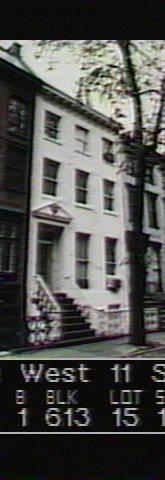
The city photographed every building for its tax records around 1940 and again in the 1980s. NYC Municipal Archives.
Written with AI from the source each entry cites, then fact-checked.
- 1856
Fish merchant David Magie Earl buys the house and raises a large family in it
After tenants rented the new 1853 house for its first years, it was advertised for sale in March 1856. David Magie Earl, who ran a fish market on Greenwich Street, bought it. He and his wife Jean Kellock, married in 1845, lived here with their children, and in 1870 Jean and two daughters spent New Year's Day receiving callers.
Source: Daytonian in Manhattan
- 1872
Jean Earl advertises for a lost locket after the Horace Greeley funeral service
Jean Earl went to Horace Greeley's memorial service at the Church of the Divine Paternity on December 4, 1872, and afterward discovered that her gold locket was gone. Her notice in the next day's New York Herald traced her route down Fifth Avenue to Sixth, described the turquoise and pearl oval with the monogram J.K.E., and promised a reward for its return here.
Source: Daytonian in Manhattan
- 1894
Tammany coroner William H. Dobbs moves in and falls gravely ill
Coroner William H. Dobbs, born on Perry Street in 1832, was a carpenter turned Tammany man. He moved here after the Earls, and in July 1894 the New York Herald reported him critically ill at his home with kidney trouble. He recovered, but died on February 11, 1903, at 71, after several weeks of influenza, and his funeral was held in the parlor.
Source: Daytonian in Manhattan
- 1896
Prowlers steal the coroner's canes and umbrellas from the front hall
On January 31, 1896, Coroner Dobbs heard someone in the parlor-floor hallway and assumed it was his wife. Intruders fled down the stoop with three canes and four umbrellas. Dobbs said the value did not matter, but he was upset to lose a cane his wife had given him thirty-five years before.
Source: Daytonian in Manhattan
- 1921
Writers Will and Inez Haynes Irwin buy the house and add a pedimented doorway
A March 13, 1921, item in the New York Times said Will Irwin and Inez Haynes Irwin planned to remodel the house and live in it. He was a journalist who made his name covering the 1906 San Francisco earthquake. She was a writer and suffragist on the National Woman's Party's advisory council. Their remodeling added a triangular pediment above the entrance.
Source: Daytonian in Manhattan
- 1939
Inez Haynes Irwin keeps a steel cabinet for her papers while chairing the World Center for Women's Archives
In 1939 Inez Haynes Irwin was board chair of the World Center for Women's Archives, an organization historian Mary R. Beard had founded in 1935. Interviewed at home by Emma Bugbee that November, she lamented that housecleaning discarded old letters and papers. Bugbee noted a stern steel cabinet at her home, beside old portraits and early American glass, for preserving her own records.
Source: Daytonian in Manhattan
- 2001
A 2001 renovation returns the stuccoed house to its 1853 look
Linus Scudder built the house in 1852-53 as an Italianate brick home with a bracketed cornice. After 1948 it was possibly modernized by removing the lintels and covering the front with stucco. In 2001 architects Hottenroth & Joseph carried out a substantial renovation that returned the house to its 1853 appearance, with new paneled doors in period style.
Source: Daytonian in Manhattan
Further reading
- The David and Jane Earl House - 240 West 11th StreetDaytonian in Manhattan
- Then & Now photos: 240 West 11th StreetVillage Preservation: Greenwich Village Then & Now
Nearby
- 238 West 11th Street6 entries
- Manhattan Seventh-Day Adventist Church232 West 11th Street | 7 entries
- 251 West 11th Street6 entries
- 43 Perry Street4 entries
- Ransom Parker House228 West 11th Street | 6 entries
- Converted Stable at 33 Perry Street33 Perry Street | 6 entries