Ethel Barrymore Theatre
243 West 47th Street | Times Square | built 1928
Open on the map18 entries

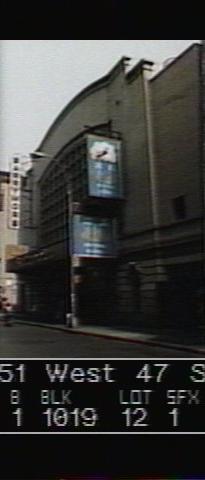
The city photographed every building for its tax records around 1940 and again in the 1980s. NYC Municipal Archives.
Written with AI from the source each entry cites, then fact-checked.
- 1927
The Shuberts agree to build a theater for Ethel Barrymore if she lets them manage her career
In 1927 the playwright Zoe Akins passed Ethel Barrymore a proposal from the Shubert brothers: if she let them handle her career, they would build a Broadway house and name it for her. Barrymore, who had been managed by the Frohman brothers for nearly all of her career, agreed. The Shuberts hired Herbert J. Krapp, and construction began in late April or early May 1928, when Barrymore was 48.
Source: Wikipedia
- 1928
The Shuberts commission their final theater from Herbert Krapp at the Barrymore
The Barrymore was the last theater the Shuberts commissioned from architect Herbert J. Krapp, in 1928. Krapp lived to 86 but apparently designed no theaters in the final four decades of his life, since the Depression glut made them an unprofitable specialty. He worked on as a building assessor for the city and turned to industrial design, patterning silver and flatware and designing mechanical couplings.
“In 1928 the Shuberts commissioned their final theater from Krapp... he apparently designed no theaters during the last forty years of his life.”
- 1928
Ethel Barrymore opens her namesake theater in The Kingdom of God to seven curtain calls
Opening night, with Barrymore starring in The Kingdom of God, drew producers Arthur Hopkins and Adolph Zukor, financier Otto Kahn, George Gershwin and Florenz Ziegfeld. The New York Times reported she bowed several times before she could speak her first lines and took seven curtain calls. She then thanked Lee Shubert for his courage in building the theater, and the Times called it a striking addition to Broadway.
- 1928
Krapp's facade pairs white brick with a Roman-inspired terra-cotta screen that echoes a proscenium
The theater has a facade wider than it is tall, in glazed white brick over a granite base and rusticated terra cotta made to look like limestone. Two large arched entrances flank a smaller doorway, and bronze brackets once held glass canopies. Above rises a big arched terra-cotta screen, drawn from Roman models, that echoes the shape of a proscenium. A stepped parapet and a shallow cornice finish the top.
- 1930
Ethel Barrymore's daughter makes her stage debut in a play that closes within three weeks
Ethel Barrymore returned to her namesake theater in the 1930-31 season in Scarlet Sister Mary, a play in which she appeared in blackface. The production also marked the stage debut of her daughter, Ethel Barrymore Colt. The novelty of seeing the famous actress in that makeup did not rescue it, and the show shut down inside three weeks.
“Scarlet Sister Mary, in which her daughter, Ethel Barrymore Colt, made her own stage debut... did not save the play from closing in three weeks.”
- 1932
Ethel Barrymore leaves Shubert management and her first name comes off the marquee
In 1932 Ethel Barrymore stopped performing under the Shuberts' management, the arrangement that had led the brothers to build the theater in her honor. They responded by removing her first name from the marquee, leaving the sign to read simply Barrymore. Her last appearance on that stage came in 1940, in An International Incident.
“Ethel Barrymore stopped performing under the Shuberts' management, prompting the brothers to remove her first name from the marquee.”
Source: Wikipedia
- 1932
Fred Astaire stars in Cole Porter's Gay Divorce, featuring "Night and Day"
Cole Porter's musical Gay Divorce came to the Barrymore in 1932 with Fred Astaire in the cast and the song "Night and Day" in its score. The show left while audiences still wanted it, giving up the stage to Design for Living, a Noel Coward play in which Coward appeared alongside Alfred Lunt and Lynn Fontanne.
“Cole Porter's Gay Divorce featured... Fred Astaire, as well as the song "Night and Day." The show closed long before the public had tired of it…”
- 1936
Clare Boothe Luce's all-female comedy The Women opens and runs 657 performances
The Women, a comedy by Clare Boothe Luce, opened at the Barrymore on December 26, 1936, after a tryout in Philadelphia earlier that month. Max Gordon produced it, Robert B. Sinclair directed, and Jo Mielziner designed the sets. No men appeared in the cast, which included Margalo Gillmore, Ilka Chase, Marjorie Main and Arlene Francis, and the play stayed for 657 performances.
Source: Wikipedia
- 1940
Gene Kelly and Vivienne Segal open in Rodgers and Hart's Pal Joey
Pal Joey, a musical with a book by John O'Hara and a score by Richard Rodgers and Lorenz Hart, opened at the Barrymore on Christmas Day 1940. Gene Kelly and Vivienne Segal headed the cast, with Van Johnson also in the company. The show settled in for 270 performances.
- 1945
Montgomery Clift appears at the Barrymore in Foxhole in the Parlor
Montgomery Clift took the stage at the Barrymore in Elsa Shelley's Foxhole in the Parlor, which opened on May 23, 1945, with Grace Coppin also in the cast. The play ran 45 performances. The landmark report lists it among the house's 1945 productions, alongside the 87-performance run of The Barretts of Wimpole Street with Katharine Cornell, which had opened in March.
- 1947
A Streetcar Named Desire opens with Marlon Brando and Jessica Tandy and runs 855 performances
Tennessee Williams's A Streetcar Named Desire, produced by Irene Mayer Selznick, opened at the Barrymore in 1947 with Marlon Brando, Kim Hunter, Karl Malden and Jessica Tandy. It ran for 855 performances over the next two years. It was one of several plays Selznick produced at the theater.
Source: Wikipedia
- 1953
Tea and Sympathy opens with Deborah Kerr and John Kerr and reaches 712 performances
Robert Anderson's Tea and Sympathy opened at the Barrymore on September 30, 1953, with Deborah Kerr and John Kerr in the leading roles. It proved a durable hit: it reached 712 performances in total, and on February 7, 1955 it moved to the Longacre Theatre to continue its run there.
- 1959
A Raisin in the Sun opens at the Barrymore, and the theater dims its lights when Ethel Barrymore dies that June
A Raisin in the Sun began its run in March 1959 and stayed for seven months, 530 performances in all. In June of that year Ethel Barrymore died, and the theater's lights were dimmed in her honor. A Majority of One, starring Gertrude Berg and Cedric Hardwicke, moved in later in 1959 and ran into June 1960.
Source: Wikipedia
- 1971
Melvin Van Peebles puts two of his musicals on the Barrymore stage in seven months
Melvin Van Peebles brought two of his own shows to the Barrymore within about seven months. Ain't Supposed to Die a Natural Death opened on October 20, 1971 and played 325 performances. Don't Play Us Cheap followed on May 16, 1972, with Esther Rolle and Mabel King in the cast, and it ran for 164 performances.
- 1981
Katharine Hepburn stars in The West Side Waltz after Gilda Radner's Lunch Hour
Katharine Hepburn and Dorothy Loudon headed the cast of Ernest Thompson's The West Side Waltz, which opened at the Barrymore on November 19, 1981, and ran 128 performances. A year earlier the same stage had hosted Gilda Radner in Jean Kerr's Lunch Hour, with Sam Waterston, which opened on November 11, 1980 and ran 263 performances.
- 1987
The Landmarks Commission designates the Barrymore after 81 witnesses speak in favor
The city's Landmarks Preservation Commission designated the Barrymore Theater on November 4, 1987, five years after it first took up the case. At hearings on June 14 and 15, 1982, continued to October 19, eighty-one witnesses spoke or sent statements in favor and two opposed. The owner attended with representatives and said he had not yet formed an opinion.
“Eighty-one witnesses spoke or had statements read into the record in favor of designation. Two witnesses spoke in opposition to designation.”
- 2021
The Barrymore reopens with Waitress after more than seventeen months dark
The Barrymore went dark on March 12, 2020, when the pandemic closed Broadway, a few days before The Inheritance was due to finish its run. The theater stayed closed for more than seventeen months. A limited revival of Waitress brought audiences back in September 2021 and played through the end of that year.
“…the Barrymore temporarily closed on March 12, 2020... The theater reopened on September 4, 2021, with a limited revival of Waitress…”
Source: Wikipedia
- 2025
Othello takes in $2.8 million over eight performances, an all-time Broadway box-office record
A revival of Othello opened at the Barrymore in March 2025 and ran for three months. Over eight performances it took in $2,818,297 in ticket sales, the highest total any Broadway theater has recorded, helped by high average ticket prices. The theater's own earlier records included Waitress's single-performance house record in September 2021 and El Mago Pop's $2.717 million week in 2023.
Source: Wikipedia
Further reading
- Ethel Barrymore TheatreWikipedia
Nearby
- Longacre Theatre220 West 48th Street | 13 entries
- Samuel J. Friedman Theatre261 West 47th Street | 14 entries
- Lena Horne Theatre256 West 47th Street | 13 entries
- Hotel Edison221 West 46th Street | 7 entries
- Walter Kerr Theatre219 West 48th Street | 12 entries
- Morgan Stanley Building1585 Broadway | 12 entries