Sunshine Hotel
245 Bowery | Lower East Side | built 1900
Open on the map10 entries

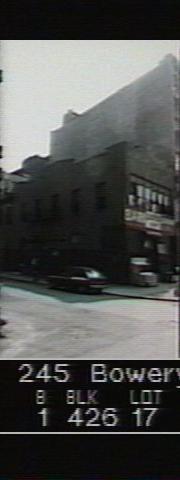
The city photographed every building for its tax records around 1940 and again in the 1980s. NYC Municipal Archives.
Written with AI from the source each entry cites, then fact-checked.
- 1872
A pre-1830 townhouse at 245 Bowery is raised to four stories and houses a German Exchange Bank
A survey of the Bowery lists 245 as a brick townhouse of three and a half stories that predates 1830. It was altered to four stories in 1872, the year the survey ties to a German Exchange Bank, and its cast-iron pilasters from that work remain on the ground floor. Gunpowder was sold there in the 1850s, and a photo gallery later occupied the fourth floor. The upper two stories came down in 1935.
Source: National Register nomination
- 1922
Broom-maker Frank Mazzara opens the Sunshine Hotel on the Bowery
Frank Mazzara, a broom-maker, entered the lodging business after his brother-in-law Mike Gatto, who ran the Andrews Hotel. He bought the building at 241 Bowery in 1922 and opened the Sunshine, which eventually spread across the upper floors of 241, 243 and 245. Mazzara gave the front a pale yellow brick Art Deco face. A night's stay originally cost ten cents.
Source: Wikipedia
- 1949
NAACP investigators find the Sunshine Hotel turning away Black lodgers
Carl Mazzara took over the hotel from his father in 1946. The NAACP's New York branch investigated the flophouses of the Bowery in 1949 and concluded that the Sunshine was discriminating, refusing service to Black people.
“In 1949, the New York branch of the NAACP investigated Bowery hotels and found that the Sunshine Hotel was discriminating against black people by refusing them service.”
Source: Wikipedia
- 1970
Hotel manager James Adair is shot dead over a pack of cigarettes
James Adair, who was managing the Sunshine Hotel in 1970, declined to sell cigarettes to a man on the premises. The man shot him, and Adair died on the hotel's second floor, where the lobby sat.
“In 1970 James Adair, the hotel manager at the time, refused to sell cigarettes to a man and was then shot to death on the hotel's second floor.”
Source: Wikipedia
- 1984
Carl Mazzara retires and sells the Sunshine to a restaurant-supply family
After running the flophouse for 38 years, Carl Mazzara retired in 1984. He sold it to the Bari family, whose business was restaurant supply, and the Baris used part of the hotel to store pizza ovens from that business.
“Carl retired in 1984 and sold the hotel to the Bari family, who were in the restaurant supply business, who used part of the hotel to store their business's pizza ovens.”
Source: Wikipedia
- 1998
NPR airs a radio documentary on the Sunshine Hotel, narrated by its manager
David Isay and Stacy Abramson spent a year on the piece, which ran on All Things Considered on September 18, 1998. Isay cut 70 hours of tape to under half an hour. Manager Nathan Smith, on the job for 16 years, narrated for a hotel of about 125 residents, where rooms were wire-topped cubicles four feet by six and rates had reached $10 a night. It won a Prix Italia in 1999.
“David Isay and Stacy Abramson spent a year creating an All Things Considered segment on the Sunshine Hotel which aired on September 18, 1998.”
Source: Wikipedia
- 2001
Michael Dominic's feature documentary Sunshine Hotel is released
Filmmaker Michael Dominic, who worked on the Bowery and knew several flophouse residents, began shooting inside the hotel in 1999 and finished the film in 2001. It was his first documentary and, like the radio piece, was narrated by manager Nathan Smith, who died of cancer in 2002. The film won numerous festival awards and ran for two years on the Sundance Channel.
Source: Wikipedia
- 2004
Julianne Swartz links the hotel's second floor to the sidewalk with a yellow tube
Around July 2004, artist Julianne Swartz ran a yellow PVC tube from the Sunshine's second floor down to a platform on the sidewalk. Fitted with mirrors, it let passersby look and talk through to residents. The piece, called Can You Hear Me?, was part of an exhibition on the Bowery staged ahead of the New Museum's arrival, and residents were split on it.
“Julianne Swartz created an art installation titled "Can You Hear Me?" that used a yellow PVC tube to connect the second floor of the Sunshine Hotel to a platform on the sidewalk.”
Source: Wikipedia
- 2008
City housing agency rules the Sunshine Hotel was harassing residents to push them out
In August 2004 owner Anton Bari began buying out residents and turning away new guests, and the roughly 44 people living there had dropped below 30 by 2008. On June 30, 2008, the Department of Housing Preservation and Development, a city agency, found that the hotel was harassing tenants. The city gave three more years before developers could use the site.
Source: Wikipedia
- 2011
The Bowery Diner takes over a ground floor as the flophouse shrinks
In 2011 the Bowery Diner was created on the ground floor of a single building among the hotel's three, and the plywood Sunshine signage came down. In August 2014 work began to convert the upper two floors of the building into offices, while 30 to 40 residents stayed in neighboring 239 Bowery. After the ground floor at 245 sat dormant from 2019, the bar chain Veloce applied in 2022 to expand into it.
“…workers converted the first floor of one of the hotel's three buildings into the Bowery Diner. In August 2014, Roseann Carone started converting the building's two upper floors into offices.”
Source: Wikipedia
Further reading
- Sunshine HotelWikipedia
Nearby
- Sunshine Hotel241 Bowery | 3 entries
- New Museum235 Bowery | 10 entries
- 11 Stanton Street1 entry
- 205 Chrystie Street6 entries
- The Bowery Mission227 Bowery | 5 entries
- Mike Lyons' Restaurant building261 Bowery | 4 entries