Emma D. Barr House
245 Waverly Place | West Village | built 1888
Open on the map5 entries

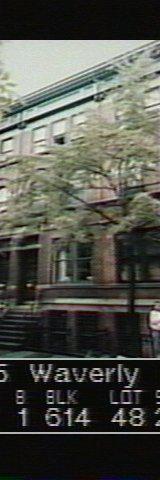
The city photographed every building for its tax records around 1940 and again in the 1980s. NYC Municipal Archives.
Written with AI from the source each entry cites, then fact-checked.
- 1888
William B. Tuthill designs a Romanesque Revival row for John C. Barr at 243-247 Waverly Place
John C. Barr built three town houses in 1888, with 245 in the middle, to designs by William B. Tuthill. The Landmarks Preservation Commission calls the row an outstanding example of Romanesque Revival work in finish brick. Its high stoops keep their twisted ironwork, the nine-paneled doors have iron grilles, and the round-arched second-story windows are emphasized by radial brickwork. The doorways of 245 and 247 are paired.
“This handsome row of three town houses, built in 1888 for John C. Barr, was designed by the noted architect William B. Tuthill.”
- 1890
James Irving Barr dies of pneumonia at 245 Waverly Place just before his wedding
James Irving Barr, an assistant cashier at Chemical Bank, lived at 245 with his widowed mother, Emma D. Barr. At 37 he became engaged and rented a furnished house for a wedding set for April 24, 1890. Two days before the ceremony he left the bank early feeling ill, went home to 245 Waverly Place, and died of pneumonia.
Source: Daytonian in Manhattan
- 1899
A good Samaritan is jailed along with the drunk boarder of 245 Waverly Place he helped
On September 21, 1899, William Van Tassel, a 70-year-old iron dealer boarding at 245 Waverly Place, came home from a Hoboken Turtle Club picnic at Kingsbridge. Around midnight he stepped off an Eighth Avenue streetcar drunk and nearly helpless, carrying $1,000 in cash and diamond jewelry. A friend, John Ransom, put him in a cab, but Policeman Van Huskirk suspected a robbery and arrested both men.
Source: Daytonian in Manhattan
- 1951
Printmaker Stanley William Hayter, founder of Atelier 17, lives at 245 Waverly Place
By the early 1950s the English-born painter and printmaker Stanley William Hayter lived at 245 Waverly Place. He had founded the Atelier 17 studio and school in Paris in 1927. Among those linked to the workshop were Chagall, Pollock, Rothko, Calder and Picasso.
Source: Daytonian in Manhattan
- 1981
Yazoo Records, based at 245 Waverly Place, issues blues trading cards drawn by R. Crumb
The Yazoo Record Co., a label founded in the mid-1960s by Nick Perls to specialize in blues, country and jazz, worked from 245 Waverly Place from about 1975 until about 1985. The building was divided into ten apartments in 1977. In April 1981 the label issued a set of 36 blues trading cards, slightly larger than baseball cards, drawn by the cartoonist R. Crumb of Zap Comics, each with a short biography on the back.
Source: Daytonian in Manhattan
Further reading
- The 1888 Emma D. Barr House - 245 Waverly PlaceDaytonian in Manhattan
- Then & Now photos: 245 Waverly PlaceVillage Preservation: Greenwich Village Then & Now
Nearby
- 241 Waverly Place4 entries
- William J. Van Arsdale House10 Bank Street | 5 entries
- 14 Bank Street1 entry
- 6 Bank Street1 entry
- 215 West 11th Street6 entries
- Joseph Low House211 West 11th Street | 4 entries