Church of the Transfiguration
25 Mott Street | also 108 Mosco Street, 23 Mott Street | Chinatown | built 1915
Open on the map10 entries

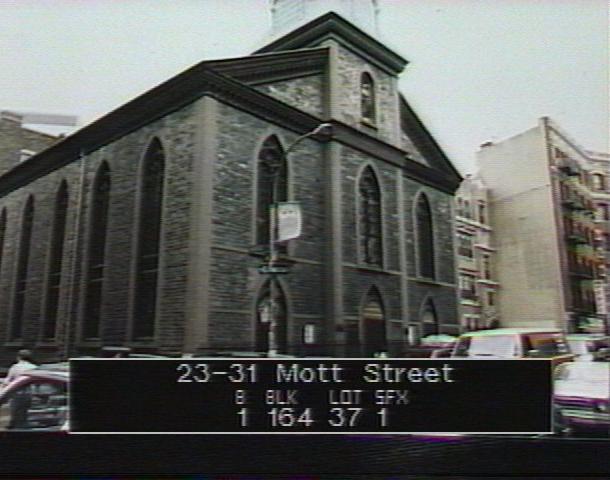
The city photographed every building for its tax records around 1940 and again in the 1980s. NYC Municipal Archives.
Written with AI from the source each entry cites, then fact-checked.
- 1801
English Lutherans build Zion Church on the site
English-speaking Lutherans who had split from a German-speaking downtown congregation built this Georgian fieldstone church in 1801 at a cost of $15,000. Within six years the congregation left Lutheranism altogether, reorganizing as an Episcopal parish.
Source: Daytonian in Manhattan
- 1815
A fire guts the church and destroys 35 neighboring houses
A fire on August 31, 1815 swept through the neighborhood, gutting the church and destroying 35 homes. The rector's costly rebuilding attempt ruined him financially and he resigned in 1817; the property was sold at auction and merchant Peter Lorillard bought it, promising to hold it until friends of the church could finish the rebuilding. Six congregants donated and Trinity Church lent $10,000, and Bishop Hobart dedicated the rebuilt church on November 16, 1818.
Source: Daytonian in Manhattan
- 1853
The Catholic Diocese buys the church for the Transfiguration parish
As the Episcopal congregation moved uptown in 1853, judging the neighborhood's revival "a hopeless undertaking," the Roman Catholic Diocese of New York bought the building for the Parish of the Transfiguration, which Cuban-born priest Félix Varela had founded a generation earlier to serve the area's poor.
Source: Daytonian in Manhattan
- 1871
A 1,500-pound bell for the new tower is blessed before a ticketed crowd
On February 13, 1871, the archbishop blessed a 1,500-pound bell for the church's new bell tower. The bell was hoisted on a derrick in front of the altar, and despite bad weather the church was packed, with admission by ticket at fifty cents. The Times reported that the ceremony was long. The tower itself had been designed three years earlier by Henry Engelbert, who had recently rebuilt the old St. Patrick's Cathedral following a fire.
Source: Daytonian in Manhattan
- 1882
A new Carrara marble altar is consecrated, resembling the one at St. Ann's on East 12th Street
In 1882 the parish consecrated a new altar of Carrara marble. The Times said its general look matched the altar at St. Ann's Church on East Twelfth Street. A niche at the front held a marble figure of the Savior lying in the tomb, flanked by carved scenes from his life, and the canopy over the tabernacle rested on four columns of mottled red Vermont marble, topped by a crucifix.
Source: Daytonian in Manhattan
- 1899
The pastor asks a city board to move Chinese residents out of the neighborhood, and the effort fails
In March 1899 Rev. Dr. McLoughlin of Transfiguration told the Board of Local Improvements of the Tenth District that he looked after more than 5,000 parishioners, mainly English-speaking and Italian, and asked that Chinese residents be moved elsewhere, condemning Pell and Doyers Streets. His appeal did not work: the Chinese stayed, and a few years later the Salesian Society took charge of the parish and began seeking ways to include them.
Source: Daytonian in Manhattan
- 1902
Father Ernest Coppo ends the segregation of Italian parishioners
Through the 1890s the parish's Irish leadership had confined Italian immigrant worshippers to the church basement. When Father Ernest Coppo became pastor in 1902, he ended the practice and allowed Italian parishioners to worship upstairs alongside the Irish congregation.
Source: Daytonian in Manhattan
- 1949
The Maryknoll Fathers take over the parish from the Salesians
The Salesian Fathers of Don Bosco served the parish from 1902 until 1949, when the Maryknoll Fathers took over. Maryknoll's order has roots in overseas missions, particularly to China, and its priests and brothers staffed the parish until 2018. Among its later pastors was Bishop John W. Comber, a Maryknoll missionary who had served in Fushun and led the parish from 1967 to 1969.
Source: Wikipedia
- 1966
The Landmarks Preservation Commission designates the church, ending a hearing with no opposition
After a public hearing on October 19, 1965, at which one witness spoke for designation and none against, the Landmarks Preservation Commission designated the church a city landmark on February 1, 1966, along with its tax lot, Block 164, Lot 37. It called the building a fine Georgian-Gothic example, a good expression of masonry construction and one of the finest ecclesiastical buildings of its time.
“…the Church of the Transfiguration is a fine example of Georgian-Gothic architecture, that it represents a good expression of masonry construction…”
- 2015
The merged Parish of St. Joseph/St. James is folded into the Church of the Transfiguration
In 2015 the Church of the Transfiguration absorbed the combined Parish of St. Joseph/St. James. Those two parishes had themselves joined in 2007, when the 1835 parish of St. James, on James Street, merged with nearby St. Joseph. The Church of the Transfiguration stands at 25 Mott Street, at the corner of Mosco Street.
Source: Wikipedia
Further reading
- Church of the Transfiguration, Roman Catholic (Manhattan)Wikipedia
- The 1801 Catholic Church of the Transfiguration -- 25 Mott StreetDaytonian in Manhattan
Nearby
- Church of the Transfiguration29 Mott Street | 4 entries
- Banca Italia Building28 Mulberry Street | 4 entries
- Quong Yuen Shing & Co. (32 Mott Street General Store)32 Mott Street | 3 entries
- Moo Tie Temple and Chinatown post office13 Mott Street | 1 entry
- 11 Mott Street1 entry
- Chung Wah Gong Shaw (former CCBA headquarters)16 Mott Street | 4 entries