Museum of Modern Art
25 West 53rd Street | also 26 West 54th Street | Midtown | built 1980
Open on the map16 entries

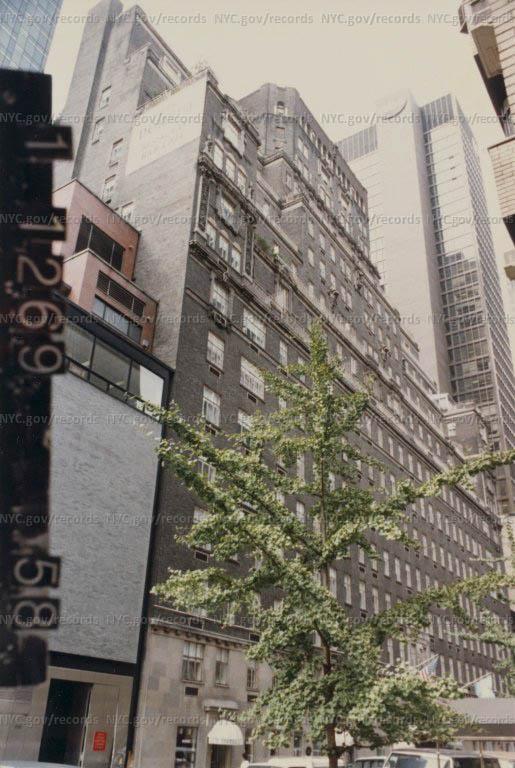
The city photographed every building for its tax records around 1940 and again in the 1980s. NYC Municipal Archives.
Written with AI from the source each entry cites, then fact-checked.
- 1932
MoMA moves into John D. Rockefeller Jr.'s five-story townhouse at 11 West 53rd Street
In 1932 the young museum left its rented rooms and moved into a five-story town house on West 53rd Street owned by John D. Rockefeller Jr., at number 11. John Updike noted that this is still the museum's address. The house stood only until 1939, when a boxy museum by Philip L. Goodwin and Edward Durell Stone, designed in the International Style, replaced it on the same ground.
Source: The New Yorker
- 1939
The Museum of Modern Art opens its new building on 53rd Street
Architects Philip L. Goodwin and Edward Durell Stone designed the museum's International Style building, which opened to the public on May 10, 1939. About 6,000 people attended, and President Franklin D. Roosevelt gave an opening address by radio from the White House. The museum had spent its earlier years in temporary quarters, most recently offices and basement galleries in the Time-Life Building at Rockefeller Center.
Source: Wikipedia
- 1953
Philip Johnson redesigns the sculpture garden behind the museum
In 1953 architect Philip Johnson reworked the museum's sculpture garden, which Alfred Barr and curator John McAndrew had laid out when the building opened in 1939. Johnson knew the place well, having served as the museum's first curator of architecture and design in 1932-34 and again from 1946 to 1954. The garden later took the name of Abby Aldrich Rockefeller, whom her son David Rockefeller wished to honor.
Source: Wikipedia
- 1955
Edward Steichen's The Family of Man opens with 503 photographs from 68 countries
From January 24 to May 8, 1955, MoMA showed The Family of Man, an exhibition of 503 photographs from 68 countries assembled by Edward Steichen, head of its photography department. Steichen drew the title from a line by the poet Carl Sandburg and regarded the show as the high point of his career. After its New York run, copies toured the world for about eight years.
Source: Wikipedia
- 1964
Philip Johnson's addition brings the great Picasso-Matisse room and choices of route
Philip Johnson's 1964 addition to the 1939 building added a large Picasso-Matisse gallery and larger milled-steel windows with rounded corners on 53rd Street. John Updike, who first visited in the late 1940s, remembered the older museum as a one-way route that could be hustled through in an hour or two. The 1964 expansion, he wrote, gave visitors some choice in how to walk through.
Source: The New Yorker
- 1969
MoMA pulls its funding for the antiwar poster And Babies at the last minute
The Art Workers Coalition made a poster in 1969 pairing a Ronald Haeberle photograph with a reference to the My Lai massacre. MoMA had promised to pay for and circulate it, but withdrew support after seeing the two-by-three-foot proof. Trustees including Nelson Rockefeller and William S. Paley were reportedly furious. The poster still appeared in the museum's Information exhibition, which ran from July 2 to September 20, 1970.
Source: Wikipedia
- 1974
MoMA's film department screens Fred Halsted's L.A. Plays Itself to a capacity audience
On April 23, 1974, the museum's film department showed L.A. Plays Itself, Fred Halsted's gay pornographic film, to a capacity audience. The screening is one of the less conventional entries in the department's history, which also holds Andy Warhol's eight-hour Empire and a Chris Cunningham music video for Bjork. The film department's collection has grown to more than 25,000 titles.
“Fred Halsted's gay pornographic L.A. Plays Itself (screened before a capacity audience on April 23, 1974)…”
Source: Wikipedia
- 1983
Cesar Pelli's expansion more than doubles MoMA's gallery space
In 1983 an expansion led by architect Cesar Pelli more than doubled the museum's gallery space and enlarged its curatorial department by 30 percent. It added an auditorium, two restaurants, and a bookstore, and it came with the construction of the adjoining 56-story Museum Tower.
Source: Wikipedia
- 1984
Four hundred women artists picket the newly expanded museum over its all-male survey
On June 14, 1984, about 400 demonstrators marched outside the reopened 53rd Street building to protest the opening show, An International Survey of Recent Painting and Sculpture, in which only 14 of the artists were women. Marchers wore suffragette yellow and white, and pins parodied the museum's staff badges with the added words 'But Not to Women Artists.' Cards listed 100 omitted women, among them Alice Neel, Louise Nevelson, Faith Ringgold and Louise Bourgeois.
“400 demonstrators, wearing suffragette yellow and white, marched in front the entrance to MoMA's newly expanded 53rd street building…”
Source: Wikipedia
- 1996
MoMA buys the Dorset Hotel and nearby brownstones, setting up the Taniguchi rebuild
In 1996 the Dorset Hotel, remembered for a tiny lobby and slow elevators, and several adjoining brownstones on 53rd and 54th Streets came up for sale, and the museum bought them. Its holdings then stretched from St. Thomas Church on Fifth Avenue to the Folk Art Museum, a few doors from Sixth. A full redesign became possible and went to Taniguchi Associates of Tokyo, for whom it was the first international commission.
Source: The New Yorker
- 2002
The Midtown building closes completely and public programs move to MoMA QNS in Queens
MoMA broke ground on its 53rd Street expansion in May 2001 and spent the following year closing two-thirds of its galleries, moving some exhibits online. The Midtown building shut completely in May 2002. The next month the museum moved its public-facing operations to a temporary site called MoMA QNS in Long Island City, Queens, while the rebuilding went on. The Midtown building reopened on November 20, 2004.
Source: Wikipedia
- 2004
Builders rebuild the galleries beneath Cesar Pelli's residential tower
The 2004 reopening folded the lower seven floors of Pelli's residential tower into the museum, and a sixth-floor skylight looks up at the tower above. Project director William Maloney asked how anyone could have built under it, and said residents reported jolts and shudders during three years of work below their feet. No harm seems to have come of it, Updike wrote.
Source: The New Yorker
- 2004
Taniguchi's reopened Modern lets its walls float on quarter-inch gaps
When John Updike toured the unfinished rebuild in 2004, he found a black gap, a quarter inch across, running at the top and bottom of every interior wall and at the base of pillars. The gaps help with air handling, but their real effect is to make the walls seem to hover, like Japanese paper screens. Updike also noted a 110-foot atrium and north windows that frame the brownstones of West 54th Street, since architect Yoshio Taniguchi wanted visitors to know they were in New York.
Source: The New Yorker
- 2004
Danny Meyer's group takes over the restaurants, led by a new fine-dining room on the garden
For the 2004 reopening, every eating place in the museum was to be run by Danny Meyer's Union Square Hospitality Group. The showpiece was a restaurant called the Modern, with a close view of the sculpture garden and chef Gabriel Kreuther in charge. A bar named for founding director Alfred H. Barr Jr. sat nearby, and the first-floor spots shared a speakeasy-style entrance.
Source: The New Yorker
- 2004
Yoshio Taniguchi's $425 million renovation nearly doubles MoMA's space
Architect Yoshio Taniguchi, selected in 1997, led a renovation that reopened on November 20, 2004, after a $425 million project for the Midtown building alone. It nearly doubled the space available for exhibitions and programs and added the Peggy and David Rockefeller Building for galleries, plus a building for education and research: Lewis B. and Dorothy Cullman Education and Research Building.
Source: Wikipedia
- 2019
Diller Scofidio + Renfro's expansion adds 47,000 square feet
A final construction phase completed in October 2019 by Diller Scofidio + Renfro with Gensler added 47,000 square feet of new space, following an earlier 2017 phase that opened 15,000 square feet across three floors. The additions brought the museum's total footprint to about 708,000 square feet.
Source: Wikipedia
Further reading
- Museum of Modern ArtWikipedia
Nearby
- 53W5353 West 53rd Street | 9 entries
- Rockefeller Apartments17 West 54th Street | 13 entries
- Joseph and Josephine Bissell House46 West 55th Street | 4 entries
- Warwick Hotel1348 Avenue of the Americas | 10 entries
- Black Rock51 West 52nd Street | 13 entries
- Paley Center for Media25 West 52nd Street | 6 entries