St. James' Episcopal Church
2500 Jerome Avenue | Fordham | built 1865
Open on the map7 entries

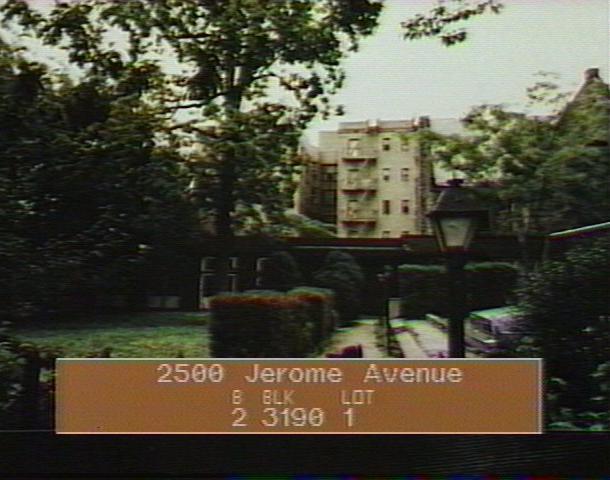
The city photographed every building for its tax records around 1940 and again in the 1980s. NYC Municipal Archives.
Written with AI from the source each entry cites, then fact-checked.
- 1854
A new Fordham parish moves a $90 wooden schoolhouse onto its lot and starts holding services
St. James' was incorporated in 1853 by wealthy villa owners who had recently settled in Fordham, then part of Westchester County, and first worshipped in the Reformed Dutch Church. In April 1854 the vestry acquired an acre at Fourth and Croton Avenues, now Jerome Avenue and East 190th Street, once part of Peter Valentine's farm. They bought a small school house for $90, moved it here, and held services in it from June 11.
- 1863
The vestry sends one man to find an architect for a church costing no more than $12,000
Having outgrown the old schoolhouse, the vestry first looked to Frederick Clarke Withers in July 1863, though he had just been discharged from the Union army and his wife had died that month. In September they made George W. Devoe a committee of one to obtain plans. In October he returned with a scheme from Dudley & Diaper, which the vestry accepted.
“…the vestry appointed George W. Devoe, a committee of one "to get an Architect to draw up plans of a church ... to cost not over $12,000.”
- 1865
Bishop Horatio Potter consecrates the new stone church on All Saints' Day
Potter had laid the cornerstone on May 28, 1864, and returned to consecrate the finished building on All Saints' Day, November 1, 1865. Built of native stone with brownstone trim in the Gothic Revival style, the church cost $25,000. The parish, founded in 1853, was the first Episcopal congregation in Fordham.
“Bishop Horatio Potter laid the cornerstone of the present building on May 28, 1864, and the church was consecrated by the same on All Saints' Day, November 1, 1865.”
Source: Wikipedia
- 1865
The vestry thanks Henry Dudley alone for a church built on the strict rules of ecclesiology
Dudley, who came from England in 1851 to partner with Frank Wills, shaped the church after a medieval English parish church. Following ecclesiological doctrine, the front faces west, the chancel points east, the entrance porch sits at the southwest corner, and the nave, aisle, transept and chancel each read clearly from outside. The vestry thanked Dudley alone in December 1865, with no mention of his partner Frederick Diaper.
“In December, 1865, the vestry of St. James' tendered its thanks to "Mr. Dudley for his services as Architect"; no mention was made of Diaper…”
- 1889
A Tiffany window copying Leonardo's "Last Supper" is installed in memory of Gustav Schwab
Schwab, a leading member of the congregation whose villa still stands on the Bronx Community College campus, had given the chancel windows of the Evangelists, made at the Royal Stained Glass Factory in Munich, when the church opened in 1865. In 1889 a rectangular Tiffany window reproducing the Da Vinci painting was added in his memory. Another Tiffany window, "Lillies and Apple Blossoms," honors Julia Wheeler Tiffany, wife of the third rector, Charles C. Tiffany.
“…a rectangular Tiffany window in the north side aisle added to the building in 1889. This window, which is a copy of DaVinci's "Last Supper…”
- 1891
The parish hires Henry Kilburn to build a stone parish house in place of a decaying wooden Sunday school
In 1889 the vestry discussed replacing the rotting wooden Sunday School, the former district school, and in May 1891 agreed to spend no more than $17,600. Kilburn, known for Presbyterian churches on Amsterdam Avenue, designed a rock-faced Gothic Revival building extending from the north side of the church, with a recessed porch on carved foliate capitals. A one-story brick office wing was added in 1959.
“In May, 1891, they "resolved to contract for Parish House at cost not exceeding $17,600.”
- 1980
St. James' becomes a city landmark as new West Indian members revive the congregation
The Landmarks Preservation Commission designated the church one of the finest Gothic Revival religious buildings in the city and one of the last reminders that this part of the Bronx had been rural Westchester County. The report noted that the neighborhood's population was changing and that newcomers from the West Indies were bringing fresh life to the parish, a block north of Fordham Road.
Further reading
Nearby
- Dollar Savings Bank2526 Grand Conc | 4 entries
- Dollar Savings Bank Building2530 Grand Conc | 9 entries
- Loew's Paradise Theater2415 Grand Conc | 11 entries
- Edgar Allan Poe Cottage2640 Grand Concourse | 1 entry
- Bronx Library Center310 East Kingsbridge Road | 4 entries
- Kingsbridge Armory29 West Kingsbridge Road | 7 entries