251 Water Street
also 22 Peck Slip | Financial District | built 1888
Open on the map6 entries

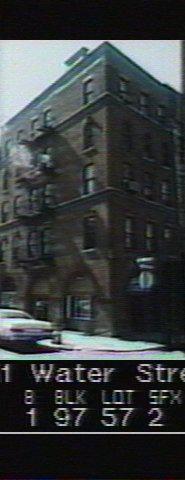
The city photographed every building for its tax records around 1940 and again in the 1980s. NYC Municipal Archives.
Written with AI from the source each entry cites, then fact-checked.
- 1865
Abraham Lincoln orders bail for John N. Eitel, the clothier who later built 251 Water Street
Eitel sold clothing to naval recruits and brokered recruits for the Union during the Civil War. Suspected of fraud, he was arrested in February 1865 and held in Washington. On March 17 Lincoln overruled a judge and ordered him bailed, with $10,000 set as the amount. Eitel owned the building at 251 Water Street by 1888 and replaced it with the present one.
Source: Daytonian in Manhattan
- 1888
An earlier four-story wood-frame house on this lot is replaced by John N. Eitel's tenement
A four-story wood-frame house stood on this corner of Water Street and Peck Slip until 1888, when John N. Eitel had it replaced. The new building, designed by architect Carl F. Eisenbach, held stores at street level and housed eight families above.
- 1888
Carl F. Eisenbach designs a Romanesque Revival tenement with sunflowers and terra-cotta faces
Eisenbach built a five-story mix of Romanesque Revival and Italianate in red brick with terra-cotta trim, with broad arches at the Peck Slip shopfronts. A band of sunflowers decorates the tympanum over the apartment entrance on Water Street. It cost Eitel $12,000, and by 1933 a federal survey found that vandals had stolen most of the terra-cotta heads.
Source: Daytonian in Manhattan
- 1894
A night watchman who lives here is killed at a candy factory on Franklin Street
August Loeffler, a 63-year-old Civil War veteran, lived in the building with his five children and worked nights at Henry Heide's candy factory. On April 17, 1894 he never came home, and an engineer found him dead in the factory basement at 6 a.m. Investigators concluded that he had caught Charles Miller, a fired packer, robbing the timekeeper's desk, and that Miller killed him with a hammer.
Source: Daytonian in Manhattan
- 1925
The Eagle Fish Company, run from the ground floor, defies a federal grand jury
The Level Fish Company ran the Eagle Fish Company from the first floor here. In July 1925 Eagle refused to hand its books to a federal grand jury, and before the month ended partner Frank Maibach was indicted with 11 others for price fixing in the fish trade. He was convicted the next year and fined $31,000 under the Sherman Antitrust Act.
Source: Daytonian in Manhattan
- 1933
Fish-trade racketeers tied to this building are accused of stench bombs and terror
In June 1933 charges of conspiring to monopolize the fresh-water fish trade were brought against Frank Maibach and his brother Jack, the Eagle Fish Company's vice president. Prosecutors said the group hired gangsters who assaulted retailers, dumped fish in transit, threw stench bombs and cut off electricity to stores. The indictment named the American Federation of Labor, 24 corporations, 53 other people and three trade associations.
Source: Daytonian in Manhattan
Further reading
- Fish, Murder and Gangsters -- No. 251 Water Street (22 Peck Slip)Daytonian in Manhattan
Nearby
- 247 Water Street2 entries
- 245 Water Street2 entries
- 24 Peck Slip2 entries
- 232 Front Street2 entries
- 228 Front Street1 entry
- 226 Front Street1 entry