Apollo Theater
253 West 125th Street | also 258 West 126th Street, 252 West 126th Street | Harlem | built 1914
Open on the map13 entries

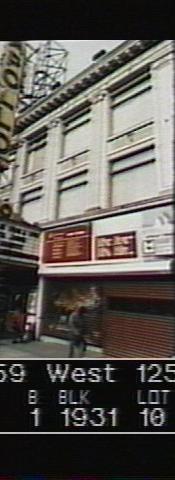
The city photographed every building for its tax records around 1940 and again in the 1980s. NYC Municipal Archives.
Written with AI from the source each entry cites, then fact-checked.
- 1914
Hurtig and Seamon's New Theatre opens as a whites-only burlesque house
Architect George Keister designs the 2,500-seat neoclassical theater for burlesque producers Jules Hurtig and Harry Seamon, who bar Black patrons from what will become the Apollo. Burlesque here fades through the early 1930s; the house briefly stages Black vaudeville in 1932 and closes in 1933 after failing to renew its burlesque license.
Source: Wikipedia
- 1928
Billy Minsky takes over the Harlem burlesque house and charges $1.65 a ticket
In 1928 Billy Minsky took over the theater, backed by his financial partner Joseph Weinstock, a building and theater contractor. Under Minsky the house, by then called Hurtig & Seamon's Apollo, turned a good profit with lavish shows, long engagements, performers who strolled among the audience and a higher ticket price of $1.65. Around 1930 his attention shifted to the Republic Theater on 42nd Street, and the Apollo's burlesque years began to fade.
“…in 1928 Billy Minsky took over the theater ... a higher ticket price of $1.65…”
- 1934
Sidney Cohen reopens the former burlesque house as the 125th Street Apollo Theatre
The theater opened in 1914 as Hurtig and Seamon's New Burlesque Theater. On January 26, 1934, Sidney Cohen reopened it as the 125th Street Apollo Theatre, trading burlesque for variety revues. The first bill, "Jazz a la Carte," featured Benny Carter's orchestra with Ralph Cooper and Aida Ward. Amateur Night contests began soon after, and a teenage Ella Fitzgerald won one that same year.
Source: apollotheater.org
- 1934
Ralph Cooper launches radio Amateur Night as the Tree of Hope is cut down
Actor and producer Ralph Cooper began Amateur Night at the Apollo in 1934 and put the contests on the radio. The same year, a tall elm that Harlem treated as a good-luck charm, the Tree of Hope, was chopped down. A shellacked 12-inch log from it, mounted on a gold pillar in the wings, has since been rubbed for luck by performers before they step onto the stage.
Source: mentalfloss.com
- 1934
Seventeen-year-old Ella Fitzgerald makes her debut at Amateur Night
In 1934, the year the Apollo took up its new life as a theater for Black performers, Ella Fitzgerald, then 17, made her first appearance at Amateur Night. Mayor La Guardia's anti-burlesque campaign had shut the old burlesque theater in 1933, and owner Sidney Cohen then reoriented it. Tap dancer Howard "Sandman" Sims would later win the contest 25 times.
Source: 6sqft
- 1957
Buddy Holly and the Crickets become the first white act at the Apollo since it turned to Black entertainment
In 1957 Buddy Holly and the Crickets played the Apollo, the first white act to appear there since the theater began centering on African American performers. The booking reflected a shift in the 1950s: variety shows were fading, big bands were giving way to R&B, rock concerts had arrived, and a typical booking meant five or six performances a day for seven days.
Source: Wikipedia
- 1962
James Brown records Live at the Apollo at his own expense
James Brown paid for the recording himself after his label, King Records, balked at the idea of a live album. Taped on the night of October 24, 1962, and released in May 1963, Live at the Apollo spent 66 weeks on Billboard's pop albums chart and peaked at number 2. The Library of Congress added it to the National Recording Registry in 2004.
Source: Wikipedia
- 1978
A group of Black businessmen buys the Apollo, its first Black owners
Rich Morris, Elmer T. Morris and Guy Fisher purchase the theater from Robert Schiffman and reopen it after $250,000 in renovations, becoming the Apollo's first Black owners. The revival is short-lived: the IRS raids the building in 1979, and the operators file for bankruptcy in 1981 before Percy Sutton's Inner City Broadcasting takes over.
Source: Wikipedia
- 1981
Percy Sutton's Inner City Broadcasting buys the Apollo for about $225,000
Inner City Broadcasting, owned by Percy Sutton, agreed in late 1981 to purchase the Apollo for $220,000 or $225,000, beating a bid from the Bible of Deliverance Evangelist Church. The previous operators had filed for bankruptcy that May. Sutton remembered "roaches, dead rats, swimming rats" in the flooded basement and called the purchase price the cheapest part of the revival.
“Inner City Broadcasting, a firm owned by Percy E. Sutton, agreed in late 1981 to buy the theater…”
Source: Wikipedia
- 1983
The city designates the Apollo's facade and interior as landmarks
The Landmarks Preservation Commission protected both the exterior and the auditorium of George Keister's neoclassical theater on June 28, 1983, and the building joined the National Register of Historic Places that November. Percy Sutton and a group of investors had bought the struggling theater in late 1981 for about $220,000; after a renovation it reopened on May 22, 1985.
Source: Wikipedia
- 1985
The Apollo reopens after renovation with jazz, rock, gospel and Amateur Night
The first shows at the refurbished Apollo took place on May 22, 1985, though the recording studio was not yet finished. Percy Sutton scheduled Amateur Night for Wednesdays, jazz and rock for weekend evenings and gospel for Sunday mornings, plus a mixed-race dance company meant to signal that everyone was welcome. The first phase cost $5.5 million, and the full renovation eventually reached $20 million by 1988.
“The first shows at the refurbished theater were hosted on May 22, 1985.”
Source: Wikipedia
- 1999
Ossie Davis replaces Charles Rangel as Apollo chairman after the attorney general's lawsuit
In 1998 the state attorney general's office began investigating whether Inner City Broadcasting was underpaying the Apollo Theater Foundation, and Attorney General Dennis Vacco sued six board members, including chairman Charles Rangel, over mismanagement. In 1999 Time Warner donated $500,000 and enlarged the board. Rangel at first refused to step down, but actor Ossie Davis became chairman in September, and Eliot Spitzer's office then dropped the suits.
Source: Wikipedia
- 2006
James Brown lies in state on the Apollo stage as thousands pay their respects
After James Brown died in 2006, his body was brought back to the Apollo, where he lay in state on the stage. Thousands of mourners gathered at the theater to pay their respects to the singer known as the Godfather of Soul.
Source: 6sqft
Further reading
- Apollo TheaterWikipedia
Nearby
- Victoria Theater233 West 125th Street | 4 entries
- Blumstein's Department Store230 West 125th Street | 4 entries
- Hotel Theresa200 West 125th Street | 15 entries
- Adam Clayton Powell Jr. State Office Building163 West 125th Street | 8 entries
- Studio Museum in Harlem144 West 125th Street | 10 entries
- P.S. 157327 St Nicholas Avenue | 4 entries