Congregation B'nai Jeshurun
257 West 88th Street | Upper West Side | built 1918
Open on the map11 entries

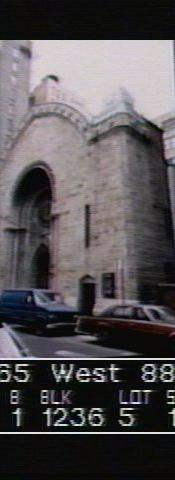
The city photographed every building for its tax records around 1940 and again in the 1980s. NYC Municipal Archives.
Written with AI from the source each entry cites, then fact-checked.
- 1825
German and Polish Jews break away to found B'nai Jeshurun
A group of German- and Polish-Jewish immigrants forms B'nai Jeshurun after Congregation Shearith Israel declines to allow them a separate service in their own rite. The new congregation becomes the second synagogue founded in New York City and the third-oldest Ashkenazi congregation in the United States, beginning nearly a century of relocations before it settles on West 88th Street.
Source: Daytonian in Manhattan
- 1917
B'nai Jeshurun dedicates its synagogue on West 88th Street
Founded in 1825 by members who broke away from Shearith Israel to form an Ashkenazi community, B'nai Jeshurun was the second synagogue in New York. Its building here, designed by Henry B. Herts with Walter S. Schneider in a Semitic Revival style, was dedicated in 1917 and added to the National Register of Historic Places in 1989.
Source: Wikipedia
- 1922
Former Ambassador James Gerard addresses the congregation on the Klan
Former U.S. Ambassador James W. Gerard addresses the West 88th Street congregation on the Ku Klux Klan, cautioning Jews against retaliating and insisting the government will handle the group. The talk is one of a series by prominent speakers at the synagogue, including Rabbi Israel Goldstein and, years later, former Ambassador Charles H. Sherrill on the proposed Berlin Olympics boycott.
Source: Daytonian in Manhattan
- 1929
Mourners overflow the synagogue for shoe dealer Israel Miller's funeral
On August 21, 1929, B'nai Jeshurun held the funeral of Israel Miller, the shoe dealer and importer behind I. Miller. A Polish cobbler who reached New York in 1892 at 19, he had built a business whose stores included a Times Square building adorned with marble statues of actresses. Newspapers reported more than 2,000 mourners at the service, with hundreds more who could not get in crowding the street.
Source: Daytonian in Manhattan
- 1933
Charles Sherrill tells the congregation a boycott of the Berlin Olympics would be worse
On November 30, 1933, Charles H. Sherrill, a former ambassador to Turkey, spoke to the congregation about the proposed ban on the Berlin Olympics. The New York Times reported that he called the treatment of Jews in Germany outrageous and hideous but said a boycott would be worse, and that it might stir anti-Semitic feeling in the United States.
Source: Daytonian in Manhattan
- 1947
The congregation marks the United Nations vote for a Jewish state
B'nai Jeshurun holds a service celebrating the United Nations General Assembly's vote to partition Palestine and establish a Jewish state, passed days earlier. The West 88th Street synagogue, built with Moorish-influenced granite facades and a rose window bearing a Star of David, seats 1,100 worshippers for the occasion.
Source: Daytonian in Manhattan
- 1978
B'nai Jeshurun stages the lecture series Dialogue '78
In 1978 the congregation staged a lecture series called Dialogue '78. Speakers included Rabbi Irving Greenberg, who spoke on the Holocaust, Shimon Peres, who later became Israel's president and prime minister, and the philosopher Emil Fackenheim. Daytonian in Manhattan cites the series as evidence of the synagogue's tradition of political and social involvement.
Source: Daytonian in Manhattan
- 1985
Rabbi Marshall Meyer arrives and revives B'nai Jeshurun
Rabbi Marshall Meyer's arrival in 1985 began a spiritual and demographic renaissance at the congregation, which introduced musical services drawing on Jewish traditions from around the world. B'nai Jeshurun became independent of the Conservative movement in the late 1980s and is now non-denominational.
Source: Wikipedia
- 1989
The synagogue is listed on the National Register of Historic Places
In June 1989 B'nai Jeshurun's building at 257 West 88th Street went onto the National Register of Historic Places. It was also included in the Riverside Drive-West End Historic District, which New York City created in 1990. The synagogue was designed by Henry B. Herts, a congregant and theater architect, with Walter S. Schneider, and dedicated in 1917.
“The synagogue building was listed on the National Register of Historic Places in June 1989.”
Source: Wikipedia
- 1991
The synagogue's roof collapses, forcing a five-year restoration
The roof of B'nai Jeshurun's West 88th Street synagogue collapses, badly damaging the sanctuary built in 1918 by architects Henry B. Herts and Walter S. Schneider. The congregation, revitalized since Rabbi Marshall Meyer's arrival in 1985, undertakes a restoration that takes five years to complete.
Source: Daytonian in Manhattan
- 2018
B'nai Jeshurun decides to officiate interfaith marriages
In 2018 B'nai Jeshurun announced that it would officiate at interfaith marriages, provided the couple pledged to raise any children exclusively as Jews. The congregation had left the Conservative movement in the late 1980s to become independent, and had first held a Stonewall Shabbat Seder in 1995.
Source: Wikipedia
Further reading
- B'nai Jeshurun (Manhattan)Wikipedia
- B'nai Jeshurun -- 257 West 88th StreetDaytonian in Manhattan
Nearby
- 601 West End Avenue3 entries
- St. Ignatius of Antioch Church552 West End Avenue | 4 entries
- The Cornwall255 West 90th Street | 2 entries
- Church of St. Paul and St. Andrew263 West 86th Street | 8 entries
- The Belnord2360 Broadway | 13 entries
- 345 West 88th Street1 entry