Rogers Peet Building
258 Broadway | also 11 Warren Street, 259 Broadway | Tribeca | built 1900
Open on the map8 entries

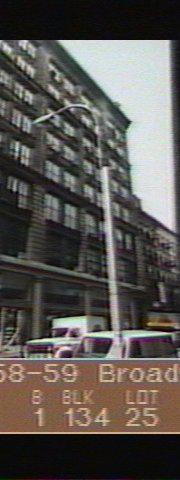
The city photographed every building for its tax records around 1940 and again in the 1980s. NYC Municipal Archives.
Written with AI from the source each entry cites, then fact-checked.
- 1854
Samuel Verplanck Hoffman has John B. Snook build a five-story commercial palace on the corner
In 1827 the corner of Broadway and Warren Street was bought from Trinity Church by Garrit Storm, a wealthy grocer. It passed in 1852 to his daughter Glorvina Russell Hoffman, and her husband, Samuel Verplanck Hoffman, hired John B. Snook to replace three row houses with a five-story store. Snook modeled the colonnaded design on A. T. Stewart's marble store a block north. Finished in 1854, it housed Devlin & Co. for years, among the first clothiers to set up on Broadway.
“…commissioned architect John B. Snook to design and construct a five-story commercial "palace" to replace the existing three row houses.”
- 1870
Alfred Beach's pneumatic subway opens to the public, entered from the clothing store at the corner
Alfred Ely Beach, an inventor who edited Scientific American, built a demonstration pneumatic railway under Broadway after the city refused him a permit. Its entrance was at 260 Broadway, at the corner of Warren Street opposite City Hall, beneath the clothing store of Devlin & Co., in the building that stood here before the present one. The tunnel ran about 300 feet to Murray Street and was dug in 58 days. It opened to the public on February 26, 1870, with a 25-cent admission fee that went to a charity for soldiers' and sailors' orphans, and ran as a demonstration until 1873.
Source: nycsubway.org
- 1889
Rogers, Peet & Company takes over the Broadway and Warren corner after Devlin & Co. leaves for Union Square
When Devlin & Co. moved to a new Union Square store in 1889, following retail's drift north, the men's clothing firm Rogers, Peet & Company took the basement, first and second floors at 258-260 Broadway. The firm dated to 1874, when merchants Marvin N. Rogers and Charles B. Peet combined their businesses. It sold ready-made clothes at fixed prices with quality guaranteed, and in 1886 it began sharing profits with its employees.
“…the men's clothing firm of Rogers, Peet & Company moved into the building at 258-260 Broadway (3-5 Warren Street), occupying the basement, first, and second floors.”
- 1890
Rogers Peet's plain-spoken single-column ads, steered by partner Frank Chambers, become a model for advertising
Frank R. Chambers, a Rogers Peet partner, oversaw the firm's advertising from 1880 to 1915 and wrote much of the copy himself. His advice was to tell the truth and understate. The ads of the 1890s ran as a single column of informal text beside a small cartoon, set apart from the boxed, boastful clothing ads of the day. The firm also issued illustrated catalogs and advertised in theater playbills, on posters and on streetcars.
- 1898
A fire that starts in the basement storeroom destroys the building and scorches the Home Life tower
On December 4, 1898, a fire that began in the basement, where Rogers Peet kept a storeroom, destroyed the earlier building at 258 Broadway, which the present one replaced. The blaze also badly damaged its southern neighbors, the 16-story Home Life Insurance Company Building and the Postal Telegraph Cable Company Building. Critics of tall buildings pointed to the burned upper floors of Home Life as a case against skyscrapers. Supporters of fireproof construction replied that both towers had stood up well and had stopped the blaze from spreading.
- 1900
Snook & Sons rebuild with a steel skeleton whose frame shows on the facade
Eugene A. Hoffman, a clergyman, hired John B. Snook & Sons, whose office was across Warren Street and whose founder had designed the earlier building for Hoffman's father. Built in just under a year and finished in April 1900, the eight-story building had a riveted steel frame carrying brick curtain walls, with wide window bays between slim masonry piers. That frank display of the structure reflects the Chicago school and was rare among New York skyscrapers. Rogers Peet took the basement and first two floors, with offices above.
- 1976
Rogers Peet's Warren Street store closes, and the upper floors become apartments
By the 1970s the retail landscape had shifted through consolidation, suburban malls and national chains, and more casual workplace dress was hard on an old-fashioned clothing house. The Warren Street store shut around 1976, and two years later the firm had no New York stores left. By 1981 apartments, six or seven to a floor, filled the upper stories, and in the 1980s Strawberry, a regional women's clothing chain, held the street-level storefront.
“The Rogers, Peet & Co. Warren Street store closed its doors c. 1976, and by 1978 no Rogers Peet stores remained in New York.”
- 2010
The Landmarks Commission designates the Rogers, Peet & Company Building as an early steel-frame skyscraper
After a public hearing on June 22, 2010, at which two people spoke in favor, including a representative of the Historic Districts Council, the Landmarks Preservation Commission designated the building, with a designation list dated December 14, 2010. The report calls it an early steel-skeleton skyscraper, influenced by the Chicago school, that stands out among the skyscrapers near City Hall. It also notes that Rogers Peet occupied the building for more than 70 years.
Further reading
- Rogers Peet BuildingWikipedia
Nearby
- Home Life Insurance Company Building256 Broadway | 5 entries
- Postal Telegraph Building253 Broadway | 8 entries
- Fountain Pen Hospital8 Warren Street | 2 entries
- Thomas N. Dale & Co. Building18 Warren Street | 5 entries
- Tower 270270 Broadway | 8 entries
- 23 Park Place Building23 Park Place | 5 entries