Benjamin Franklin High School (Manhattan Center for Science and Mathematics)
260 Pleasant Avenue | also 280 Pleasant Avenue | East Harlem | built 1942
Open on the map10 entries

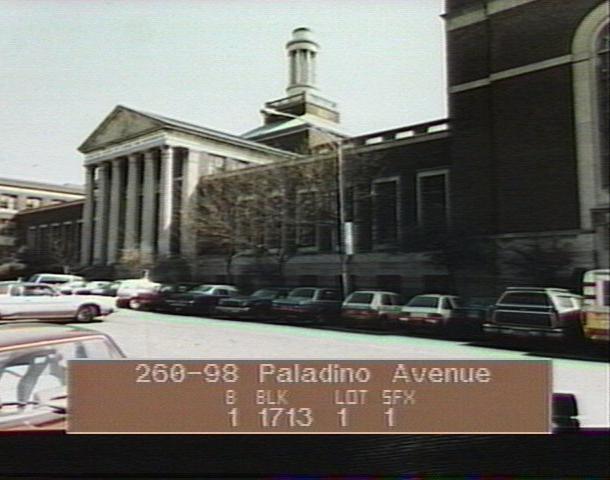
The city photographed every building for its tax records around 1940 and again in the 1980s. NYC Municipal Archives.
Written with AI from the source each entry cites, then fact-checked.
- 1940
Benjamin Franklin High School's groundbreaking on a former coal yard and ice plant draws a speech from Mayor La Guardia
In fall 1940 a groundbreaking ceremony takes place on Pleasant Avenue, where the new school replaces the old Standard Gaslight Company coal yard and ice plant. The boys of Franklin nickname the riverfront site the East Riviera. Mayor Fiorello La Guardia speaks and says city officials are working to live up to Benjamin Franklin's principles of equal opportunity.
- 1940
Eric Kebbon's design pairs a Greek-inspired cupola with street access to the auditorium and library
Eric Kebbon's red brick and limestone building is crowned by a cupola inspired by the Choragic Monument of Lysicrates in Athens, and its pediments carry a carved medallion portrait of Benjamin Franklin. Inside, the plan lets adults enter the auditorium and library from the street without passing through student areas. The Times reports plans for a roof playground, weather station, observatory and greenhouse.
“…the plan provided access from the street directly into the auditorium and library, allowing adults to enter the building during school hours…”
- 1942
Leonard Covello's Benjamin Franklin High School gets its Pleasant Avenue building
Benjamin Franklin was East Harlem's first high school, founded under Leonard Covello, an educator, activist, urban sociologist and East Harlem resident. Its Georgian Revival building on Pleasant Avenue, designed by Eric Kebbon, the Board of Education's head architect for schools, was completed in 1942. Covello's programs tried to ease the neighborhood's racial tensions in the 1950s by building understanding among ethnic groups competing for scarce resources.
Source: nyc.gov
- 1943
Franklin High hosts race-relations conferences with the NAACP and Urban League
In 1942 and 1943 the school's administration holds conferences on race relations, co-hosted or attended by groups including the NAACP, the American Jewish League and the National Urban League. They are planned in response to race riots in other cities and growing local tension, as East Harlem's Italian population shrinks and Puerto Rican and African American residents grow. Staff try to persuade students that fighting over scarce resources is futile.
- 1945
A gym dispute at Franklin High is reported as a race riot, then played down by investigators
The New York Times reports in 1945 that a race riot broke out at the school and spread to nearby streets. Principal Leonard Covello says the story was exaggerated: a small disagreement in the gym between African American and Italian American students. Two investigating groups agree it grew out of a fight rather than race. Covello responds with events that include a Frank Sinatra assembly on racial tolerance.
“…the incident was not a race controversy but a dispute growing out of a fight…”
- 1947
Franklin High founds Club Borinquen to serve its new Puerto Rican students
As East Harlem becomes the heart of New York's Puerto Rican community, the school founds Club Borinquen in 1947. Modeled on the Italian club Leonard Covello had started at DeWitt Clinton in the 1920s, it studies Puerto Rican culture and looks at ways the school can help the new arrivals.
“…the staff of Franklin High School established Club Borinquen in 1947…”
- 1948
Students launch a two-year sanitation campaign across East Harlem
From 1948 to 1950 Franklin's boys run a Sanitation Campaign aimed at the garbage that piled up in empty lots and on sidewalks while children played on the streets. It has four goals: recreation, education, local action and political action. The campaign is one of the last big projects of Leonard Covello's tenure as principal.
- 1948
Saxophonist Sonny Rollins graduates from Benjamin Franklin High
Saxophonist Sonny Rollins graduated from Benjamin Franklin High School in the Pleasant Avenue building in 1948, several years before becoming one of jazz's most influential improvisers. Senator Daniel Patrick Moynihan had graduated from the same building four years earlier, in 1944. Both passed through classrooms shaped by longtime principal Leonard Covello, the city's first Italian-American principal.
Source: Wikipedia
- 1982
The building reopens as the Manhattan Center for Science and Mathematics
The Board of Education closed Benjamin Franklin High School in June 1982 over poor performance and turned the building into a new four-year school, the Manhattan Center for Science and Mathematics, starting that September. The building also houses Isaac Newton Middle School, and the Landmarks Preservation Commission designated it a city landmark in 2018.
Source: Wikipedia
- 2018
The city designates the school building a landmark
The Landmarks Preservation Commission designated the Pleasant Avenue school building a New York City landmark on May 29, 2018, citing its history under longtime principal Leonard Covello, the city's first Italian-American principal. By then the building had spent more than three decades split between the Manhattan Center for Science and Mathematics and the Isaac Newton Middle School, following a 1982 reorganization.
Source: Wikipedia
Further reading
Nearby
- Rao's265 Pleasant Avenue | 6 entries
- Church of Our Lady of Mount Carmel473 East 115th Street | 6 entries
- East River Plaza517 East 117th Street | 4 entries
- Patsy's Pizzeria2287 1st Avenue | 5 entries
- St. Ann Church312 East 110th Street | 3 entries
- Church of Our Lady Queen of Angels228 East 113th Street | 2 entries