Metro Theater
2626 Broadway | Upper West Side | built 1933
Open on the map13 entries

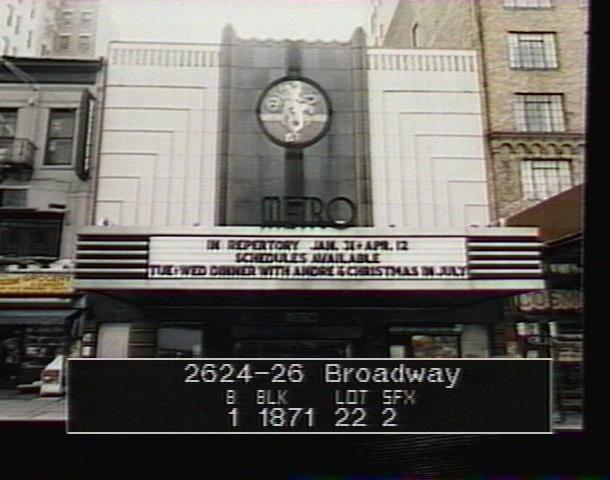
The city photographed every building for its tax records around 1940 and again in the 1980s. NYC Municipal Archives.
Written with AI from the source each entry cites, then fact-checked.
- 1931
A seven-story tenement is demolished to clear the site for the Midtown Theater
A seven-story tenement stood on the site of the Midtown Theater until it was demolished in November 1931. Boak & Paris finished the theater plans in December 1932. In January 1933 the A. C. and H. M. Hall Realty Co. was issued a permit for a small movie house, and J. J. Secoles Inc. was hired to build it.
- 1933
The Art Deco Midtown Theater opens on Broadway
Designed by Boak & Paris, the 550-seat movie house opened on June 2, 1933, as the Midtown Theater, showing first-run films. By the 1950s it had turned to foreign and art films, and in the 1970s and 1980s it showed adult films. The city designated its Art Deco facade a landmark on July 11, 1989.
Source: Wikipedia
- 1970
By the early 1970s the Midtown is showing adult films
After decades of first-run, then foreign and art-house programming, the Midtown had turned to pornographic films by the early 1970s, and that use continued well into the next decade. A Times reporter counted the conversion among mixed signs of where the neighborhood was heading. At the time, Broadway between 96th and 110th Streets had suffered a sharp decline and had many single-room-occupancy buildings.
“By the early 1970s, the Midtown had begun to show pornographic films, a use that continued well into the next decade.”
Source: Wikipedia
- 1982
Dan Talbot reopens the theater as the Metro
Dan Talbot bought the theater in August 1982, renamed it the Metro and spent $300,000 renovating it to show repertory films, making it the largest repertory theater in Manhattan, with 535 seats. He split it into two screens in 1986. Later owners included Cineplex Odeon and Cablevision; it closed in January 2003 and for good in November 2005.
Source: Wikipedia
- 1985
Dan Talbot tries first-run films at the Metro, adds a street screen, and gets hundreds of critical letters
Dan Talbot began showing first-run films at the Metro in June 1985, which observers tied to the closing of the nearby New Yorker Theater and to the growing popularity of newer movies. To lure passersby, he added a screen and speakers to the storefront. He received hundreds of letters criticizing the change and, after six months, returned the theater to repertory programming.
Source: Wikipedia
- 1986
The Metro is split into two screens
After Dan Talbot's 1982 renovation the Metro had 535 seats and was the largest repertory site in Manhattan. By August 1986 it had been twinned, with 325 seats on the lower level and 200 upstairs. Cineplex Odeon began operating the theater in 1987.
“By August 1986, the Metro was "twinned" (or divided into two distinct theaters)…”
- 1986
The Metro appears in Woody Allen's Hannah and Her Sisters
The Metro appeared in Woody Allen's film Hannah and Her Sisters in 1986. It was also seen in the video for Janet Jackson's "Let's Wait Awhile", a 1987 release. Cineplex Odeon began operating the theater in 1987.
“The Metro appeared in the Woody Allen film Hannah and Her Sisters in 1986…”
Source: Wikipedia
- 1989
City officials briefly close the Metro because Cineplex Odeon never applied for an operating license
Cineplex Odeon, which had taken over the theater's lease in 1987, never applied for an operating license for the Metro. City officials shut the theater for a time in May 1989. Two months later the Landmarks Preservation Commission designated it an individual landmark, and Albert Bialek bought the building that year while Cineplex Odeon kept running it.
“Cineplex Odeon failed to apply for an operating license for the Metro, leading city officials to close it temporarily in May 1989.”
Source: Wikipedia
- 1989
The city landmarks the theater's Art Deco facade, but not its interior
On July 11, 1989, the Landmarks Preservation Commission designates the pink and black terracotta facade that architects Boak and Paris gave the 1933 Midtown Theater, along with its eyebar-hung marquee. The protection covers only the exterior. The twin-screen Metro closes for good in November 2005, and owner Albert Bialek's interior is gutted the following year, leaving nothing but the landmarked front.
Source: Wikipedia
- 2004
Peter Elson reopens the Metro as the Embassy's New Metro Twin after two years of closures
The Metro had closed, reopened and closed again over two years, amid rumors that a Gristede's would replace it, before it was set to reopen on December 3, 2004, under the operator Peter H. Elson. It had 292 new seats upstairs, 188 downstairs and new red carpet. The Times counted it as the theater's sixth incarnation in 71 years, after stints as a first-run house, a pornographic house, an art theater and part of two national chains.
Source: Internet Archive
- 2007
The Metro's interior is gutted behind its landmark facade
By late 2007 the inside of the Metro had been gutted. A Times writer described the seats, plaster, curtains, screen, floral ceiling molding, sylph-filled niches and grillework as gone. Broker Benjamin Fox said nothing was kept and that the next tenant might be a home-furnishing store, a clothier or a sit-down restaurant, with a rendering on the door showing the landmark facade preserved.
Source: Internet Archive
- 2024
A nonprofit buys the empty Metro to bring back movies
After the gutted theater sat empty from 2006 and plans for an Alamo Drafthouse and a Planet Fitness fell through, the Upper West Side Cinema Center bought the building in 2024. It plans to reopen it as the Uptown Film Center, with five screens and community programming.
Source: Wikipedia
- 2025
The revived theater takes on a new name, the Uptown Film Center
In October 2025, the nonprofit that bought the shuttered Metro Theater announces it will reopen as the Uptown Film Center, part of a planned $29 million restoration with five screening rooms, targeting construction in 2027. The plan follows a string of failed deals at the site, including a second Alamo Drafthouse lease that collapsed in April 2024 amid disputed claims about the chain's finances.
Source: Wikipedia
Further reading
- Metro Theater (New York City)Wikipedia
Nearby
- Church of the Holy Name of Jesus207 West 96th Street | 4 entries
- Hotel Marseilles2689 Broadway | 5 entries
- Frederick Douglass Houses840 Columbus Avenue | 5 entries
- Humphrey Bogart House245 West 103rd Street | 3 entries
- 96th Street subway station4 entries
- Hostelling International New York891 Amsterdam Avenue | 5 entries