Edgar Allan Poe Cottage
2650 Grand Conc | also 2640 Grand Concourse | Fordham | built 1812
Open on the map8 entries

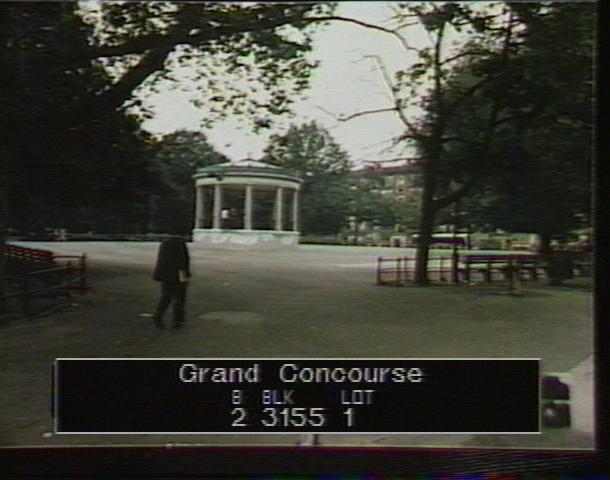
The city photographed every building for its tax records around 1940 and again in the 1980s. NYC Municipal Archives.
Written with AI from the source each entry cites, then fact-checked.
- 1846
Edgar Allan Poe moves his family into a small rented farm cottage in rural Fordham
Around May 1846 Poe arrived with his wife, Virginia Clemm, and her mother, Maria, after a short stay in Turtle Bay. The cottage then stood on Kingsbridge Road east of Valentine Avenue, with a sitting room and kitchen downstairs and an unheated bedroom and study above, on two acres. Poe paid about $5 a month or $100 a year to John Valentine, who had bought the place from Richard Corsa that March 28 for $1,000.
Source: Wikipedia
- 1846
Living here from 1846, Poe writes "Annabel Lee" and "Ulalume" with the family cat on his shoulder
During the stay that began in 1846, Poe composed both poems here and published "The Literati of New York City," a gossipy series on writers such as Margaret Fuller, Thomas Dunn English and Lewis Gaylord Clark. He befriended the Jesuit faculty of nearby St. John's College, now Fordham University, whose church bells inspired "The Bells," and his last short story, "Landor's Cottage," was likely drawn from this house.
“In this home, Poe wrote his poems "Annabel Lee" and "Ulalume" while the family cat sat on his shoulder.”
Source: Wikipedia
- 1847
Virginia Poe dies of tuberculosis in the cottage's first-floor bedroom
Poe's wife had been ill with tuberculosis throughout the family's time in Fordham; the family friend Mary Gove Nichols described her as almost a spirit already leaving the body. Virginia died in the downstairs bedroom on January 30, 1847, and was laid in the Valentine family's vault on February 2.
Source: Wikipedia
- 1849
Maria Clemm learns of Poe's death in Baltimore two days late and leaves the cottage
Poe died in Baltimore on October 7, 1849. His mother-in-law, Maria Clemm, still living in the Fordham cottage, did not hear the news until October 9, when he had already been buried. Soon afterward she gave up the house and went to live with a family in Brooklyn.
“At Fordham, Maria did not hear of his death until October 9, after he was already buried. Shortly thereafter, she moved out of the cottage…”
Source: Wikipedia
- 1889
William Fearing Gill buys the neglected Poe cottage at auction for $775
A visitor writing in Appletons' Journal in 1874 had found the house badly out of repair. In 1889 it went at auction for $775 to William Fearing Gill, who later became Poe's first American biographer; the Parks Department had judged it too costly to take on.
“The cottage was sold at auction in 1889 for $775 to William Fearing Gill in the first step of preservation…”
Source: Wikipedia
- 1896
Theodore Roosevelt and Rudyard Kipling back a magazine campaign to save the Poe cottage
"Shall We Save the Poe Cottage at Fordham," published in the Review of Reviews in 1896, urged the New York State Legislature to preserve the house. Its endorsers included Theodore Roosevelt, Rudyard Kipling, William Dean Howells, Hamlin Garland and Henry Cabot Lodge. In 1905 it was announced that the state legislature had authorized $100,000 to restore the cottage and create a park for it.
Source: Wikipedia
- 1913
Poe Cottage is moved a short distance and dedicated in the new Poe Park
After years of argument over whether moving the house would destroy its authenticity, the decision to relocate it was made in 1910. On November 13, 1913, Poe Cottage was dedicated on its new spot at Kingsbridge Road and the Grand Concourse. In 1922 the New-York Historical Society carried out further work to return it to its original condition.
Source: Wikipedia
- 1966
The city names Poe Cottage, a farmhouse from about 1812, an official landmark
The Landmarks Preservation Commission designated the one-and-a-half-story wooden farmhouse, with its attic and porch, as one of the few early 19th-century farm cottages left in the Bronx. Parks Commissioner Thomas Hoving wrote in support, and no one spoke against it. According to the report, Poe's residence ran from 1846 to 1848, and tradition holds that his last major work, "Eureka," was written here.
“Poe lived here from 1846 to 1848 and is said to have written "Anabel Lee" and his last great work, "Eureka", in this cottage.”
Nearby
- Edgar Allan Poe Cottage2640 Grand Concourse | 1 entry
- Bronx Library Center310 East Kingsbridge Road | 4 entries
- Dollar Savings Bank Building2530 Grand Conc | 9 entries
- Dollar Savings Bank2526 Grand Conc | 4 entries
- Kingsbridge Armory29 West Kingsbridge Road | 7 entries
- Kingsbridge Armory annex10 West 195th Street | 1 entry