267 West 11th Street
also 267A West 11th Street | West Village | built 1910
Open on the map5 entries

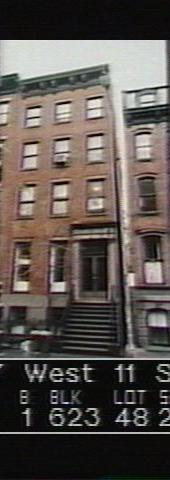
The city photographed every building for its tax records around 1940 and again in the 1980s. NYC Municipal Archives.
Written with AI from the source each entry cites, then fact-checked.
- 1843
Builder Andrew Lockwood erects a Greek Revival house for butcher Christopher Gwyer
Andrew Lockwood built this house in 1843 as an investment for the butcher Christopher Gwyer, who had bought the lot a year earlier on the condition that a brick dwelling be built within six months. The doorway keeps its full Greek Revival entablature, and the areaway railing is decorated with lyre designs. The full fourth story with a bracketed roof cornice is a later alteration.
“This house was erected by Andrew Lockwood in 1843 as an investment for Christopher Gwyer, a butcher.”
- 1892
Dr. Robert W. Buchanan, who practiced from the house, is arrested for poisoning his wife with morphine
Dr. Robert W. Buchanan leased the house in 1887 and set up a medical practice in it. After his wife Annie Sutherland Buchanan died on April 23, 1892, and he quickly remarried his first wife, suspicion grew. Police watched the house, her body was exhumed on June 5, an autopsy found large amounts of morphine, and detectives arrested him on Broadway on June 6.
Source: Daytonian in Manhattan
- 1895
Buchanan, the physician from 267 West 11th Street, is electrocuted at Sing Sing for his wife's murder
Dr. Robert W. Buchanan, who had lived and practiced in this house, was executed at Sing Sing on July 2, 1895. At his trial a witness testified that he had prepared to flee to South America, and another recalled him saying that cremation would have kept the poison from being found. The Philadelphia Times headlined the story as the wife murderer paying the penalty at last.
Source: Daytonian in Manhattan
- 1903
George B. Deane, who helped found the New York City Republican Party and was known as Old Uncle George, dies here at 86
George B. Deane bought the house around 1900 and died there on December 29, 1903. Born in Greenwich Village in 1817, he helped found the Republican Party in New York City and served in the State Assembly. The New York Times called him a picturesque and quaint figure of the neighborhood, and one story has him telling Police Board president Theodore Roosevelt that the merit system had also been in vogue when Roosevelt was appointed.
Source: Daytonian in Manhattan
- 1949
Painter Joan Mitchell and Barney Rosset rent the small studio building behind the house
The one-story building in the back yard, reached by a narrow passageway, began as a showroom for Adele Maximillian's custom children's clothing in the 1920s and became a tea house and bake shop in 1940. By 1949 it had been converted into a residence, and that year it was rented to the painter Joan Mitchell and her partner Barney Rosset. Poet Eileen Myles later described finding the tiny metal gate that leads to it.
Source: Daytonian in Manhattan
Further reading
- The 1843 Christopher Gwyer House - 267 West 11th StreetDaytonian in Manhattan
- Then & Now photos: 267 West 11th StreetVillage Preservation: Greenwich Village Then & Now
Nearby
- 261 West 11th Street3 entries
- Alma Mathews House273 West 11th Street | 4 entries
- 64 Bank Street1 entry
- 60 Bank Street1 entry
- 262 West 11th Street3 entries
- Abingdon Boarding Stable264 West 11th Street | 4 entries