J. W. Dimick Building
268 Canal Street | also 41 Cortlandt Alley | Civic Center | built 1887
Open on the map5 entries

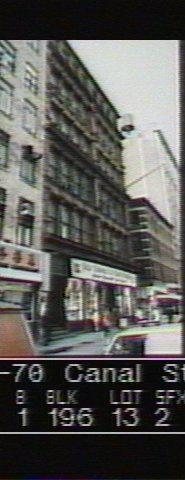
The city photographed every building for its tax records around 1940 and again in the 1980s. NYC Municipal Archives.
Written with AI from the source each entry cites, then fact-checked.
- 1868
A paper box factory's floors collapse in an earlier building on the site
An older five-story brick building on this corner, once called National Hall, was leased to Thomas Ryan for a paper box factory. About 40 girls were at work on the afternoon of August 13, 1868 when the weight of cardboard and cutting machines made the third floor give way, dropping workers and equipment through the floors. Three teenage workers were injured, and 19-year-old Mary F. Fallon died the next day. The lot's owner was the carpet dealer Jeremiah W. Dimick.
Source: Daytonian in Manhattan
- 1887
Carpet merchant Jeremiah W. Dimick builds a Queen Anne cast-iron loft for rent
The Landmarks Preservation Commission says Lansing C. Holden designed the five-story building in 1886-87 for Jeremiah W. Dimick, a carpet and wool merchant who had moved his own business to a more fashionable uptown address and built this one as an investment. Its cast-iron front was made by Atlantic Iron Works, with sunburst spandrels and tiers of pilasters and colonnettes. In the 1850s the site held a New York & New Haven Railroad depot and later the building-supply dealer Noah Wheaton.
- 1897
A three-day auction offers 500 new Fowler bicycles below list price
By 1897 the street-level showroom had passed to the auctioneer Benjamin S. Wise. Beginning June 29 he held a three-day sale of 500 of the 1897 Fowler bicycles, which retailed at $100 at the height of the cycling craze, along with other makes and accessories. His advertisement promised the public its first chance to buy the $100 Fowler for less than list price. The next year the printer Isaac H. Blanchard leased the building.
Source: Daytonian in Manhattan
- 1907
A fire traps printers on the upper floors and destroys Burr McIntosh's Monthly
Fire swept the top three floors on the night of May 6, 1907, drawing about 2,000 spectators to Canal Street. Employees of the Blanchard Press, working overtime, were trapped above the blaze when the roof hatch proved locked, and four men were rescued from the fire escape by ladder. The just-finished June issue of Burr McIntosh's Monthly was destroyed, a loss Isaac Blanchard put at $150,000. Owner Theresa D. Browning hired Israels & Harder to repair the floors and add a sixth for $18,000.
Source: Daytonian in Manhattan
- 1924
New York Edison buys the building and shows electric delivery trucks in its showroom
In 1924 the New York Edison Company bought the building. The New York Times reported on August 17 that part of its new showroom at 270 Canal Street was reserved for a permanent exhibit of electric trucks, charging boards and batteries, with three street trucks and two industrial trucks and exhibits to change every three months. Edison's showroom was also used as an emergency hospital in 1925, when firefighters were overcome by fumes at a doll factory across the street.
Source: Daytonian in Manhattan
Further reading
- The J. W. Dimick Building - Nos. 268-270 Canal StreetDaytonian in Manhattan
Nearby
- 262 Canal Street3 entries
- 272 Canal Street1 entry
- 78 Walker Street2 entries
- 408 Broadway3 entries
- 412 Broadway3 entries
- George Bruce Building254 Canal Street | 4 entries