John McComb Jr. House
27 Harrison Street | Tribeca | built 1797
Open on the map6 entries

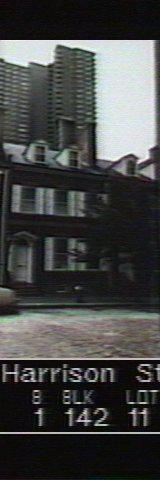
The city photographed every building for its tax records around 1940 and again in the 1980s. NYC Municipal Archives.
Written with AI from the source each entry cites, then fact-checked.
- 1636
The ground around McComb's future house belongs to Annetje Jans's farm, later a brewery site
The land at 317 Washington Street began as part of the 62-acre farm that Director General Van Twiller granted in 1636 to Annetje Jans and her first husband. The English crown took it over, and Queen Anne gave it to Trinity Church in 1705. In 1765 the church leased this part of the farm for 99 years, and it became the site of Harison's Brewery, which Philip Rhinelander bought in 1793, three years before McComb began his house.
- 1797
John McComb Jr., New York's first native-born architect, builds his own house at 317 Washington Street
John McComb Jr. began his own town house at 317 Washington Street in 1796 and finished it in 1797, living there during his early, busy years. The commission called him the city's first native-born architect and its leading designer, with City Hall and Hamilton's Grange among his surviving works. Of all his town houses, only this one and its neighbor at 315 remain, making it one of very few Manhattan houses dating to the 1700s.
“Number 317 was the architect's own house in which he lived during his earlier, very productive years.”
- 1900
Silverbank and Arbeiter take over McComb's old house as the produce market closes in
By the end of the Civil War, houses on Washington and Harrison Streets were being turned into rooming houses for immigrant workers, and as the Washington Street Market spread, warehouses crowded the old residential blocks. As the twentieth century neared, McComb's former home was taken over by the firm Silverbank and Arbeiter, who threw out its mantels and interior details to make room for business.
Source: Daytonian in Manhattan
- 1969
The city landmarks McComb's house, with his drawings on file to guide its restoration
The Landmarks Preservation Commission designated 317 Washington Street on May 13, 1969. It had a third story added and a ground floor altered for commercial use, but kept its original upper window openings and splayed lintels. The report observed that McComb's own drawings for similar town houses were in the New-York Historical Society and could guide a restoration after the house was moved.
“…original drawings of the owner-architect's plans for very similar town houses are on file at the New York Historical Society, and can be used as guides.”
- 1975
The McComb house is moved to Harrison Street, restored, and offered for sale in 1975
McComb's house, originally 317 Washington Street, had long been a warehouse as the Washington Market crept north. When the area became an urban renewal site in the mid-1960s, the Landmarks Commission chose a few Federal houses to save, and they were moved south from Washington Street to Harrison Street, where they form an L. The builders of Independence Plaza North paid for the move and restoration, and in 1975 the houses went on sale with unfinished interiors for $35,000 to $75,000.
Source: tribecacitizen.com
- 1975
Oppenheimer, Brady & Vogelstein finish the Harrison Street restoration in 1975, later called too polished
Oppenheimer, Brady & Vogelstein finish relocating and restoring the Harrison Street houses, 25-41 Harrison, in 1975. The AIA Guide to New York City later calls the work lovingly done but perhaps too lovingly, since the marks of age are gone, and notes that McComb, co-architect of City Hall, lived in one of the houses, now 27 Harrison. Oliver E. Allen's Tales of Old Tribeca devotes a chapter to the move.
Source: tribecacitizen.com
Nearby
- Jonas Wood House25 Harrison Street | 3 entries
- 315 Washington Street House27A Harrison Street | 5 entries
- Sarah R. Lambert House29 Harrison Street | 4 entries
- Jacob Ruckle House31 Harrison Street | 4 entries
- Ebenezer Miller House33 Harrison Street | 4 entries
- Wilson Hunt House37 Harrison Street | 4 entries