Woolsey G. Sterling House
27 Oliver Street | Two Bridges | built 1900
Open on the map8 entries

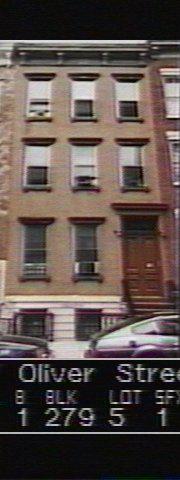
The city photographed every building for its tax records around 1940 and again in the 1980s. NYC Municipal Archives.
Written with AI from the source each entry cites, then fact-checked.
- 1791
John McLane, an artillery matross and military stores commissary, dies at an earlier house on the site
John McLane, listed as a matross of the artillery and commissionary of military stores, died at 27 Oliver Street on September 21, 1791. His house was an earlier building on the lot. By the mid-1830s it had been replaced by a brick-fronted residence built by Robert Swanton, two and a half stories tall with two dormers.
Source: Daytonian in Manhattan
- 1883
Ex-alderman Jeremiah Murphy is jailed for running an unlicensed saloon in his basement at 27 Oliver Street
Jeremiah Murphy, a meat dealer and former alderman, had set up a makeshift saloon in the basement of his home. In April 1883 a customer named Bernard Callahan said Murphy gave him only $3 change from a $10 note and struck him when he complained, and Callahan had Murphy arrested. Murphy then stabbed Callahan through the bars of a station-house cell. Despite his Tammany ties, he was sentenced in November 1883 to 30 days in the penitentiary for selling liquor without a license.
Source: Daytonian in Manhattan
- 1891
The Church of St. James buys 27 Oliver Street and makes it home to the St. James Union club
In July 1891 Ann and Jeremiah Murphy sold the house to the Church of St. James. The church rented out the upper floors and turned the basement and parlor level into the St. James Union, which The New York Times called the pioneer Catholic club of the city. It had billiard rooms, a gymnasium, and a stage for the St. James Literary Union's plays, such as The Confederal Spy in 1893.
Source: Daytonian in Manhattan
- 1904
Assemblyman Alfred E. Smith acts in a play at the St. James Union at 27 Oliver Street
Alfred E. Smith, who had grown up next door at 25 Oliver Street, took a role in the play Gloriana at the St. James Union in January 1904. The Tammany Times noted it was not his first time on that stage, and Tammany figures Thomas Foley, Daniel Riordan, and Timothy Sullivan sat in the audience. Smith returned in April 1906 to run a booth at the club's fundraising bazaar.
Source: Daytonian in Manhattan
- 1906
Republican leader Mike Hines revives his unconscious family after a gas leak at 27 Oliver Street
Mike Hines, a Republican district leader living upstairs, came home after midnight on July 22, 1906 and was nearly overcome by the smell of illuminating gas. He found his wife and five children unconscious, threw open the windows, and fetched two neighborhood doctors, who revived everyone after an hour's work. Hines traced the leak to the billiard room, where someone had turned the jets fully on while meaning to shut them off.
Source: Daytonian in Manhattan
- 1908
St. James's Union prepares to disband after 34 years as the neighborhood's population changes
The Sun reported in October 1908 that the St. James's Union was settling its affairs ahead of disbandment. Membership had dropped over several years, and the paper blamed the arrival of Italians and Jews in the neighborhood. The Evening World had earlier described the club as among the city's oldest organizations of that kind.
Source: Daytonian in Manhattan
- 1919
Neighbor Julia Drumm, 73, votes for the first time, following Governor Al Smith to the polls
The New-York Tribune reported on November 5, 1919 that Julia Drumm of 27 Oliver Street followed Governor Smith to the polls. She was 73 and it was her first vote, since New York women could not vote before 1917. She had known Smith as a boy and voted for him again in 1922, when she and her husband were offered tickets to his inauguration ball.
Source: Daytonian in Manhattan
- 1997
Federal government seizes 27 Oliver Street, a former Taoist temple, over heroin dealing
The house became the Temple of the Heavenly Mother in 1989 after decades as a rooming house, and the Buildings Department recorded it as entirely a church. The temple closed in 1992 following a drug raid. The Villager reported on June 25, 1997 that the Justice Department had taken the building after temple members were arrested for dealing heroin there. It was converted to two duplex apartments the next year.
Source: Daytonian in Manhattan
Further reading
- The Woolsey G. Sterling House - 27 Oliver StreetDaytonian in Manhattan
Nearby
- Alfred E. Smith House25 Oliver Street | 4 entries
- Alfred E. Smith House25REAR Oliver Street | 5 entries
- 47 Madison Street3 entries
- St. James Church32 James Street | 7 entries
- Daniel Riordan House15 Oliver Street | 5 entries
- P.S. 1 Alfred E. Smith School8 Henry Street | 3 entries