Colored School No. 3
270 Union Avenue | also 276 Union Avenue | East Williamsburg | built 1900
Open on the map7 entries

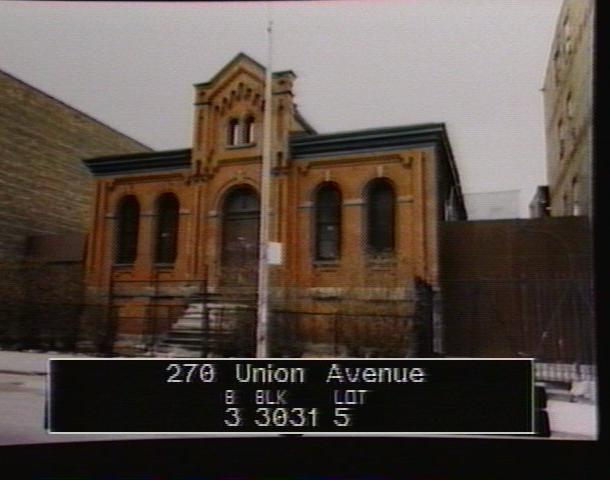
The city photographed every building for its tax records around 1940 and again in the 1980s. NYC Municipal Archives.
Written with AI from the source each entry cites, then fact-checked.
- 1868
The Black school of Williamsburgh settles on Union Avenue between Scholes and Stagg Streets
Colored School No. 3 grew out of Williamsburgh's African Free School, which local Black leaders founded before 1841. It was moved from building to building, from North 1st Street to a Union Avenue site near Keap Street and then to the old Bushwick district school, before reaching Union Avenue between Scholes and Stagg Streets by 1868. The Board of Education bought the lot from Henry B. and Elizabeth Scholes, possibly in 1867. A new schoolhouse replaced the old building on the site in 1879.
- 1875
Superintendent Leonard calls the old Colored School No. 3 unfit and asks for $12,000 for a new one
In early 1875 Samuel B. Leonard, the Board of Education's Superintendent of Buildings and Repairs, judged the school building unfit. He urged selling it and budgeting $12,000 for a one-story brick replacement, 27 by 85 feet. The Board did nothing, and Leonard repeated the request later, backed by a petition from Black parents in the Eastern District. Signers included Louis Napoleon, W.C.H. Curtis and John M. Nixon, who noted that they paid taxes on a large amount of property.
“…declared the Colored School No. 3 building to be unfit, recommending that ".... the old building be sold, and an appropriation of twelve thousand dollars be put in the budget…”
- 1876
Catherine Clow becomes principal, the first Black woman to head a Brooklyn school
In 1876 Catherine Clow took charge of Colored School No. 3 on Union Avenue. The Landmarks Preservation Commission calls her Brooklyn's first Black female principal, and says she held the post for many years. Her appointment came three years before the school's present building rose.
- 1879
Leonard designs a new brick schoolhouse for Colored School No. 3 on Union Avenue
In March 1879 the Board of Education authorized Leonard to prepare plans, and the drawings were filed with the Buildings Department that June. The Romanesque Revival schoolhouse has round-arched openings and a central gabled dormer, with four classrooms for 220 pupils. It was budgeted at $5,300 but ended up costing $8,963. Leonard died in October 1879, and this may have been his last design.
“The projected cost of the building was $5,300, but the final price was $8,963. The building, which consisted of four classrooms with a 220-seat capacity…”
- 1934
The Board of Education closes P.S. 191 and hands the old Colored School No. 3 to a federal agency
The school was renumbered P.S. 69 in 1887 but kept an all-Black student body, lost its independence to a neighboring school in 1896, and by 1919 was an annex of P.S. 18. In 1924 it opened as the independent P.S. 191. The Board of Education closed it in 1934 and turned the site over to the Public Works Commission, an agency that put it to use for Depression-era federal work. The Department of Sanitation moved in afterward.
“The Board of Education closed P.S. 191 in 1934, relinquishing ownership of the property to the Public Works Commission…”
- 1983
Artists James and Linda Clark buy the abandoned schoolhouse and make it a home and studio
Brownstoner's building-of-the-day writer reports that after the city let the former school sit closed and decaying, the building was bought in 1983 by the artists James O. Clark and his wife Linda. By then its windows were broken and the brick was losing its paint. They turned the interior into living and studio space, and the article says they were still living there in 2012.
Source: brownstoner.com
- 1998
The city designates the former Colored School No. 3 as a landmark
The Landmarks Preservation Commission designated the schoolhouse as an individual landmark on January 13, 1998, after a hearing the previous October at which a Historic Districts Council representative spoke in favor. The commission described it as the only known building from Brooklyn's colored-school system still standing, a reminder of the city's race-based school segregation in the nineteenth century.
Nearby
- Barcade388 Union Avenue | 3 entries
- St. Paul's Evangelical Lutheran Church306 Rodney Street | 4 entries
- Powers Street Mosque104 Powers Street | 2 entries
- Congregation Beth Jacob Ohev Sholom284 Rodney Street | 4 entries
- Williamsburgh Branch, Brooklyn Public Library240 Division Avenue | 4 entries
- The Brick Theater575 Lorimer Street | 4 entries