Enid A. Haupt Conservatory
2700 Southern Boulevard | also 2600 Southern Boulevard | Bronx Park | built 1897
Open on the map6 entries

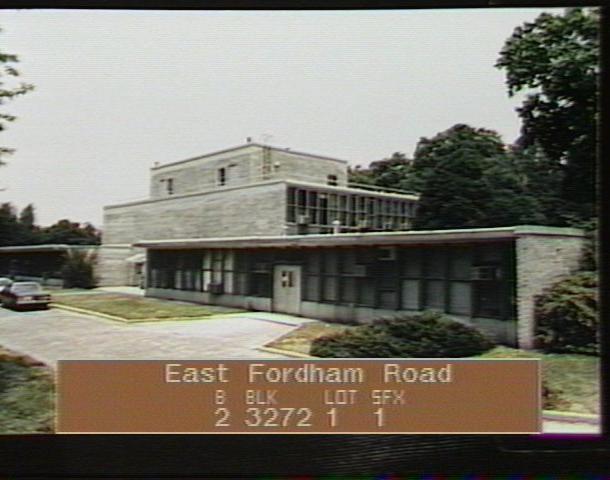
The city photographed every building for its tax records around 1940 and again in the 1980s. NYC Municipal Archives.
Written with AI from the source each entry cites, then fact-checked.
- 1896
Nathaniel Britton's garden plans a glasshouse modeled on Kew's famous greenhouse
Botanist Nathaniel L. Britton set out to found the New York Botanical Garden after a visit to the Royal Botanic Gardens at Kew in 1888. He was drawn as well to Kew's famous greenhouse, designed by Decimus Burton and built in 1845-47. A rendering of the proposed Bronx greenhouse, printed in an 1896 New York clipping, came close to copying Burton's design.
- 1899
Lord & Burnham begins building the steel-framed Conservatory in two stages
The Conservatory is believed to be the work of William R. Cobb, designer for the greenhouse firm Lord & Burnham. Its Palm House, about 100 feet across, anchors a C-shaped run of ten connected greenhouses. The center and one side wing went up from January 1899 to June 1900, and the rest from 1901 to early 1902. Unlike British glasshouses of the mid-1800s, built of iron and wood, it was framed largely in steel, with bowed steel ribs carrying a curved glass roof.
“…the central portion and one of the side wings, January 1899 to June 1900, and the remaining greenhouses, 1901 to early in 1902…”
- 1901
A newspaper predicts New York's greenhouse will trail only Kew's in size
While the Conservatory was still going up, the New York Journal of June 16, 1901, wrote that the city would soon have the largest greenhouse equipment of its kind anywhere in the world. The only exception the paper allowed was the famous one at Kew Gardens in England, the model Nathaniel Britton had in mind.
“New York will have the largest [greenhouse] equipment of the kind in the world, with the exception of the famous Kew Gardens…”
- 1937
Lord & Burnham rebuilds the Conservatory, stripping some original ornament
Between 1937 and 1939 Lord & Burnham, the firm that built the glasshouse, carried out a large reconstruction. Many of the wooden members holding the glass, first made of cypress, were replaced. The Landmarks Preservation Commission believed the original ornamental window frames on the wings and the acanthus-leaf crestings along the roofs were taken off at that time, while the Palm House kept its original windows and fan-light transoms.
- 1973
The city designates the Conservatory a landmark with no opposition
The Landmarks Preservation Commission designated the Conservatory, Palm House and wings included, on October 16, 1973. Four witnesses had spoken in favor at the September hearing, among them the garden's president, Howard S. Irwin, and nobody spoke against it. The Commission called it the largest and most elegant horticultural house in the city, still used for its original purpose.
- 1991
The Holiday Train Show begins, with New York landmarks built from plants
Each year from mid-November to mid-January the Conservatory holds a model railroad running past G-scale copies of real New York places. Artist Paul Busse and his Kentucky firm, Applied Imagination, have made the pieces since the show began in 1991, using nuts, seeds, leaves, fungus, branches and even tree resin for windows. The 25th show, in 2016, laid nearly half a mile of track, and the collection of replicas has grown past 150.
Source: atlasobscura.com
Nearby
- Rose Hill Gymnasium455 East Fordham Road | 6 entries
- Fordham University Church425 East Fordham Road | 5 entries
- Keating Hall635 East Fordham Road | 6 entries
- LuEsther T. Mertz Library2600 Southern Boulevard | 8 entries
- International Plant Science Center (Steere Herbarium)2670 Southern Boulevard | 4 entries
- Tierney Hall665 East Fordham Road | 1 entry