Public School 9 Annex
279 Sterling Place | also 689 Vanderbilt Avenue | Prospect Heights | built 1895
Open on the map4 entries

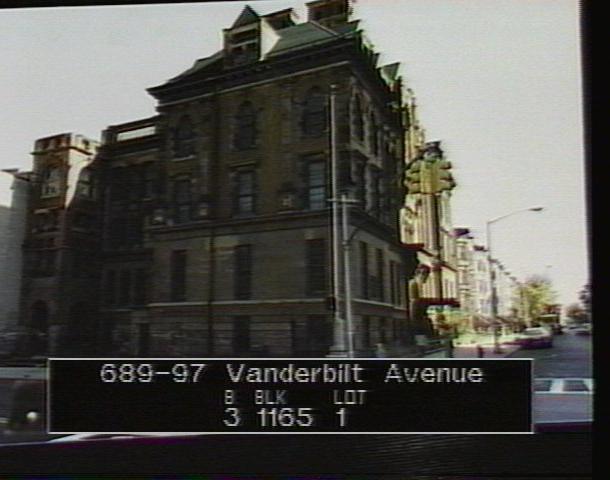
The city photographed every building for its tax records around 1940 and again in the 1980s. NYC Municipal Archives.
Written with AI from the source each entry cites, then fact-checked.
- 1895
Brooklyn builds the Public School 9 Annex to relieve a crowded Prospect Heights school
Prospect Heights grew quickly in the 1890s, helped by new civic improvements nearby and good transit to downtown and the ferries. That growth strained Public School 9, across Vanderbilt Avenue, which had served the area since 1868. The Annex opened in 1895 to take on the extra pupils.
“This growth, however, taxed the facilities that Public School 9 (now P.S. 111) had provided for the section since it opened in 1868. In 1895, the Annex was built…”
- 1895
School architect James W. Naughton designs the Annex
James W. Naughton, Superintendent of Buildings for Brooklyn's school board, designed the Annex. He held that post for nearly twenty years, and every school built in Brooklyn during his time in it was his design. Born in Ireland in 1840, he apprenticed in Milwaukee and studied at the University of Wisconsin and Cooper Union. He died in 1898, three years after the Annex was built. His best-known works include Girls' High School and Boys' High School.
“All the schools built in Brooklyn during this period were designed by Naughton.”
- 1895
The Annex pairs Romanesque Revival arches with classical pilasters
The three-story building stands on a high rusticated basement and is laid out in the shape of the letter H. Its brick and sandstone walls carry terra-cotta medallions. A Romanesque Revival center section with a round-arched entrance sits between end pavilions that use classical details such as Corinthian pilasters. Gabled dormers crown the roofline.
“The end pavilions of this facade are designed with distinctly classical elements in contrast to the Romanesque Revival character of the central section.”
- 1978
The Annex becomes a city landmark after a community effort to save it
The Landmarks Preservation Commission designated the Public School 9 Annex a landmark on January 10, 1978. By then the building no longer served as a school. After what the commission called a great community effort to save it, residents had turned it into a center for neighborhood activities.
“There had been a great community effort to save the Annex building and it now functions as the center for many neighborhood activities.”
Nearby
- Public School 9 (P.S. 111)227 Sterling Place | 4 entries
- Montauk Club19 8th Avenue | 7 entries
- On Prospect Park1 Grand Army Plaza | 1 entry
- Union Temple of Brooklyn17 Eastern Parkway | 6 entries
- Unnameable Books615 Vanderbilt Avenue | 2 entries
- Soldiers' and Sailors' Memorial Arch20 Grand Army Plaza | 7 entries