Queen of Green Street
28 Greene Street | SoHo | built 1872
Open on the map5 entries

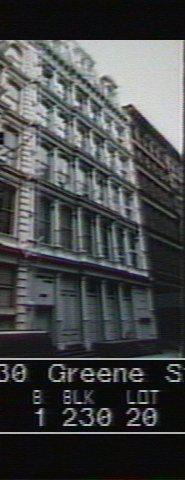
The city photographed every building for its tax records around 1940 and again in the 1980s. NYC Municipal Archives.
Written with AI from the source each entry cites, then fact-checked.
- 1872
Picaut, Simon & Capel start a six-story iron warehouse at 28-30 Greene Street
Greene Street's old houses had become a red-light district by the 1850s; police raided Anna Maack's house at No. 30 in August 1860. In 1872 the firm Picaut, Simon & Capel bought that lot and No. 28, and architect Duckworth filed plans for a warehouse. Ground was broken on November 25, 1872, and the building was finished on August 29, 1873.
Source: Daytonian in Manhattan
- 1873
Duckworth's French Second Empire facade stands out on Greene Street
The Landmarks Preservation Commission ranks this as the strongest design on its block, crediting the projecting central bays, their free-standing columns and the mansard roof. Broken pediments top the central bays and the large dormer above them, and the report calls the mansard unique in the district and the city. It is one of three Duckworth designs on the block.
- 1891
Importer Lehmaier & Co. fails and its books are laid open
Lehmaier & Co., dry goods importers and commission merchants, had been in the building after the Picaut firm dissolved in 1876. When it declared bankruptcy in March 1891, The New York Times said it had once ranked among the leaders of its trade. Examination of its books by June showed irregularities, and a company official said it hardly mattered because every importer did business the same way.
Source: Daytonian in Manhattan
- 1895
E. T. Mason & Co. imports Japanese silks and rugs from Greene Street
By 1895 Edmund T. Mason's firm was the most prominent tenant at 28-30 Greene. Fluent in Japanese and a yearly traveler to Tokyo and Yokohama, he was credited with introducing Japanese goods to American buyers around 1891, selling portieres, crepes and silks. In February 1897 a Chicago newspaper reported he might be named minister to Japan, which he denied hearing of. The firm stayed until 1903.
Source: Daytonian in Manhattan
- 2002
Swiss furniture maker USM opens its flagship showroom and restores the facade
Rosaria Rava & Son owned the building from 1951 through SoHo's change from industrial district to artists' quarter. The Witkoff Group then bought it and sold it in April 2001 to USM for $6.75 million. In 2002 USM set up its flagship showroom here and announced a full restoration of the cast-iron facade; four residential lofts fill the upper floors.
Source: Daytonian in Manhattan
Further reading
- Paris in Cast Iron -- Nos. 28-30 Greene StreetDaytonian in Manhattan
Nearby
- 32 Greene Street2 entries
- 20 Greene Street2 entries
- 25 Mercer Street2 entries
- 93 Grand Street2 entries
- 27 Mercer Street4 entries
- 18 Greene Street1 entry